
Quiz
Experiments till Hooke's Law
This quiz has question types that open in the usual player.
Questions in this quiz (6)
1What is the object marked?
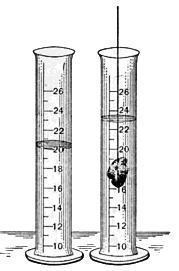
- ARegular object
- BIrregular object
- CMeasuring cylinder
2What is the object marked?
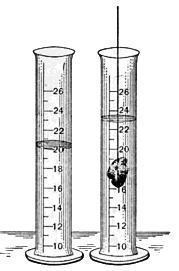
- Aregular object
- Birregular object
- Cmeasuring cylinder
3To find the density of an irregular object one has to find the [blank_start]mass[blank_end] and the [blank_start]volume[blank_end] of the irregular object. The mass of the object is found using [blank_start]an electronic balance[blank_end] while the volume of the irregular object is found using a [blank_start]measuring cylinder[blank_end]. To find the volume of the irregular solid, one has to first insert a [blank_start]known volume[blank_end] of water and gently inserting the irregular object without splashing. The new volume is recorded and this is the highest volume. The initial (smallest) volume is [blank_start]subtracted[blank_end] from the final (highest) volume. This will equal the volume of the irregular object alone. The equation [blank_start]density=mass/volume[blank_end] is then used to find the density of the object.
- Amass
- Blength
- Cdensity
- Dmass
- Evolume
- Fdensity
- Gknown volume
- Hmeasuring tape
- Ielectronic balance
- Jmeasuring cylinder
- Kmeasuring cylinder
- Lstone
- Mknown volume
- Nirregular object
- Oan electronic balance
- Pa measuring cylinder
- Qa measuring tape
- Rmultiplied
- Sadded
- Tsubtracted
- Udensity=mass x volume
- Vdensity=volume/mass
- Wdensity=mass/volume
4Label the diagram:
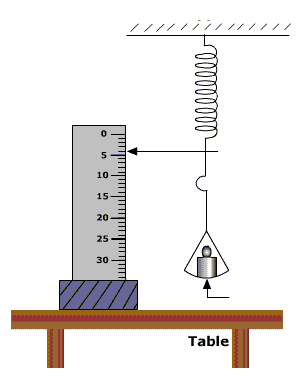
- Astand and clamp
- Bspring
- Cpointer
- Druler
5Label the diagram
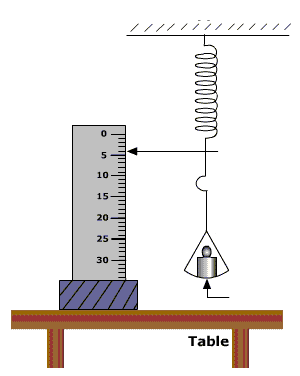
- Astand and clamp
- Bruler
- Cspring
- Dmasses
6The ruler was clamped a small distance behind the spring, making sure
that the ruler and spring hang off the desk properly.
3. The distance between the two pointers recorded. This showed the [blank_start]un-extended length[blank_end] of the starting position of the spring.
4. The [blank_start]masses[blank_end] were gradually added and the new readings recorded, the
ending position was marked.
5. The [blank_start]extension[blank_end] was found by subtracting the starting position from the ending position.
6. The results were tabulated and the force calculated- Aun-extended length
- Bextension
- Cnew length
- Dmasses
- Eextension
- Fweight
- Gnew length
- Horiginal length
- Iextension
Information
- Description
- Form 3-Form 5 Physics Quiz on Experiments till Hooke's Law, created by Karen Bugeja on 18/01/2016.
- Author
- Karen Bugeja
- Language
- English
- Views
- 71
- Tags
- Rating
- 5.0 out of 5 · 3 ratings Rate this quiz