
Quiz
Diffraction (and Superposition)
This quiz has question types that open in the usual player.
Questions in this quiz (26)
1Definition of Diffraction:
Diffraction - the [blank_start]spreading[blank_end] [blank_start]out[blank_end] of a wave as it passes through an [blank_start]aperture[blank_end] or [blank_start]around[blank_end] an [blank_start]obstacle[blank_end].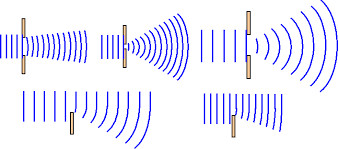
- Aspreading
- Bout
- Caperture
- Daround
- Eobstacle
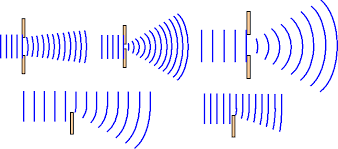
2Increasing Diffraction:
- The [blank_start]longer[blank_end] the wavelength, the more diffraction (relative to the [blank_start]aperture[blank_end]).
- The [blank_start]smaller[blank_end] the aperture, the more diffraction (relative to the [blank_start]wavelength[blank_end]).
- Maximum diffraction happens when the aperture [blank_start]approximately[blank_end] equals the wavelength.
- Zero diffraction happens when the aperture [blank_start]is greater than[blank_end] the wavelength.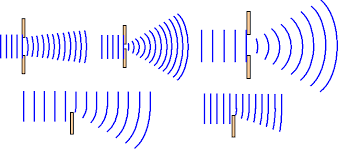
- Alonger
- Bshorter
- Csmaller
- Dwider
- Eapproximately
- Fexactly
- Gaperture
- Hwavelength
- Iwavelength
- Japerture
- Kis greater than
- Lequals
- Mis less than
3As Diffraction Increases:
- [blank_start]Shadow[blank_end] region decreases.
- Shape of diffracted waves becomes more [blank_start]circular[blank_end].
- [blank_start]Angle[blank_end] of spread of diffraction [blank_start]increases[blank_end].
- [blank_start]Amplitude[blank_end] of diffracted waves [blank_start]decreases[blank_end] (less [blank_start]energy[blank_end] carried by the wave gets through).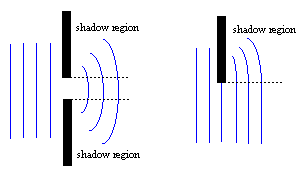
- AShadow
- Bcircular
- CAngle
- Dincreases
- EAmplitude
- Fdecreases
- Genergy
4Shadow and Obstacles:
- When a wave meets an obstacle, you get diffraction around the [blank_start]edges[blank_end].
- Longer wavelengths diffract [blank_start]more[blank_end] around obstacles. This [blank_start]reduces[blank_end] the "shadow" and hence [blank_start]increases[blank_end] [blank_start]coverage[blank_end] for radio signals/waves.
- The [blank_start]wider[blank_end] the object compared with the wavelength of the wave, the [blank_start]less[blank_end] diffraction you get, and so the [blank_start]longer[blank_end] the shadow.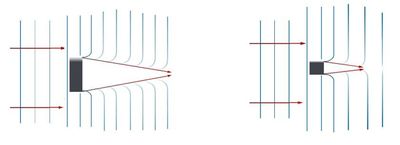
- Aedges
- Bmore
- Creduces
- Dcoverage
- Eincreases
- Fwider
- Gless
- Hlonger
5Wavelengths of Light:
Red light has a [blank_start]longer[blank_end] wavelength than blue light.
Therefore red light diffracts [blank_start]more[blank_end] than blue light.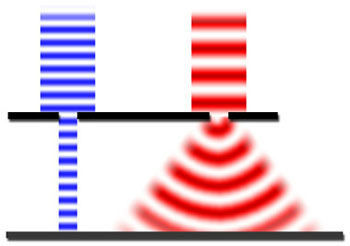
- Alonger
- Bshorter
- Cmore
- Dless
6Energy carried by wave ∝ ([blank_start]Amplitude[blank_end])^[blank_start]2[blank_end]
- AAmplitude
- B2
7The Principle of Superposition of Waves:
- When two or more waves meet, the total [blank_start]displacement[blank_end] at any point is equal to the [blank_start]sum[blank_end] of the [blank_start]individual[blank_end] displacements.
- Waves must be [blank_start]coherent[blank_end] for an interference [blank_start]pattern[blank_end] to be observed. This is because coherent means a constant [blank_start]phase[blank_end] [blank_start]relationship[blank_end] so if they are not coherent the phase difference will [blank_start]vary[blank_end] so the constructive and destructive [blank_start]interference[blank_end] will vary and you won't see a [blank_start]pattern[blank_end].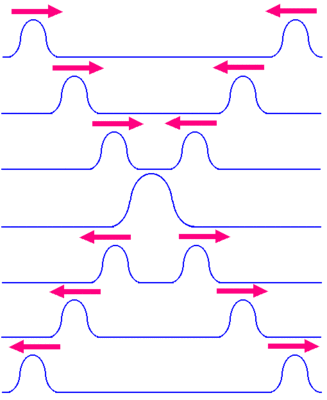
- Adisplacement
- Bsum
- Cindividual
- Dcoherent
- Epattern
- Fphase
- Grelationship
- Hvary
- Ipattern
- Jinterference
8Complete Cancellation:
- The waves must have the same [blank_start]frequency[blank_end] OR [blank_start]wavelength[blank_end].
- The waves must have the same [blank_start]amplitude[blank_end].
- The waves must be in [blank_start]antiphase[blank_end] (180°/π radians out of phase).
You can only have [blank_start]complete destructive interference[blank_end] with something with [blank_start]constant[blank_end] frequency like a [blank_start]vibrating[blank_end] object. NOT speech or music which have [blank_start]varying[blank_end] amplitude and frequency (it's very difficult to match a [blank_start]changing signal[blank_end]).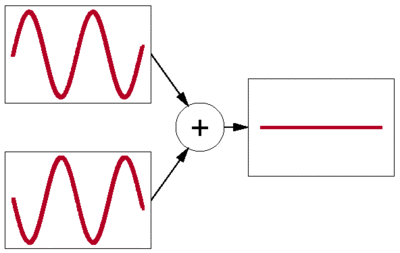
- Afrequency
- Bwavelength
- Camplitude
- Dantiphase
- Ecomplete destructive interference
- Fconstant
- Gvibrating
- Hvarying
- Ichanging signal
9Answering Interference Questions:
1. Some kind of g[blank_start]aps[blank_end] or s[blank_start]lits[blank_end] cause diffraction so the waves [blank_start]spread[blank_end] [blank_start]out[blank_end] from each gap/slit.
2. The waves from each gap/slit meet and [blank_start]superpose[blank_end].
3. The waves are [blank_start]coherent[blank_end] because they come from the same [blank_start]source[blank_end]. Hence an interference [blank_start]pattern[blank_end] is created.
4. When they are in phase, [blank_start]constructive[blank_end] interference takes place and when they are in [blank_start]antiphase[blank_end] destructive interference takes place.
5. Maximum amplitude occurs at places of [blank_start]constructive[blank_end] interference e.g. resulting in light band/fringe, maximum erosion of sand or maximum [blank_start]volume[blank_end] of sound.
6. Minimum amplitude occurs at places of [blank_start]destructive[blank_end] interference e.g. resulting in [blank_start]dark[blank_end] band/fringe, minimum erosion of sand or minimum volume of sound.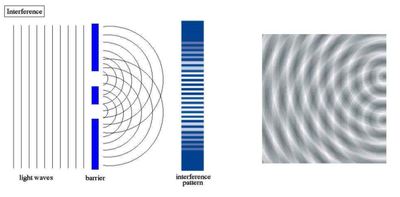
- Aaps
- Blits
- Cspread
- Dout
- Esuperpose
- Fcoherent
- Gsource
- Hpattern
- Iconstructive
- Jantiphase
- Kconstructive
- Ldestructive
- Mdark
- Nvolume
10Light Theories:
Thomas [blank_start]Young[blank_end]'s double slit experiment [blank_start]disproved[blank_end] Newton's c[blank_start]orpuscular[blank_end] theory (p[blank_start]article[blank_end] theory) because it showed an [blank_start]interference[blank_end] pattern and interference [blank_start]only[blank_end] occurs with [blank_start]waves[blank_end].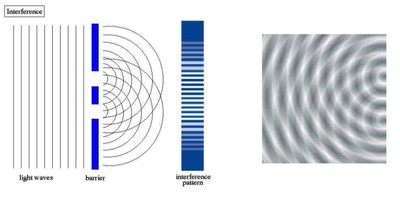
- AYoung
- Bdisproved
- Corpuscular
- Darticle
- Einterference
- Fonly
- Gwaves
11Path Difference and Superposition Questions:
1. Work out one path length e.g. [blank_start]SX[blank_end] + XZ = 9 + 23 = [blank_start]32[blank_end] cm
2. Work out other path length e.g. [blank_start]SY[blank_end] + [blank_start]YZ[blank_end] = 36 + 8 = 44 cm
3. Work out path lengths in terms of λ by [blank_start]dividing[blank_end] by λ e.g. 32/[blank_start]12[blank_end] = 8/3 λ and 44/12 = 11/3 λ
4. Work out [blank_start]path[blank_end] [blank_start]difference[blank_end] and give in terms of λ e.g. [blank_start]44[blank_end] - [blank_start]32[blank_end] = [blank_start]12[blank_end] cm = λ
5. State [blank_start]phase[blank_end] [blank_start]difference[blank_end] e.g. path difference λ => phase difference [blank_start]0[blank_end] or [blank_start]360[blank_end]°
6. State if constructive or destructive [blank_start]interference[blank_end] is occurring (hot or cold spot - hot for [blank_start]in phase[blank_end], cold for [blank_start]antiphase[blank_end]). e.g. Point Z is a [blank_start]hot[blank_end] spot because the waves are [blank_start]in phase[blank_end] so [blank_start]constructive[blank_end] interference is occurring.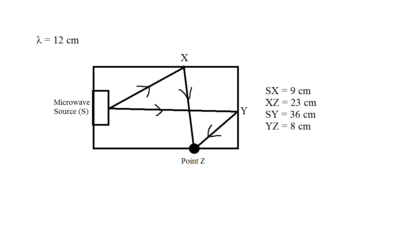
- ASX
- B32
- CSY
- DYZ
- Edividing
- F12
- G44
- H32
- I12
- Jpath
- Kdifference
- Lphase
- Mdifference
- N0
- O360
- Pinterference
- Qin phase
- Rantiphase
- Shot
- Tin phase
- Uconstructive
12Diffraction Grating Calculations:
dsinθ = nλ
d = slit/grating [blank_start]spacing[blank_end]
θ = angle of [blank_start]diffraction[blank_end]
n = [blank_start]order[blank_end] of diffracted [blank_start]beam[blank_end]
d = 1 / lines per m = 1 / lines per mm [blank_start]x 10^-3[blank_end]
λ = wavelength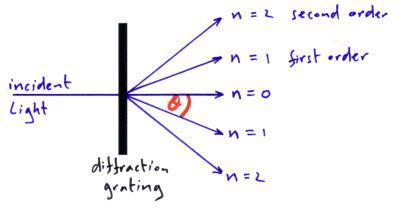
- Aspacing
- Bdiffraction
- Corder
- Dbeam
- Ex 10^3
13Showing or Finding Out if Any More Orders Can be Observed:
1. Substitute given order ([blank_start]n[blank_end]) or next order up into [blank_start]dsinθ = nλ[blank_end].
2. Rearrange to sinθ = 2λ / d to work out [blank_start]θ[blank_end].
3. If θ - error on calculator then [blank_start]no more[blank_end] beam orders can be observed.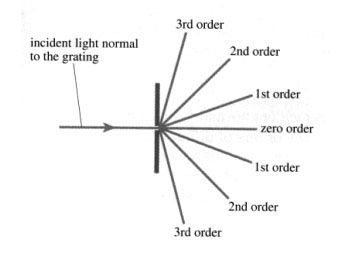
- Adsinθ = nλ
- Bθ
- Cno more
- Dn
14Spectrometer with a Diffraction Grating:
- Used for a[blank_start]nalysis[blank_end] of light from stars e.g. [blank_start]red[blank_end] [blank_start]shift[blank_end] measurements.
- At an angle of zero degrees [blank_start]white[blank_end] light is seen and light is at maximum [blank_start]intensity[blank_end].
- When a spectrum is first observed it will be a [blank_start]first[blank_end] [blank_start]order[blank_end] spectrum/beam.
- Violet/blue light will be observed [blank_start]first[blank_end] at a lower a[blank_start]ngle[blank_end] because they have the shortest [blank_start]wavelengths[blank_end] so diffract the [blank_start]least[blank_end].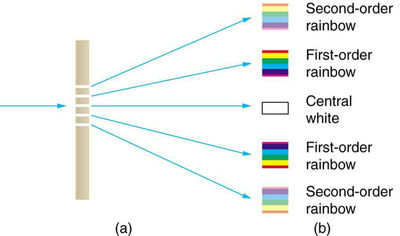
- Ared
- Bshift
- Cwhite
- Dintensity
- Efirst
- Forder
- Gfirst
- Hwavelengths
- Ileast
- Jnalysis
- Kngle
15Explaining How a Diffraction Pattern is Created:
1. Light passing through a [blank_start]narrow[blank_end] aperture [blank_start]spreads out[blank_end].
2. Light reaches the wall from [blank_start]each part[blank_end] of the aperture with differing [blank_start]phase relationships[blank_end] (there are multiple sources/wavelets of light in the aperture).
3. When the waves meet [blank_start]superposition[blank_end] takes place.
4. If the waves are in phase, [blank_start]constructive interference[blank_end] takes place resulting in a [blank_start]bright spot[blank_end] seen.
5. If the waves are in antiphase, [blank_start]destructive interference[blank_end] tales place resulting in a [blank_start]dark spot[blank_end] seen.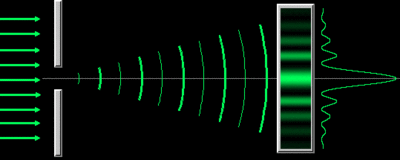
- Aspreads out
- Bnarrow
- Cphase relationships
- Deach part
- Esuperposition
- Fconstructive interference
- Gdestructive interference
- Hbright spot
- Idark spot
16Differing Diffraction Patterns:
E.g. If green light was used instead of red light:
- Green light would diffract [blank_start]less[blank_end] than red light.
- This is because green light has a shorter [blank_start]wavelength[blank_end] than red light.
- The central fringe would be n[blank_start]arrower[blank_end] because of the [blank_start]decreased[blank_end] diffraction.
- The dark points would be closer to the [blank_start]centre[blank_end] because of the decreased diffraction (minima and maxima get [blank_start]closer[blank_end] [blank_start]together[blank_end]).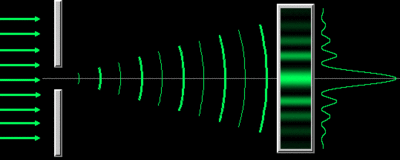
- Acloser
- Btogether
- Cless
- Dwavelength
- Edecreased
- Fcentre
- Garrower
17Huygens' Construction:
Every [blank_start]point[blank_end] on a [blank_start]wavefront[blank_end] may be considered to be a [blank_start]point source[blank_end] of secondary [blank_start]wavelets[blank_end] that [blank_start]spread out[blank_end] in the [blank_start]forward direction[blank_end] at the [blank_start]speed[blank_end] of the wave. The new wavefront is the [blank_start]surface[blank_end] that is [blank_start]tangential[blank_end] to all of these [blank_start]secondary[blank_end] wavelets.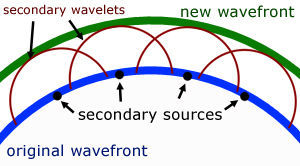
- Apoint source
- Bpoint
- Cwavefront
- Dspread out
- Eforward direction
- Fspeed
- Gtangential
- Hsurface
- Iwavelets
- Jsecondary
18Huygens' Construction and Diffraction:
Huygens' construction can be used to explain the shape of the wavefronts as light travels through a slit.
1. The secondary [blank_start]wavelets[blank_end] that pass through the slit are what produce the c[blank_start]urve[blank_end] of the new wavefront emerging from the slit.
2. The w[blank_start]avelength[blank_end] and the s[blank_start]peed[blank_end] of the wavelets are the same as those of the p[blank_start]rimary[blank_end] wave.
3. The amplitude of the wave at any later point can be predicted by the [blank_start]summation[blank_end] of the amplitudes of the [blank_start]wavelets[blank_end].
4. The new wavefronts are always just the s[blank_start]urface[blank_end] t[blank_start]angential[blank_end] to the [blank_start]secondary[blank_end] wavelets.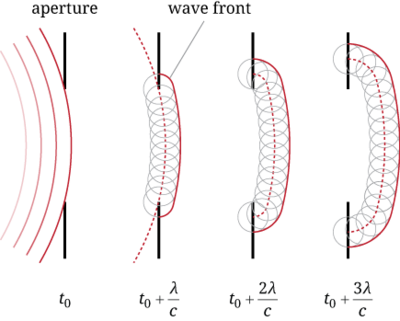
- Awavelets
- Burve
- Cavelength
- Dpeed
- Erimary
- Fsum
- Gwavelets
- Hsecondary
- Iurface
- Jangential
19Microwaves and Diffraction:
- There is no detector output when there is [blank_start]no gap[blank_end] (gap size = 0 cm) because all the microwaves are [blank_start]reflected[blank_end] by the metal plates.
- When the gap is very small there is [blank_start]little[blank_end] detector output because although there is a [blank_start]large[blank_end] angle of diffraction, most of the [blank_start]wave energy[blank_end] is reflected by the metal plates.
- There is a maximum detector output when the gap is [blank_start]approximately equal[blank_end] to the [blank_start]wavelength[blank_end] because there is [blank_start]maximum diffraction[blank_end].
- When the gap becomes larger, the detector output [blank_start]decreases[blank_end] because there is [blank_start]less diffraction[blank_end] when the gap is much [blank_start]larger[blank_end] than [blank_start]the wavelength[blank_end] of the microwaves.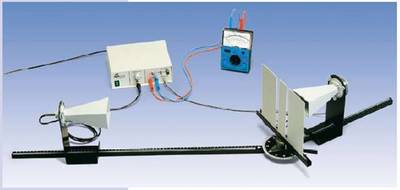
- Ano gap
- Breflected
- Clittle
- Dlarge
- Ewave energy
- Fapproximately equal
- Gwavelength
- Hmaximum diffraction
- Idecreases
- Jless diffraction
- Klarger
- Lthe wavelength
20What happens when the gap becomes too small for waves to pass through?
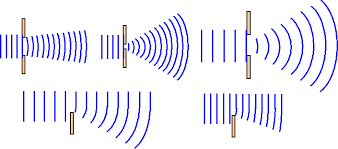
- AThe waves are reflected back on themselves.
- BThe waves are refracted back on themselves.
- CThe waves are blocked.
21How do you get a sharp interference pattern and why is it better to have sharp fringes?
- AWhen monochromatic light is passed through a grating, which has hundreds of slits per mm, the interference pattern is really sharp because there are so many beams reinforcing the pattern.
- BSharper fringes are better because they make for more precise measurements as they are easier to tell apart and so are easier to measure.
- CWhen monochromatic light is passed through a grating, which has hundreds of slits per mm, the interference pattern is really sharp because there are few beams reinforcing the pattern.
- DSharper fringes are better because they make for more accurate measurements as they are easier to tell apart and so are easier to measure.
22Measuring the Wavelength of Light Using a Diffraction Grating:
1. Position a laser (or other [blank_start]monochromatic[blank_end] light source) in f[blank_start]ront[blank_end] of and p[blank_start]erpendicular[blank_end] to a diffraction grating so that the light travels through the grating and creates an [blank_start]interference[blank_end] pattern on a flat w[blank_start]all[blank_end] or s[blank_start]creen[blank_end] a few metres away.
2. Measure the distance, [blank_start]D[blank_end], between the diffraction grating and the wall.
3. Measure the distance, [blank_start]x1[blank_end], between the [blank_start]zero[blank_end] order maximum and the [blank_start]first[blank_end] order maximum for both sides and take an [blank_start]average[blank_end] of the two readings.
4. Using the fringe width, x1, and the distance to the wall, D, the [blank_start]angle[blank_end] between the first order fringe and the zero order line can be calculated using trigonometry where tanθ = [blank_start]x1[blank_end] / [blank_start]D[blank_end].
5. Then use dsinθ = nλ to calculate the [blank_start]wavelength[blank_end] of the light.
6. Repeat the measurements for more [blank_start]order[blank_end] lines to find an [blank_start]average[blank_end] for the wavelength.
7. Repeat the experiment for a diffraction [blank_start]grating[blank_end] that has a different [blank_start]distance[blank_end] between the [blank_start]slits[blank_end].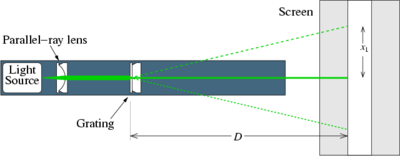
- Amonochromatic
- Bront
- Cerpendicular
- Dinterference
- Eall
- Fcreen
- GD
- Hx1
- Izero
- Jfirst
- Kaverage
- Lx1
- MD
- Nangle
- Owavelength
- Porder
- Qaverage
- Rgrating
- Sdistance
- Tslits
23Astronomers and chemists often need to study spectra to help identify elements. They use diffraction gratings rather than prisms because they're more accurate.
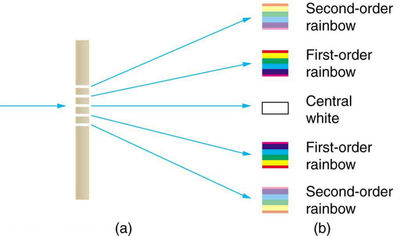
- ATrue
- BFalse
24Example of White Light Being Split into a Spectrum due to Diffraction:
- There are [blank_start]grooves[blank_end] etched into the [blank_start]reflective[blank_end] surface of CDs and DVDs which causes the light to [blank_start]diffract[blank_end]. Constructive [blank_start]interference[blank_end] occurs at [blank_start]different[blank_end] points for light with different [blank_start]wavelengths[blank_end], so you end up seeing a [blank_start]rainbow[blank_end] pattern.
- Agrooves
- Breflective
- Cdiffract
- Dinterference
- Edifferent
- Fwavelengths
- Grainbow
25Path Difference and Superposition:
Path difference nλ: [blank_start]integer multiple[blank_end] of λ => [blank_start]in phase[blank_end] => [blank_start]constructive[blank_end] interference.
Path difference (2n+1)λ / 2: [blank_start]odd[blank_end] number of [blank_start]half[blank_end] wavelengths (λ/2) => [blank_start]in antiphase[blank_end] => [blank_start]destructive[blank_end] interference.
[blank_start]Microwaves[blank_end] have a rotating turntable to reduce [blank_start]uneven[blank_end] heating of food. The food moves through [blank_start]hot and cold spots[blank_end] so that over a time period [blank_start]all parts[blank_end] of the food receive a [blank_start]similar[blank_end] amount of [blank_start]energy[blank_end].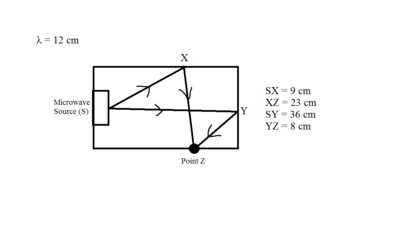
- Ainteger multiple
- Bconstructive
- Cdestructive
- Din phase
- Ein antiphase
- Fodd
- Ghalf
- HMicrowaves
- Iuneven
- Jall parts
- Kenergy
- Lsimilar
- Mhot and cold spots
26Fringe Spacing in Light Patterns:
If slit spacing decreases, fringe spacing [blank_start]increases[blank_end].
Likewise, having fewer lines per mm causes the minima and maxima to move [blank_start]closer together[blank_end] due to the [blank_start]decreased[blank_end] diffraction.
As distance between 2 slits is increased, initially the bands will get closer together (spacing will decrease) due to decreased diffraction but eventually the gap/distance will be [blank_start]too large[blank_end] for overlap of light waves (interference/[blank_start]superposition[blank_end]) to occur so [blank_start]no[blank_end] fringes/pattern will be seen.- Aincreases
- Bdecreases
- Ccloser together
- Dfurther apart
- Edecreased
- Fincreased
- Gtoo large
- Htoo small
- Isuperposition
- Jno
- Kmany
Information
- Description
- AS - Level Sally's Physics (Waves and Particle Nature of Light) Quiz on Diffraction (and Superposition), created by Sally Lancaster on 22/03/2016.
- Author
- Sally Lancaster
- Language
- English
- Views
- 9
- Tags
- Rating
- No ratings yet Rate this quiz