
Quiz
Exam 3 - Chapter 9, Part One
Create a free account to finish this quiz
Save your progress and see your final score.
Already have an account? Sign in
Questions in this quiz (74)
1Which of the following is NOT considered one of the basic properties of muscle tissue?
- Aexcitability
- Belasticity
- Csupport
- DContractility
2The primary role of this type of muscle tissue is to push fluid and solids along the digestive tract and to perform varied functions in other systems.
- ASmooth muscle
- BCardiac muscle
- CSkeletal muscle
3The primary role of this type of muscle tissue is to push blood through arteries and veins in rhythmic contractions
- ASkeletal muscle
- BCardiac muscle
- CSmooth muscle
4Movement of skeletal muscles is an involuntary contraction
- ATrue
- BFalse
5__________ muscles are contractile organs directly or indirectly attached to bones of the skeleton.
- ASkeletal muscle
- BCardiac muscle
- CSmooth muscle
6_____ is the ability to continue to contract over a range of resting lengths
- AExtensibility
- BElasticity
- CExcitability
- DContractility
7The ability to respond to stimuli
- AExcitability
- BResponsibility
- CReaction
- Dstimulated
8The ability to rebound toward its original length
- AElasticity
- BContractility
- CStimulate
- DFlexion
9Which of the following is/are considered function(s) of skeletal muscle?
(Choose all that apply)- Aproduce skeletal movement
- BMaintain posture and body position
- CSupport soft tissue
- Dregulate entering and exiting of material
- Econtrol of the body and communication among its parts.
10Is control over swallowing, defecation, and urination voluntary or involuntary?
- AVoluntary
- BInvoluntary
11Some of the energy used for contraction is converted to heat
- ATrue
- BFalse
12dense tissue that contain connective tissue wrapped around each muscle fiber, which binds each fiber to its neighbor
- AEpimysium
- BPerimysium
- CEndomysium
13dense tissue that divides the muscle into parallel compartments of fascicles (a bundle of structures)
- APerimysium
- BEpimysium
- CEndomysium
14dense tissue that surrounds individual muscle fibers
- AEndomysium
- BPerimysium
- CEpimysium
15Nerves innervate the muscle by penetrating the _______
- Aepimysium
- BEndomysium
- CPerimysium
16There is a chemical communication between a nerve and a muscle
The chemical is released into the _____- Aneuromuscular junction (aka, neuromuscular synapse)
- BAxon
- CAxon Terminal
- DSynaptic Cleft
17• Blood vessels often parallel the nerves that innervate the muscle.
• They then ______- Abranch to form coiled networks to accommodate flexion and extension of the muscle
- Bdont do anything at all
- Cbranch to form coiled networks to push blood through arteries and veins
- Dflood the body with neural activity
18Membrane that surrounds the muscle cell
- ASarcolemma
- BSarcoplasm
- CMuscle fiber
- Dmyofilaments
19The cytosol (the aqueous component of the cytoplasm of a cell) of the muscle cell
- ASarcoplasm
- BMuscle fiber
- CSarcolemma
- Dmyosatellite cells
20______ is the same thing as muscle cell
- AMuscle fiber
- BSarcoplasm
- CSarcolemma
- Dmyosatellite cells
21Where are nuclei of muscle fibers located?
- Ajust deep to the sarcolemma
- Bin the sarcolemma
- Cin the Sarcoplasm
- Djust deep to the Sarcoplasm
- Ethe muscle fibers dont have nuclei
22______ are responsible for the contraction of muscles
- Amyofibrils
- Bmyofilaments
- CMuscle fibers
- Dsarcomeres
23______ are attached to the sarcolemma at each end of the muscle cell
- Amyofibrils
- Bmyofilaments
- Csarcomeres
- DMuscle fibers
24______ surrounds each myofibril
- Asarcoplasmic reticulum
- Bepimysium
- Cmyosin
- Dmyofilaments
25_____ are structures that consist primarily of the proteins actin and myosin
- Amyofilaments
- BCisternae
- CSarcolemmas
- DSarcomeres
26______ are thin protein filaments in myofilaments
- AActin
- BMyosin
- Ctitin
- Dtroponin
27______ are thick protein filaments in myofilaments
- AMyosin
- BActin
- Ctroponin
- Dtitin
28All the myofilaments are arranged parallel to the long axis of the cell
- ATrue
- BFalse
29______ are/is the main functioning unit of muscle fibers
- ASarcomere
- Bmyofibrils
- CMuscle fibers
- Dmybrofiber
30_____ creates the striations that give the skeletal muscle its identifiable characteristic
- Aoverlapping actin and myosin (A Band)
- Bseparation of actin and myosin
- Cthe 10,000 myofibril per sarcomere
- DThe Z Line (Z disc)
31Within a sarcomere, the region between the A band and the Z line that contains of only thin filaments is the __________.
- AI band
- BM line
- CH band
- Dzone of overlap
32Overlapping _____ bands create striations
- AZ bands
- BI band
- CA band
- DH band
- EM line
33_____ is a protein that covers the binding sites when the muscle is relaxed
- ATropomyosin
- BTroponin
- Ctitin
- Dnebulin
34Know this picture . . .
https://image.slidesharecdn.com/ch09lecturepresentation-140913123742-phpapp01/95/dr-b-ch-09lecturepresentation-15-638.jpg?cb=1410612013
Skeletal muscles consist of muscle fascicles
• Muscle fascicles consist of muscle fibers
• Muscle fibers consist of myofibrils
• Myofibrils consist of sarcomeres
• Sarcomeres consist of myofilaments
• Myofilaments are made of actin and myosin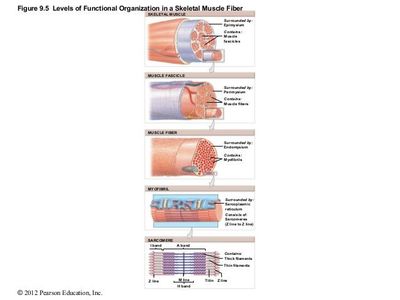
- Aok
- Bno
35Which of the following statements regarding thick filaments is FALSE?
- AMyosin heads project toward the actin filaments
- BAdjacent thick filaments are interconnected by proteins of the H band.
- CMyosin filaments consist of an elongated tail and a globular head
- DA core of titin connects the Z lines
36Which of these consists of Actin?
- AThin Filaments
- BThick Filaments
37Which of these consists of Myosin?
- AThin Filaments
- BThick Filaments
38A contracting muscle shortens in length
- ATrue
- BFalse
39Contraction is caused by interactions between _______ and _______ within the sarcomere
- Athick and thin filaments
- Bmyofibrl and fascicle
- Cepimysium and perimysium
- DI band and H band
40Contraction is triggered by the presence of ______
- Acalcium ions
- Bphosphate ions
- Ccollagen fibers
41Arrange the following from smallest structure to largest structure:
(perhaps do it on a piece of paper):
a. Muscle cell or muscle fiber
b. Fascicle
c. Myofilaments
d. Whole skeletal muscle
e. Myofibril- AMyofilaments, Myofibril, Muscle cell or muscle fiber, Fascicle, Whole skeletal muscle
- Bdont got it
42According to the sliding filament theory when a muscle contracts, what happens?
- AThe thick filaments slide past the thin filaments, and the sarcomere shotens.
- BThe thin filaments slide past the thick filaments, and the sarcomere shortens.
- Cactin filaments slide away from each other allowing the fibers in the muscle to contract
43What controls muscle fibers?
- Amotor unit
- Bmotor unit and motor neuron
- Cmotor neuron
- Dmuscles
- ENone of the listed responses is correct.
44Motor Units (Motor Neurons Controlling Muscle Fibers) have two types of control.
The control over the eye muscles is an example of _________; meaning a ___________.- APrecise control; motor neuron controlling two or three muscle
fibers - Bless precise control; motor neuron controlling two or three muscle
fibers - CPrecise control; A motor neuron controlling perhaps 2000 muscle fibers
- Dless precise control; A motor neuron controlling perhaps 2000 muscle fibers
- APrecise control; motor neuron controlling two or three muscle
45__________ refers to the condition in which muscles of the body remain semi-contracted for an extended period
- AMuscle tension
- BMuscle contraction
- CMuscle retraction
46Muscle tension depends on (choose all that apply)
- AThe frequency of stimulation
- BThe number of motor units involved
47A ______ is a motor neuron controlling Muscle Fibers
- AMotor Units
- Bmuscle fascicles
- Cmotor neurons
- Dneural pathway
48______ is the tension of a muscle when it is relaxed
- AMuscle Tone
- BMuscle Control
- CMuscle Contraction
- DResting Muscle
49_______ stabilizes the position of bones and joints.
An example would be the amount of muscle involvement that results in normal body posture- AResting Muscle
- BMuscle Contraction
- CMuscle Tone
- DMuscle Control
50_______ are specialized muscle cells that are monitored by sensory nerves to control muscle tone
- AMuscle Spindles
- BMuscle Fibers
- Cred fibers
- Dwhite fiber
51Enlargement of the muscle is known as _______
- AMuscle Hypertrophy
- BMuscle Atrophy
- CMyopathies
52Exercise causes (choose all that apply)
- AAn increase in the number of mitochondria
- BAn increase in the activity of muscle spindles
- CAn increase in the concentration of glycolytic enzymes
- DAn increase in the glycogen reserves
- EAn increase in the number of myofibrils
53______ is the discontinued use of a muscle
- AMuscle Atrophy
- BMuscle Hypertrophy
- CMyopathies
54What is muscle tone?
- Athe reduction in muscle size, tone, and power
- Bthe resting tension of skeletal muscles
- Ca single contraction
- Dmuscle recruitment
55the study of, Myofibrils, Myofilaments, Sarcomeres is _______
- AMicroscopic anatomy
- BGross anatomy
56Myofibrils are bundles of myofilaments (protein filaments).
- ATrue
- BFalse
57Humans rely on muscles for:
- AMany of our physiological processes
- BVirtually all our dynamic interactions with the environment
- CStores minerals needed by blood cells.
- DOxen-agates the body
58Epimysium, perimysium, and endomysium converge to form ______. (Read them all)
- Atendons
- Bconnective tissue
- CAponeuroses
- DAll of these (they're the same thing - tends = bundle, aponeuroses = sheet)
59Myosin (thick filament) and Actin are arranged in repeating units called _______
- Asarcomeres
- Btropomyosin
- Cmuscle waves
- Dtransverse tubules
60Thin Filaments (Actin) Consists of twisted filaments of F actin strands and G actin globular molecules. Which of these consists of an active site (binding site)
- AG actin molecules
- BF actin strand
61One sarcomere can defined as _____ line to _____ line
- Az to z
- Ba to a
- Ch to h
- Db to b
62This is a picture of a portion of a sarcomere.
What bank is represented by the red on the bottom. This is a stack of Actin and Z line.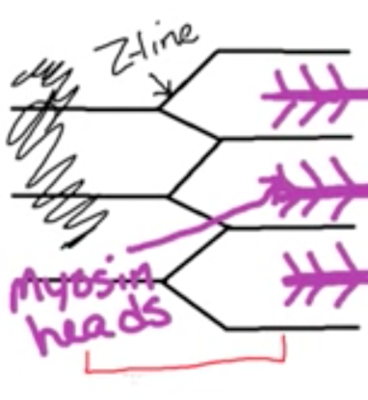
- AI band
- BZ line
- CB line
- DH line
63In between the I bands is the ____ band. This is represented by the green in this picture.
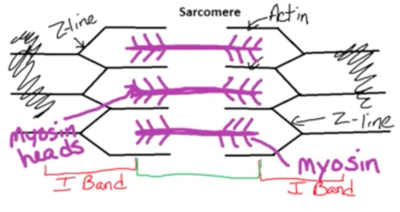
- AA band
- BB band
- CBoy band
- DZ band
64In this picture the orange is the H zone. In the H zone there is only myosin and it is therefore less dark than the rest of the A band where actin and myosin are stacked.
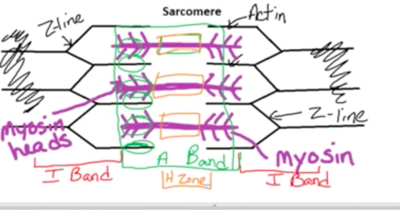
- ATrue
- BFalse
65Muscle fiber also contains an abundance of WHAT, a starchlike carbohydrate that provides energy for the cell during heightened levels of exercise.
- Aglycogen
- Bcalcium
- Ccalcium phosphate
- Dcytosol
66Part of actin filaments. A thin filament also has molecules of protein called WHAT (an elongated protein winds along the groove of the F actin).
- ATropomyosin
- BTroponin
- Ctitin
- Dmyoblast
67Each tropomyosin molecule has a smaller calcium-binding protein called WHAT bound to it.
Holds tropomyosin in position- Atitin
- Bmyoblast
- Ctroponin
- Dmyosin
68a light band; from Z disks to ends of thick filaments
- AI band
- Bh band
- Ca band
- Dz band
69n the middle of the A band, there is a lighter region called the WHAT, into which the thin filaments do not reach.
- AH band
- BB band
- Cz band
- DI band
70The thick filaments originate at a dark WHAT in the middle of the H band.
- AM Line
- BZ line
- CK line
- DS line
71Each light I band is bisected by a dark narrow WHAT which provides anchorage for the thin filaments
- AZ disk
- BM line
- CH band
- DI band
72Each segment of a myofilament from one Z disc to the next is called a WHAT
- Amuscle fiber
- Bmyofibril
- Csarcomere
73Myofilaments are made of actin and myosin
- ATrue
- BFalse
74Study of Perimysium, Endmysim and epimysium
- Agross
- Bmicroscopic
Information
- Description
- Quiz on Exam 3 - Chapter 9, Part One, created by Levi Chodorow on 19/03/2017.
- Author
- Levi Chodorow
- Language
- English
- Views
- 22
- Tags
- Rating
- 5.0 out of 5 · 1 rating Rate this quiz