
Quiz
Cert12c_067_121afin_passLeader
Questions in this quiz (40)
1QUESTION 121
You want the execution of large database operations to suspend, and then resume, in the event of space allocation failures.
You set the value of the initialization parameter resumable_timeout to 3600.
Which two statements are true?- AA. A resumable statement can be suspended and resumed only once during execution.
- BB. Data Manipulation Language (DML) operations are resumable, provided that they are not embedded in a PL/SQL block.
- CC. A suspended statement will report an error if no corrective action has taken place during a timeout period.
- DD. Before a statement executes in resumable mode, the alter session enable resumable statement must be issued in its session.
- EE. Suspending a statement automatically results in suspending a transaction and releasing all the resources held by the transaction.
2QUESTION 122
Your database is running in archivelog mode and Automatic Undo Management is enabled.
Which two tasks should you perform before enabling Flashback Database?- AA. Enable minimal supplemental logging.
- BB. Ensure that the db_flashback_retention_target parameter is set to a point in time (in minutes) to which the database can be flashed back.
- CC. Enable the recyclebin.
- DD. Enable undo retention guarantee.
- EE. Enable Fast Recovery Area.
3QUESTION 123
Consider the following scenario for your database:
- Backup optimization is enabled in RMAN.
- The recovery window is set to seven days in RMAN.
- The most recent backup to disk for the tools tablespace was taken on March 1, 2013.
- The tools tablespace is read-only since March 2, 2013.
On March 15, 2013, you issue the RMAN command to back up the database to disk.
Which statement is true about the backup of the tools tablespace?- AA. The RMAN backup fails because the tools tablespace is read-only.
- BB. RMAN skips the backup of the tools tablespace because backup optimization is enabled.
- CC. RMAN creates a backup of the tools tablespace because backup optimization is applicable only for the backups written to media.
- DD. RMAN creates a backup of the tools tablespace because no backup of the tablespace exists within the seven-day recovery window.
4QUESTION 124
You set the following parameters in the parameter file and restart the database instance:
NEMORY_MAX_TARGET=0
MEMORY__TARGET=500M
PGA_AGGREGATE_TARGET=90M
SGA_TARGET=270M
Which two statements are true?- AA. The memory_max_target parameter is automatically set to 500 MB.
- BB. The pga_aggregate_targetand sga_target parameters are automatically set to zero.
- CC. The value of the memory_max_targetparameter remains zero for the database instance.
- DD. The lower limits of the pga_aggregate_target and sga_targetparameters are set to 90 MB and 270 MB respectively.
- EE. The instance does not start up because Automatic Memory Management (AMM) is enabled but pga_aggregate_target and sga_target parameters are set to nonzero values.
5QUESTION 125
Your database supports an OLTP workload. Examine the output of the query:
SQL> SSLECT target_mttr, estimated_mttr
FROM v$instance_recovery
Target_mttrestimated_mttr
---------------------- ---------------------------
To ensure faster instance recovery, you set the fast_start_mttrjtargh:t initialization parameter to 30.
What is the effect of this setting on the database?- AA. Automatic checkpoint tuning is disabled.
- BB. The frequency of log switches is increased.
- CC. The overhead on database performance is increased because of frequent writes to disk.
- DD. The MTTR advisor is disabled.
6QUESTION 126
Which three statements are true about persistent lightweight jobs?- AA. A user cannot set privileges on them.
- BB. They generate large amounts of metadata.
- CC. They may be created as fully self-contained jobs.
- DD. They must reference an existing Scheduler Program.
- EE. The are useful when users need to create a large number of jobs quickly.
7QUESTION 127
You restore and recover your database to a new host by using an existing RMAN open database backup.
Which step must you perform next?- AA. Execute catproc.sqi to recompile invalid PL/SQL modules.
- BB. Open the database with the resetlogs option.
- CC. Set a new database identifier (DBID) for the newly restored database.
- DD. Use the RMAN set newname and switch commands to switch to new files.
8QUESTION 128
Which two statements are true about unified auditing?- AA. A unified audit trail captures audit information from unified audit policies and audit settings.
- BB. Unified auditing is enabled by executing make-fins_rdbms.mk uniaud_onioracle ORACLE_HOME=SORACLE_HOME.
- CC. Audit records are created for all users except sys.
- DD. Audit records are created only for the DML and DDL operations performed on database objects.
- EE. Unified auditing is enabled by setting the audit_trail parameter to db, extended.
- FF. A unified audit trail resides in a read-only table in the audsys schema in the system tablespace.
9QUESTION 129
Your database is running in archivelog mode.
You are taking a backup of your database by using RMAN with a recovery catalog.
Because of a media failure, one of the data files and all the control files are lost.
Examine the steps to recover the database:
1.Restore the control files by using the RMAN restore controlfile command.
2.Mount the database.
3.Restore the data files by using the RMAN restore database command.
4.Open the database with the resetlogs option.
5.Recover the data files by using the RMAN recover using backup controlfile command.
6. Start the database instance in nomount state.
7. Connect to the target database by using a recovery catalog.
8.Open the database.
9.Restore the data file.
10.Recover the data file.
Identify the required steps in the correct order.- AA. 7, 6, 1, 2, 3, 5, 4
- BB. 7, 2, 1, 3, 5, 8
- CC. 7, 6, 1, 2, 9, 10, 8
- DD. 7, 6, 1, 2, 9, 10, 4
10QUESTION 130
You plan to use the In-Database Archiving feature of Oracle Database 12c, and store rows that are inactive for over three months, in Hybrid Columnar Compressed (HCC) format.
Which three storage options support the use of HCC?- AA. ASM disk groups with ASM disks consisting of Exadata Grid Disks.
- BB. ASM disk groups with ASM disks consisting of LUNS on any Storage Area Network array
- CC. ASM disk groups with ASM disks consisting of any zero padded NFS-mounted files
- DD. Database files stored in ZFS and accessed using conventional NFS mounts.
- EE. Database files stored in ZFS and accessed using the Oracle Direct NFS feature
- FF. Database files stored in any file system and accessed using the Oracle Direct NFS feature
- GG. ASM disk groups with ASM disks consisting of LUNs on Pillar Axiom Storage arrays
11QUESTION 131
You notice a performance change in your production Oracle 12c database.
You want to know which change caused this performance difference.
Which method or feature should you use?- AA. Compare Period ADDM report
- BB. AWR Compare Period report
- CC. Active Session History (ASH) report
- DD. taking a new snapshot and comparing it with a preserved snapshot
12QUESTION 132
Which two resources might be prioritized between competing pluggable databases (PDBs) when creating a multitenant container database (COB) plan using Oracle Database Resource Manager?- AA. maximum undo per consumer group
- BB. maximum idle time for a session in a PDB
- CC. parallel server limit
- DD. CPU
- EE. maximum number of sessions for a PDB
13QUESTION 133
Which three types of failures are detected by the Data Recovery Advisor (DRA)?- AA. loss of a non-critical data file
- BB. loss of a control file
- CC. physical data block corruption
- DD. logical data block corruption
- EE. loss of an archived redo log file
14QUESTION 134
You want to capture column group usage and gather extended statistics for better cardinality estimates for the customers table in the SH schema.
Examine the following steps:
1. Issue the SELECTDBMS_STATS. CREATE_EXTENDED_STATS(`SH', 'CUSTOMERS')from dual statement.
2. Execute the dbms_stats.seed_col_usage (null,`SH',500) procedure.
3. Execute the required queries on the customers table.
4. Issue the select dbms_stats.reportwcol_usage(`SH', 'customers') from dual statement.
Identify the correct sequence of steps.- AA. 3, 2, 1, 4
- BB. 2, 3, 4, 1
- CC. 4, 1, 3, 2
- DD. 3, 2, 4, 1
15QUESTION 135
Examine the initialization parameter that is set in the PFILE:
DB_CREATE_FILE_DEST ='/u01/app/oracle/oradata/'
You execute the following command to create the CDB1. container database (CDB):
SQL>CREATEDATABASECDB1
DEFAULTTABLESPACE users
DEFAULTTEMPORARY TABLESPACEtemp
UNDO TABLESPACEundotbsl
ENABLEPLUGGA3LEDATABASE
SEED
SYSTEMDATAFILESSIZE125M AUTOEXTEND ON NEXT10M MAXSIZEUNLIMITED
SYSAUXDATAFILESSIZE100M;
Which three statements are true?- AA. It creates a multitenant container database with a root and a seed pluggable database (PDB) that are opened in read-write and read-only modes, respectively.
- BB. The files created for both the root and seed databases use Oracle Managed Files (OMF).
- CC. It creates a multitenant container database with the root and seed databases opened and one PDB mounted.
- DD. It sets the users tablespace as the default for both the root and seed databases.
- EE. undotbs1is used as the undo tablespace for both the root and seed databases.
- FF. It creates a multitenant container database with the root database opened and the seed database mounted.
16QUESTION 136
Examine the steps to configure Oracle Secure Backup (OSB) for use with RMAN:
1.Create media families for data files and archived redo log files.
2.Configure database backup storage selectors or RMAN media management parameters.
3.Create an OSB user preauthorized for RMAN operations.
4.Configure RMAN Access to the OSB SBT.
5.Disable Non-Uniform Memory Access (NUMA) awareness by setting the ob_ignore_numa parameter to 0.
Identify the steps in the correct order.- AA. 1, 4, 3, 2, 5
- BB. 1, 3, 4, 5, 2
- CC. 4, 3, 1, 2, 5
- DD. 4, 3, 5, 1, 2
17QUESTION 137
Examine the RMAN command:
RMAN> SET ENCRYPTION IDENTIFIED BY <password> ON FOR ALL TABLESPACES; RMAN> BACKUP DATABASE PLUS ARCHIVELOG;
Which type of encryption is used for the backup performed by using this command?- AA. password-mode encryption
- BB. dual-mode encryption
- CC. transparent encryption
- DD. default encryption
18QUESTION 138
The following parameters are set for your Oracle 12c database instance:
OPTIMIZER_CAPTURE_SQL_PLAN_BASELINES=FALSE
OPTIMIZER_USE_SQL_PLAN_BASELINES=TRUE
You want to manage the SQL plan evolution task manually. Examine the following steps:
1.Set the evolve task parameters.
2.Create the evolve task by using the DBMS_SPM.CREATE_EVOVLE_TASK function.
3.Implement the recommendations in the task by using the
DBMS_SPM.IMPLEMENT_EVOLVE_TASK function.
4.Execute the evolve task by using the DBMS_SPM.EXECUTE_EVOLVE_TASK function.
5.Report the task outcome by using the DBMS_SPM.REPORT_EVOLVE_TASK function.- AA. 2, 4, 5
- BB. 2, 1, 4, 3, 5
- CC. 1, 2, 3, 4, 5
- DD. 1, 2, 4, 5
19QUESTION 139
You created a database with DBCA by using one of the Oracle supplied templates.
Which is the default permanent tablespace for all users except DBSNMP and OUTLN?- AA. USERS
- BB. SYSTEM
- CC. SYSAUX
- DD. EXAMPLE
20QUESTION 140
Your database is running in archivelog mode. Examine the parameters for your database instance:
LOG_ARCHIVE_DEST_l ='LOCATION=/disk1/arch MANDATORY'
LOG_ARCHIVE_DEST_2 ='LOCATION=/disk2/arch'
LOG_ARCHIVE_DEST_3 ='LOCATIO=/disk3/arch'
LOG_ARCHIVE_DEST _4 ='LOCATIONs/disk4/arch'
LOG_ARCHIVE _MIN_SUCCEED_DEST = 2
While the database is open, you notice that the destination set by the log_archive_dest_1 parameter is not available. All redo log groups have been used.
What happens at the next log switch?- AA. The database instance hangs and the redo log files are not overwritten.
- BB. The archived redo log files are written to the fast recovery area until the mandatory destination is made available.
- CC. The database instance is shutdown immediately.
- DD. The destination set by the log_archive_dest parameter is ignored and the archived redo log files are created in the next two available locations to guarantee archive log success.
21QUESTION 141
Identify three scenarios in which RMAN will use backup sets to perform active database duplication.- AA. when the duplicate ... from active database command contains the section size clause
- BB. when you perform active database duplication on a database with flashback disabled
- CC. when you specify set encryption before the duplicate ... from active database command
- DD. when the number of auxiliary channels allocated is equal to or greater than the number of target channels
- EE. when you perform active database duplication on a database that has read-onlytablespaces
22QUESTION 142
Which three statements are true regarding the use of the Database Migration Assistant for Unicode (DMU)?- AA. A DBA can check specific tables with the DMU
- BB. The database to be migrated must be opened read-only.
- CC. The release of the database to be converted can be any release since 9.2.0.8.
- DD. The DMUcan report columns that are too long in the converted characterset
- EE. The DMUcan report columns that are not represented in the converted characterset
23QUESTION 143
Which statements describe the capabilities of the DBMS_NETWORK_ACL_ADMIN package? (Choose all that apply.)- AA. It can be used to allow the access privilege settings for users but not roles.
- BB. It can be used to allow the access privilege settings for users as well as roles
- CC. It can be used to control the time interval for which the access privilege is available to a user.
- DD. It can be used to selectively restrict the access for each user in a database to different host computers.
- EE. It can be used to selectively restrict a user's access to different applications in a specific host computer.
24QUESTION 144
You perform an RMAN block media recovery on the tools 01.dbf data file in the SALES database.
Which two statements are true?- AA. You must ensure that the SALES database is mounted or open.
- BB. You must restore a backup control file to perform a block media recovery
- CC. You must take the tools01.dbf data file offline before you start a block media recovery.
- DD. You must put the database in NOARCHIVELOG mode to perform a block media recovery.
- EE. You can perform only a complete media recovery of individual blocks, point-in-time recovery of individualdata blocks is not supported.
25QUESTION 145
Which statement is true regarding the creation of nested plans using the Oracle Resource Manager?- AA. Only one nested subplan is allowed per parent plan
- BB. The plans can be nested up to four levels.
- CC. Nested plans only control resources used by recursive SQL
- DD. Nested plans control only the degree of parallelism and I/O requests
- EE. Each nested plan gets a proportion of the CPU resources assigned to its parent group.
26QUESTION 146
You want to perform an RMAN backup of database as a copy. Which two factors will you consider while performing the backup operation?- AA. The backup as copy can only be taken to disk
- BB. The backup as copy can only be taken to tape
- CC. Backup can be performed only when the instance is shutdown
- DD. Backup will constitute all used and unused blocks in the database
27QUESTION 147
You issue the command:
SQL> ALTER DATABASE BACKUP CONTROLFILE TO TRACE;
Which statement is true about the command?- AA. It creates a copy of the control file and stores it in the location specifiedin the diagnostic_dest initialization parameter.
- BB. It creates a file that contains the SQL statement, which is required to re-create the control file.
- CC. It updates the alert log file with the location and contents of the control file.
- DD. It creates a binary backup of the control file.
28QUESTION 148
You create a default Flashback Data Archive FLA1and enable it for the EMPLOYEES table in the HR schema.
After a few days, you want to alter the EMPLOYEES table by executing the command:
SQL> ALTER TABLE EMPLOYEES ADD PHONE NUMBER(12);
Which statement is true about the execution of the command?- AA. It gives an error because DDL statements cannot be executed on a table that is enabled for Flashback Data Archive.
- BB. It executes successfully and all metadata related to the EMPLOYEEStable before altering the table definition is purged from Flashback Data Archive.
- CC. It executes successfully and continues to store metadata related to the EMPLOYEEStable
- DD. It executes successfully but Flashback Data Archive is disabled for the EMPLOYEEStable
29QUESTION 149
Examine the commands executed in CDBS ROOT of your multitenant container database (CDB) that has multiple pluggable databases (PDB):
SQL> CREATE ROLE c ##role1 CONTAINER-ALL;
SQL> GRANT CREATE SESSION, CREATE TABLE TO c##role1 CONTAINER'ALL;
SQL> CREATE USER c##adnin IDENTIFIED BY orcl123;
SQL> GRANT c##role1 TO c##admin CONTAINER=ALL;
SQL> GRANT SELECT ON DBA_USERS to c##rola1 CONTAINER*ALL;
Which statement is true about granting the select privilege on the DBA_users view to the c##ROLE1role?- AA. The command fails and gives an error because object privileges cannot be granted to a common user.
- BB. The command fails because container is not set to current.
- CC. The command succeeds and the common user cmadnxn can create a session and query the D3A_users view in cdbssoo? and all the PDBs.
- DD. The command succeeds and the common user ct (admin can create a session in cdbSroot and all the PDBs, but can only query the dba_users view in ct3S?cdt.
- EE. The command succeeds and the common user c#(admin can create a session and query the D3A users view only in cdbsrooi.
30QUESTION 150
Examine the following steps of privilege analysis for checking and revoking excessive, unused privileges granted to users:
1. Create a policy to capture the privileges used by a user for privilege
analysis.
2. Generate a report with the data captured for a specified privilege capture.
3. Start analyzing the data captured by the policy.
4. Revoke the unused privileges.
5. Compare the used and unused privileges' lists.
6. Stop analyzing the data.
Identify the correct sequence of steps- AA. 1, 3, 5, 6, 2, 4
- BB. 1, 3, 6, 2, 5, 4
- CC. 1, 3, 2, 5, 6, 4
- DD. 1, 3, 5, 2, 6, 4
31QUESTION 151
Your multitenant container database (CDB) cdb1 that is running in archivelog mode contains two pluggable databases (PDBs), pdb2_1 and pdb2_2, both of which are open. RMAN is connected to the target database pdb2_1.
RMAN> BACKUP DATABASE PLUS ARCHIVELOG DELETE INPUT;
Which statement is true about the execution of this command to back up the database?- AA. All data files belonging to pdb2_1 are backed up and all archive log files are deleted
- BB. All data files belonging to pdb2_1 are backed up along with the archive log files.
- CC. Only the data files belonging to pdb2_ are backed up.
- DD. This command gives an error because archive log files can be backed up only when RMAN is connected to the root database.
32QUESTION 152
You notice that the performance of your production 24/7 Oracle 12c database has significantly degraded. Sometimes you are not able to connect to the instance because it hangs.
You do not want to restart the database instance.
How can you detect the cause of the degraded performance?- AA. Enable Memory Access Mode, which reads performance data from SGA.
- BB. Use emergency monitoring to fetch data directly from SGA for analysis.
- CC. Run Automatic Database Diagnostic Monitor (ADDM) to fetch information from the latest Automatic Workload Repository (AWR) snapshots.
- DD. Use Active Session History (ASH) data and hang analysis in regular performance monitoring,
- EE. Run ADDM in diagnostic mode.
33QUESTION 153
You issue commands in SQL*Plus as the Oracle owner, to enable multithreading for your UNIX- based Oracle 12c database:
CONNECT/AS SYSDBA
ALTER SYSTEMSETTHREADED__EXECUTION= TRUESCOPE=SPFILE;
SHUTDOWNIMMEDIATE
You then restart the instance and get an error:
STARTUP
ORA-01031:insufficientprivileges
Why does the startup command return the error shown?- AA. because the threaded architecture requires exiting from sql*pIus and reconnecting with sql*PIus / as sysdba before issuing a startup command
- BB. because the threaded architecture requires issuing a new connect / as sysdba from within sql*pIus before issuing a startup command
- CC. because the threaded architecture requires authentication using a password file before issuing a startup command
- DD. because the threaded architecture requires connecting to the instance via a listener before issuing a startup command
- EE. because the threaded architecture requires restarting the listener before issuing a startup command
34QUESTION 154
Your multitenant container database (CDB) cdb1, which has no startup triggers and contains multiple pluggable databases (PDBs), is started up by using the command:
SQL>STARTUP
Which two statements are true about the successful execution of the command?- AA. All redo log files are opened.
- BB. The root, the seed, and all the PDBs are opened in read-write mode.
- CC. All the PDBs are opened in read-write mode.
- DD. All the PDBs are in closed state.
- EE. Only the root database is opened in read-write mode.
35QUESTION 155
Examine the resources consumed by a database instance whose current Resource Manager plan is displayed.
SQL> SELECT name, active_sessions, queue_length,
consumed_cpu_time, cpu_waits, cpu_wait_time
FROM v$rsrc_consumer_group;
Which two statements are true?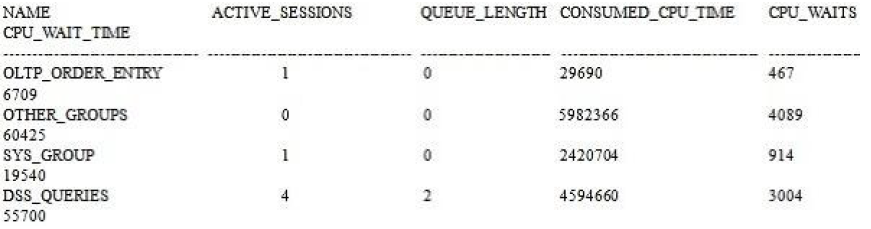
- AA. An attempt to start a new session by a user belonging to DSS_QUERIES fails with an error.
- BB. An attempt to start a new session by a user belonging to OTHE_GROUPS fails with an error.
- CC. The CPU_WAIT_TIME column indicates the total time that sessions in the consumer group waited for the CPU due to resource management.
- DD. The CPU_WAIT_TIME column indicates the total time that sessions in the consumer group waited for the CPU due to I/O waits and latch or enqueue contention.
- EE. A user belonging to the DSS__QUERIES resource consumer group can create a new session but the session will be queued.
36QUESTION 156
Examine the commands executed to monitor database operations:
$> conn sys/oracle@prod as sysdba
SQL> VAR eid NUMBER
SQL>EXEC :eid :=
DBMS_SQL_MONITOR.BEGlN_OPERATION('batch_job',FORCED_TRACKING=>'Y');
Which two statements are true?- AA. Database operations will be monitored only when they consume a significant amount of resource.
- BB. Database operations for all sessions will be monitored.
- CC. Database operations will be monitored only if the STATISTICS_LEVEL parameter is set to TYPICAL and CONTROL_MANAGEMENT_PACK_ACCESS is set DIAGNISTIC + TUNING.
- DD. Only DML and DDL statements will be monitored for the session.
- EE. All subsequent statements in the session will be treated as one database operation and will be monitored.
37QUESTION 157
Examine the command:
$expdp SYSTEM FULL=YES DUMPFILE=dpump_dir1:fulll%U.dmp, dpump_dir2:full2% U.dmp, dpump_dir3:full3%U.djnp FILESIZE=400M PARALLEL=3 JOB_NAME=expfull
Which statement is true about the execution of the command?- AA. It fails because the log file parameter is not specified.
- BB. It fails because no absolute path is specified for the log file and dump file.
- CC. It succeeds and exports the full database, simultaneously creating three copies of dump files at three different locations.
- DD. It succeeds and exports the full database, simultaneously creating three dump files at three different locations, but the total number of dump files can exceed three.
38QUESTION 158
You notice that the performance of your production 24x7 Oracle 12c database has significantly degraded. Sometimes, you are not able to connect to the database instance because it hangs.
How can you detect the cause of the degraded performance?- AA. by performing emergency monitoring using Real-Time Automatic Database Diagnostic Monitor (ADDM) to fetch data directly from SGA for analysis
- BB. by running ADDM to fetch information from the latest Automatic Workload Repository (AWR) snapshots
- CC. by using Active Session History (ASH) data and performing hang analysis
- DD. by running ADDM in diagnostic mode
39QUESTION 159
Automatic Shared Memory Management (ASMm) is enabled for your database instance, but parameters for the managed components are not defined.
You execute this command:
SQL> ALTER SYSTEM SET DB_CACHE_SIZE = 100M;
Which statement is true?- AA. The minimum size for the standard buffer cache is 100 MB.
- BB. The maximum size for the standard buffer cache is 100 MB.
- CC. The minimum space guaranteed in the buffer cache for any server process is 100 MB.
- DD. The maximum space in the buffer cache that can be released for dynamic distribution is 100 MB.
- EE. The minimum size for all buffer caches is 100 MB.
40QUESTION 160
You created a tablespace with this statement:
CREATE BIGFILE TABLESPACE adtbs
DATAFILE '/proddb/data/adtbs.dbf' SIZE 10G;
The tablespace is nearly full and you need to avoid any out of space errors for the load of a 5 gig table.
Which two alter statements will achieve this?- AA. ALTER TA3LESPACE adtbs RESI2E 20G;
- BB. ALTER TA3LESPACE adtbs ADD DATAFILE;
- CC. ALTER TABLESPACE adtbs AUTOEXTEND ON;
- DD. ALTER TA3LESPACE adtbs ADD DATAFILE '/proddb/data/adtbsl.dbf' SIZE 1QG;
- EE. ALTER TA3LESPACE adtbs MODIFY DATAFILE '/proddb/data/adtbs.dbf AUTOEXTEND ON;
Information
- Description
- Quiz on Cert12c_067_121afin_passLeader, created by A A on 19/11/2017.
- Author
- A A
- Language
- Español
- Views
- 95
- Rating
- No ratings yet Rate this quiz