
Quiz
Critical Care Quiz 1
This quiz has question types that open in the usual player.
Questions in this quiz (34)
1 A patient with a 10-year history of heart failure presents to the emergency department reporting severe shortness of breath. Assessment reveals crackles throughout the lung fields and labored breathing. The patient takes beta blockers, ACE inhibitors, and diuretics as directed. What treatment strategies does the nurse plan to implement for immediate short-term management? (Select all that apply.)
- ANesiritide
- BIntraaortic balloon pump
- CBiventricular pacemaker
- DVentricular assist device
- EDobutamine
2During cardioversion, the nurse would synchronize the electrical charge to coincide with which wave of the ECG complex?
- AP
- BR
- CS
- DT
3The patient is diagnosed with abrupt onset of supraventricular tachycardia (SVT). The nurse prepares which medication to administer to the patient?
- AAdenosine
- BAmiodarone
- CProcainamide
- DDiltiazem
4During a code situation, the nurse would prepare to use which preferred intravenous fluid?
- A5% Dextrose in 0.45 normal saline
- B5% Dextrose in water
- CDopamine infusion
- DNormal saline
5The patient presents to the ED with severe chest discomfort. A cardiac catheterization and angiography shows an 80% occlusion of the left main coronary artery. Which procedure will be most likely performed on this patient?
- AIntracoronary stent placement
- BPercutaneous transluminal coronary angioplasty (PTCA)
- CTransmyocardial revascularization
- DCoronary artery bypass graft surgery
6A patient develops frequent ventricular ectopy. The nurse prepares to administer which drug?
- AAtropine
- BLidocaine
- CAdenosine
- DMagnesium
7All of the following are major criteria for brain death EXCEPT no
- Ahyperthemia
- Bresponse to pain
- Cbody movement
- Dcranial nerve reflexes
8A patient who is undergoing withdrawal of mechanical ventilation appears anxious and agitated. The patient is on a continuous morphine infusion and has an additional order for lorazepam (Ativan) 1 to 2 mg IV as needed (prn). The patient has received no lorazepam (Ativan) during this course of illness. What is the most appropriate nursing intervention to control agitation?
- AAdminister lorazepam (Ativan) 1 mg IV now
- BAdminister fentanyl (Duragesic) 25 mg IV bolus.
- CRequest an order for a paralytic agent.
- DIncrease the rate of the morphine infusion by 50%.
9In the healthy individual, pain and anxiety: (Select all that apply.)
- Adecrease stress levels
- Bhelp remove one from harm.
- Climit sympathetic nervous system activity.
- Dactivate the sympathetic nervous system (SNS).
- Eincrease performance levels
10Which of the following statements about defibrillation are correct? (Select all that apply.)
- AEarly defibrillation (if warranted) is recommended before other actions.
- BIt is not necessary to ensure that personnel are clear of the patient if hands-off defibrillation is used.
- CIt is not necessary to synchronize the defibrillation shocks.
- DPaddles/patches can be placed anteriorly and posteriorly on the chest.
11Family assessment is essential to meet family needs. Which of the following must be assessed first to assist the nurse in providing family-centered care?
- AIdentification of immediate family, extended family, and decision makers
- BDescription of the patient’s home environment
- CAssessment of patient and family’s developmental stages and needs
- DObservation and assessment of how family members function with each other
12If pericardial tamponade is suspected during a code, which of the following procedures will be performed?
- AElective cardioversion
- BEmergency insertion of a chest tube
- CNeedle inserted into pericardial sac to aspirate fluid
- DNeedle inserted into third intercostal space to decompress the lungs
13Following insertion of a central venous catheter, the nurse obtains a stat chest x-ray film to verify proper catheter placement. The radiologist reports to the nurse: “The tip of the catheter is located in the superior vena cava.” What is the best interpretation of these results by the nurse?
- AThe physician should be called to advance the catheter into the pulmonary artery.
- BThe catheter position increases the risk of ventricular dysrhythmias.
- CThe catheter is not positioned correctly and should be removed.
- DThe distal tip of the catheter is in the appropriate position.
14The assessment of pain and anxiety is a continuous process. When critically ill patients exhibit signs of anxiety, the nurse’s first priority is to
- Areassess the patient hourly to determine whether symptoms resolve on their own.
- Badminister pain medication as ordered.
- Cadminister antianxiety medications as ordered
- Didentify and treat the underlying cause
15interpret the strip.
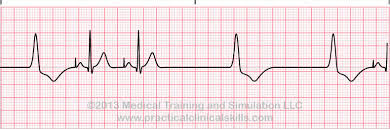
- AFailure to pace
- BFailure to capture
- CNormal pacemaker function
- DFailure to sense
16The patient has a transcutaneous pacemaker in place. Pacemaker spikes followed by QRS complexes are noted on the cardiac rhythm strip. To determine if the pacemaker is working, the nurse must do which of the following?
- AObtain a 12-lead electrocardiogram (ECG).
- BCall for a pacemaker interrogation
- CPalpate the pulse
- DRun a 2-minute monitor strip for analysis.
17A 75-year-old patient, who suffered a massive stroke 3 weeks ago, has been unresponsive and has required ventilatory support since the time of the stroke. The physician has approached the spouse regarding placement of a permanent feeding tube. The spouse states that the patient never wanted to be kept alive by tubes and personally didn’t want what was being done. After holding a family conference with the spouse, the medical team concurs, and the feeding tube is not placed. This situation is an example of
- Awithdrawal of life support.
- Bpalliative care.
- Ceuthanasia
- Dwithholding life support.
18Changing visitation policies can be challenging. The nurse manager recognizes which of the following as an effective strategy for promoting changes in practice?
- AInvite the nurses with the most experience to develop a revised policy.
- BDiscuss the pros and cons of open visitation at the next staff meeting.
- CTask the unit-based nurse practice council to invite volunteers to serve on the council to revise the current policy toward more liberal visitation.
- DAsk the clinical nurse specialist to lead a journal club on open visitation after each nurse is tasked to read one research article about visitation.
19A patient is admitted to the critical care unit with bradycardia at a heart rate of 39 beats/min and frequent premature ventricular contractions. Upon assessment, you note that she is lethargic and has complained of dizziness for the past 12 hours. Which of the following are acceptable treatments for symptomatic bradycardia? (Select all that apply.)
- AAtropine
- BEpinephrine
- CLidocaine
- DTranscutaneous pacemaker
20Comparing the patient’s current (home) medications with those ordered during hospitalization and communicating a complete list of medications to the next provider when the patient is transferred within an organization or to another setting are strategies to:
- Aimprove accuracy of patient identification.
- Bprevent errors related to look-alike and sound-alike medications.
- Creconcile medications across the continuum of care.
- Dreduce harms associated with the administration of anticoagulants.
21The monitor technician notifies the nurse "stat" that the patient has a rapid, chaotic rhythm that looks like ventricular tachycardia. What is the nurse’s first action?
- ACall a code overhead.
- BCheck the patient immediately.
- CGo to the nurse’s station and look at the rhythm strip.
- DTake the crash cart to the room
22The patient has an implanted cardioverter-defibrillator (ICD). He goes into sustained VF and loses consciousness. The responding RN should:
- Aavoid touching the patient in case the ICD fires.
- Bcall the code team, but tell them that the patient cannot be defibrillated.
- Cinitiate a code and prepare to defibrillate the patient.
- Dprepare to administer adenosine intravenously.
23It is important for critically ill patients to feel safe. Which nursing strategies help the patient to feel safe in the critical care setting? (Select all that apply.)
- AInform the patient that you have cared for many similar patients.
- BConsult with the charge nurse before making any patient care decisions.
- CAllow family members to remain at the bedside
- DProvide informal conversation by discussing your plans for after work.
- ERespond promptly to call bells or other communication for assistance.
24Family presence is encouraged during resuscitation and invasive procedures. Which findings about this practice have been reported in the literature? (Select all that apply.)
- APresence encourages family members to seek litigation for improper care.
- BFamilies benefit by witnessing that everything possible was done.
- CFamilies report that staff conversations during this time were distressing.
- DPresence reduces nurses’ involvement in explaining things to the family.
- EFamilies report reduced anxiety and fear about what is being done to the patient.
25A patient has been successfully converted from ventricular tachycardia with a pulse to a sinus rhythm. Upon further assessment, it is noted that the patient is hypotensive. The appropriate treatment for her hypotension may include (Select all that apply)
- Aadenosine.
- Bdopamine infusion.
- Csodium bicarbonate
- Dnormal saline infusion.
- Emagnesium.
26The patient has a rhythm but not pulse or blood pressure. Possible causes of this patient condition include: (Choose all that apply.)
- Acardiac tamponade.
- Bdrug overdose.
- Chypovolemia
- Dtension pneumothorax.
27The patient is in VF. The nurse must defibrillate immediately. She must know what type of defibrillator is available and determine how many joules to use. She knows that she needs: (Choose all that apply.)
- A100 joules (biphasic).
- B200 joules (biphasic).
- C300 joules (monophasic)
- D360 joules (monophasic).
28The patient is in ventricular tachycardia (VT) unresponsive to conventional treatment (epinephrine or vasopressin). Comparing the following drugs, which would be the most appropriate to use next?
- AAdenosine
- BAmiodarone
- CAtropine
- DDopamine
29Elderly patients who require critical care treatment are at risk for increased mortality, functional decline, or decreased quality of life after hospitalization. Assuming each of these patients was discharged from the hospital, which of the following patients is at greatest risk for decreased functional status and quality of life?
- AA 79-year-old woman admitted for exacerbation of heart failure. She manages her care independently but needed diuretic medications adjusted. She states that she is compliant with her medications but sometimes forgets to take them. She lives with her 82-year-old spouse. Both consider themselves to be independent and support each other.
- BAn 84-year-old woman who had stents placed to treat coronary artery occlusion. She has diabetes that has been managed, lives alone, and was driving prior to hospitalization. She was discharged home within 3 days of the procedure.
- CA 90-year-old man admitted for a carotid endarterectomy. He lives in an assisted living facility (ALF) but is cognitively intact. He is the “social butterfly” at all of the events at the ALF. He is hospitalized for 4 days and discharged to the ALF.
- DA 70-year-old man who had coronary artery bypass surgery. He developed complications after surgery and had difficulty being weaned from mechanical ventilation. He required a tracheostomy and gastrostomy. He is being discharged to a long-term acute care hospital. He is a widower.
30The [blank_start]antecubital[blank_end] vein should be the first target for IV access.
- Aantecubital
31Which rhythm would be an emergency indication for the application of a transcutaneous pacemaker?
- AAsystole
- BBradycardia (heart rate 40 beats/min) normotensive and alert
- CBradycardia (heart rate 50 beats/min) with hypotension and syncope
- DSupraventricular tachycardia (heart rate 150 beats/min), hypotensive
32[blank_start]sodium bicarbonate[blank_end] is beneficial in treating preexisting metabolic acidosis, hyperkalemia, or overdosage of tricyclic antidrepressant or phenobarbital.
- Asodium bicarbonate
33The nurse is preparing to obtain a right atrial pressure (RAP/CVP) reading. What are the most appropriate nursing actions? (Select all that apply.)
- ACompare measured pressures with other physiological parameters.
- BInflate the balloon with 3 mL of air and record the pressure tracing.
- CZero reference the transducer system at the level of the phlebostatic axis.
- DFlush the central venous catheter with 20 mL of sterile saline.
- EObtain the right atrial pressure measurement during end exhalation.
34Both the electroencephalogram (EEG) monitor and the Bispectral Index Score (BIS) or Patient State Index (PSI) analyzer monitors are used to assess patient sedation levels in critically ill patients. The BIS and PSI monitors are simpler to use because they
- Arequire only five leads
- Bprovide raw EEG data and a numeric value.
- Ccan be used only on heavily sedated patients.
- Dcan be used only on pediatric patients.
Information
- Description
- Quiz on Critical Care Quiz 1, created by Breana C. on 07/12/2018.
- Author
- Breana C.
- Language
- English
- Views
- 2,640
- Rating
- No ratings yet Rate this quiz