
Quiz
PMU - Year 1 Physics - Part 1
Create a free account to finish this quiz
Save your progress and see your final score.
Already have an account? Sign in
Questions in this quiz (136)
1Acoustic (sound) Impedance Za of a substance is equal to the product of:
- ADensity p and atomic number Z of the element - pZ;
- BDensity p and velocity of sound v in substance - pv
- CTemperature T and velocity of sound v in the substance - Tv
2The frequency of the sound is;
- APhysical (objective) characteristic of the sound;
- BPsycho-physical (subjective) characteristic of the sound;
- CCommon term for objective and subjective characteristic of the sound.
3The velocity of the sound is:
- APhysical (objective) characteristic of the sound
- BPsycho-physical (subjective) characteristic of the sound
- CCommon term for objective and subjective characteristic of the sound
4Main characteristic of the noise is:
- AMinimum amplitude and frequency which do not alter with the time;
- BMinimum frequency and amplitude which do not alter with the time;
- CFrequency and amplitude which continuously alter with the time.
5In which frequency range the human ear has maximum sensitivity:
- AFrom 1000 to 3000 кНz;
- BFrom 1000 to 3000 МНz;
- CFrom 1000 to 3000 Нz.
6The pitch of the sound is determined mainly by:
- AIntensity of the sound;
- BSound pressure;
- CSound frequency.
7The fundamental tone f0 in a complex sound has:
- AMinimum amplitude and maximum frequency;
- BMinimum frequency and maximum amplitude;
- CMedium frequency and amplitude.
8Sound can propagate in;
- AVacuum;
- BAny substance;
- CAny medium through which the electromagnetic waves also propagate.
9Sound wavelength in the hearing band is longer than that of:
- APulse Wave
- BInfrasound
- CUltrasound
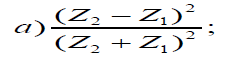
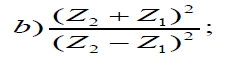
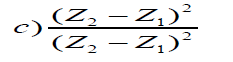
10Reflection coefficient a2 (Alpha) of sound at the boundary between two media with sound impedance Z1 and Z2 is determined by the expression:
- A
- B
- C
- A
11Which condition is least significant for sound reflection:
- ATransverse size of the boundary surface to be longer than or equal to sound wavelength
- BBoundary between two media with different acoustic impedance's
- CBoundary between two media with different densities
12When our heads are submerged in water we cannot hear people because;
- ASound is reflected almost completely at the water surface
- BSound does not propagate through water
- COur ear canals are filled with water
13Sound wave travels across two materials with similar acoustic impedance. At the boundary surface, we expect:
- ASimilar amounts of transmission and reflection;
- BMore transmission and less reflection;
- Cless transmission and more reflection;
14Sound timbre is;
- AA physical (objective) feature of sound
- BPsycho-physical (subjective) feature of the sound
- CA common term objective and subjective characteristic of the sound
15The psycho-physical law of Weber–Fehner on the sound perception is used to define the quantity:
- ASound (acoustic) pressure(p);
- BSound pitch;
- CIntensity level(Е).
16Human hearing has a maximum sensitivity at frequencies:
- Afrom 1000 to 3000 kHz
- Bfrom 1000 to 3000 MHz
- Cfrom 1000 to 3000 Hz
17The pitch of sound is determined mainly by:
- ASound Intensity
- BSound Pressure
- CSound Frequency
18The operating frequency hearing range is:
- A10 MHz - 100 MHz
- B10 kHz - 10 MHz
- C10 Hz - 10,000 Hz
19Human Frequency hearing range is:
- ABelow 20 Hz
- BFrom 20 to 20,000 MHz
- COver 20,000 Hz
20The subjective quantity "Intensity Level E" is defined at sound frequency:
- A16 Hz
- B20 kHz
- C1 kHz
21At what frequency is "Loudness L" approximately the same as "Sound Intensity Level"?
- A1000 Hz
- Bfrom 16 to 20,000 Hz
- C1 MHz
22Sound Intensity Level E is measured in units of:
- AWatt, W
- BDecibel, dB
- CHertz, Hz
23Sound Intensity Level "E" is equal to zero if:
- AI = Io
- BI > Io
- CI < Io
- DSIL is never 0
24Sound Intensity Level (SIL) is proportional to the logarithm of the ratio of incoming to threshold intensity - 10*log(I/Io). During a test, incoming intensity is increased by a factor of 100. What will be the change in SIL?:
- AWill increase by a factor of 10 (times 10)
- BWill double (times 2)
- CWill increase with 20 dB (plus 20dB)
25The timbre (quality) of a tone:
- ADecreases with loudness
- BIs proportional to the frequency
- CIs inversely proportional to the frequency
- Ddepends upon the overtones that are present
26Is it possible for Humans to detect ultrasound?:
- ANot possible
- BYes, the blue shift is visible
- CYes, some frequencies cause a heating sensation.
27Is it possible for humans to detect Infrasound:
- ANot possible
- BYes, the red shift is visible
- CThe body can sense certain vibrations
28Timbre is related to:
- AHarmonic Overtones
- BSound from a tuning fork
- CNoise from a medical apparatus
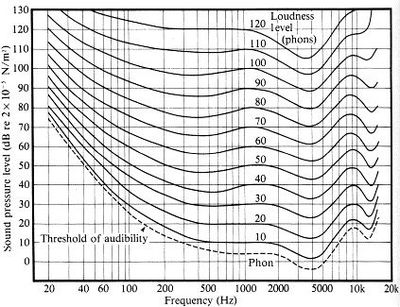
29The Equal-loudness contour, introduced by Fletcher-Munson in 1933, was designed to correlate sound intensity to the subjective perception of loudness. Use the graph to estimate perceived loudness (In Phons!) at frequency 100hz and sound intensity level of 50 dB
- A60 dB
- B40 dB
- C40 phons
- D50 phons
30During a standard audiogram procedure you hear sounds at intensity level of 0 dB. This is possible because:
- AIntensity of 10(-12) W/m2 is audible
- BMalfunction of the knob
- CTympanic membrane can generate own sounds.
- DYour colleagues are too loud.
31Percussion is a method for:
- AUltrasound Diagnostic
- BUltrasound therapy
- CDiagnostic with sound, produced by the Doctor.
- DUltrasound diagnostic, based on reflections from organs.
32W?hat diagnostic method is described in the following text? : "There are four types of sounds; Resonant, Hyper-Resonant, Stony Dull or Dull. A Dull sound indicates the presence of a solid mass under the surface. A more resonant sound indicates hollow, air-containing structures".
- AAuscultation
- BPercussion
- CAudiometry
- DPhonocardiography.
33Simple (pure) tones with frequencies 0.125, 0.25, 0.5, 1, 2, 4 and 8 kHz, are used in:
- AAuscultation
- BPercussion
- CAudiometry
- DPhonocardiography
34Sphygmomanometer is used for:
- AAtmospheric pressure in the hospital
- BArterial blood pressure
- CLungs Air Pressure
35Auscultation is:
- AUltrasound Diagnostic;
- BSound based Therapy
- CSound based diagnostic
- DInfrasound Diagnostic
36What diagnostic method use sub-audible sounds and murmurs (infrared range) produced from the heart?
- AAuscultation
- BPercussion
- CAudiometry
- DPhonocardiography
37Hearing loss diagnostic based on variation of sound frequency:
- AAuscultation
- BPercussion
- CAudiometry
- DPhonocardiography
38Mechanical waves used for breaking renal calculi (extra-corporeal lithotripsy) does not injure surrounding tissue because:
- AMechanical waves do not pass through the tissues
- BAcoustic pressure in tissues is several times lower than pressure in the calculi
- CMechanical waves do not affect tissues
39The main characteristic of noise is:
- AMinimum amplitude and frequency which do not alter with time
- Bminimum frequency and amplitude which do not alter with time
- Cfrequency and amplitude which continuously altar with time
40Consider the law of noise attenuation (figure). Which symbol refers to the type of material, noise-protection screens are made of?
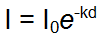
- Ak
- Bd
- Ce
41How does intensity of noise vary with the distance from the source?
- Aproportional to the distance r
- Bproportional to the square distance r(2)
- Cinversely proportional to the distance r
- Dinversely proportional to the square of the distance r(2)
42The frequency of echograph, marked on the ultrasound probe, relates mostly to:
- ASpatial resolution
- BDepth of penetration
- CVelocity of US propagation
43Velocity of US in biological tissues depend on:
- AFrequency, marked on echograph's transducer
- BUS Wavelength
- CType of Examined tissues
44Ultrasound can propagate in:
- AVacuum
- BMaterial Substance
- CAny media through which electromagnetic waves (light) can propagate
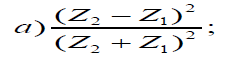
45Reflection coefficient a(2) of US at the boundary between two media with impedance Z1 and Z2 is determined by the expression:
- A
- B
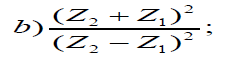
- C
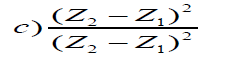
- A
46The phenomenon, direct piezoelectric effect finds application in:
- AGenerators of US
- BDetectors of US
- CParametric transducers
47The phenomenon reverse piezoelectric effect finds application in:
- AGenerators of US
- BDetectors of US
- CThermometers
48The phenomena direct and reverse piezoelectric effect find application in:
- AContact gel, used in US imaging
- BTransducers of echo-graphs
- CGenerators of alternating electric current
49Ultrasound propagates through body fluids as
- ALongitudinal Waves
- BTransverse Waves
- CBoth Longitudinal and Transverse Waves
50US propagates in the bones as
- ALongitudinal Waves
- BTransverse Waves
- CLongitudinal and Transverse waves
51What frequency ultrasound is appropriate for deep tissue scanning?
- A8 MHz
- B3 kHz
- C3 MHz
- D20 MHz
52Ultrasound propagates to a lesser depth in tissues compared to IS because:
- ASpeed of propagation of US in tissues is slower
- BUS is reflected off tissue structures with smaller cross-sectional dimensions
- CAcoustic impedance Za of tissues is lower for US
53Diagnostic imaging method that uses the phenomenon of reflection:
- APositron-emission tomography (PET)
- BEchography
- CRoentgen Diagnostics
54What is the purpose of the contact gel used in echography:
- ATo reflect US at the boundary of air and skin
- BTo create an acoustically continuous medium for US propagation
- CTo decrease harmful effects of US on the skin
55In echography, tissues are examined with:
- APermanent magnetic field
- BUltrasound
- CElectric field
56The contact gel must have:
- ADensity p equal to the mean density of soft tissues
- BChemical composition similar to that of soft tissues
- CAcoustic impedance Za equal to the average acoustic impedance of soft tissues
57In A-mode ultrasound, the difference in acoustic impedance of tissues is depicted on the monitor as:
- ASpikes with different amplitudes
- BDots with different brightness
- CRegions in different colours (the arteries in red; the veins in blue)
58In B-mode ultrasound, the difference in acoustic impedance of tissue is depicted on the monitor as:
- ASpikes with different amplitudes
- BDots with different brightness
- CRegions in different colours (the arteries in red; the veins in blue)
59During echography, the contact gel is used for:
- ANear 100% reflection of ultrasound at the air-skin boundary
- BNear 100% absorption of ultrasound in patient's skin
- CNear 100% transmission of ultrasound through the skin
60M-mode ultrasound is used for:
- AImmovable body structures
- BMovable body structures
- CRegions of the lung with pneumothorax.
61The ultrasound technique called Colour Doppler is used to obtain information about:
- AMacro-circulation of blood:
- BBone metastases
- CGlucose metabolism
62Diagnostic imaging method based on Reflection:
- APositron-emission tomography (PET)
- BColour Doppler
- CComputed-tomography (CT)
- DRoentgenography
63In a Doppler experiment, a probe frequency of 4 MHz corresponds to a frequency shift of 125 Hz. If probe frequency is now doubled to 8 MHz, what would be the expected frequency shift:
- A440 Hz
- B250 Hz
- C62.5 Hz
64A diagnostic US imaging instrument uses a frequency of 6 MHz. What is the corresponding wavelength in soft tissues in the body:
- A200 micrometre's
- B20 micrometre's
- C2 micrometre's
- D0.2 micrometre's
65Speed of blood flow could be as fast as v=75 cm/s, what is the ratio (in %) of speed of blood to the speed of ultrasound in soft tissue:
- A5%
- B0.5%
- C0.05%
66Sonophoresis is:
- AA drug sterilization method using ultrasound;
- BA therapeutic method using ultrasound
- CAn ultrasound diagnostic
67Pharmaceuticals applied with sonophoresis are:
- AWater-soluble only
- BFat-soluble only
- CEither of them
68Sonophoresis can transport
- AIons only
- BMolecules
- CEither
69High Intensity Focused Ultrasound (HIFU) procedure is:
- AUltrasound surgery
- BUltrasound diagnostic
- CPhysical therapy with ultrasound
70Ultrasound Diathermy is procedure for:
- AUltrasound Surgery
- BUltrasound Diagnostic
- CTherapy with Ultrasound
71Ultrasound diathermy causes tissue:
- ADeep Heating
- BCoagulation
- CNecrosis
72Sonophoresis and Ionophoresis are both methods for:
- AElectrostimulation
- BSurgical Procedures
- CTranscutaneous drug delivery
73Infrasound (IR) of certain frequencies can cause:
- AResonant vibration, and damage to internal organs
- BDeep penetration into tissues
- CChange in Propagation Velocity
- DEnergy Deposition in Tissues
74The speed of IS propagation, in certain medium, depends on:
- AThe Frequency of IS
- BThe Wavelength of IS
- CThe Properties of the Medium
75IS does not propagate in:
- AVacuum
- BSoft Biological Tissues
- CBones
76Wavelengths of infrasound are shorter than:
- AUltrasound
- BAudible sound
- CSound with frequency of 3 kHz
- DNone of the above
77The resonant frequency of cardiac activity is in the:
- AUltrasound Range
- BInfrasound Range
- CFrequency of about 10 MHz
78The resonant frequency of vestibular apparatus is within:
- ASound frequency of about 10 MHz
- BThe Infrasound
- CThe Ultrasound
79The resonant frequency of Internal Organs is within:
- ASound frequency of about 10 MHz
- BThe Ultrasound
- CThe Infrasound
80The phenomenon of diffraction is more common for:
- AInfrasound
- BUltrasound
- CAudible Sound
81Which Science is related to IS:
- APediatrics
- BSeismology
- CDentistry
- DArcheology
82Which of the following is not true for earthquakes?
- AThey are Longitudinal sound waves
- BThey are transverse sound waves
- CFrequency is in the ultrasound range
83What is the quantity transferred during diffusion:
- AMass
- BEnergy
- CElectric Charge
84The quantity transferred during heat conduction is:
- AImpulse
- BMass
- CEnergy (Quantity of Heat)
85Quantity transferred by internal friction:
- AEnergy
- BImpulse
- CElectric Charge
86A necessary condition for the process of diffusion is the availability of:
- ASemi-permeable membrane
- BTemperature Gradient
- CConcentration Gradient
87A necessary condition for the process of internal friction is:
- AConcentration Gradient
- BVelocity gradient, in a direction perpendicular to the direction of fluid motion
- CDifference in the concentration of free electrons
88A necessary condition for heat conduction is:
- ATemperature higher than the absolute zero
- BDifference in concentration (concentration gradient)
- CTemperature gradient
89High heat conductivity of metals is explained by:
- AHigher Density
- BFree electrons in their crystals
- CTheir smooth surface
90Wet clothes make you feel cold because:
- AThermal conductivity of water is higher than that of air:
- BIt is only a subjective sensation
- CWet clothes increase the total mass
91Which organs and tissues of the human body have the least heat conductivity:
- AMuscles
- BThe Brain
- CSkin and Fat Tissue
92Which organs and tissues have the greatest heat conductivity
- AThe Blood
- BThe Brain
- CSkin and Fat Tissue
93What is the physical meaning of cell membrane permeability, measured in m/s:
- AThe cross section of ion-channels (ionic channels), in the cell membrane
- BThe speed of ions passing across the cell membrane
- CThe density of cell membrane
94What is the different between osmosis and diffusion:
- AIn osmosis, the solvent moves in order to equalize concentrations; in diffusion - the solute moves
- BOsmosis is a special case of diffusion
- CThere is no difference
95Which fluid phenomenon is used in hemodialysis:
- AInternal Friction
- BDiffusion
- COsmosis
96Consider Fick's Law (Figure) of diffusion, If contact surface is doubled and concentration gradient is reduced by a third, how can we adjust exposure time, to ensure the same total mass transfer:

- A2/3 t
- B4/3 t
- C3/2 t
- D1/2 t
97The two properties of ideal fluids (liquid) are:
- AIncompressibility and absence of internal friction
- BFluidity and low density
- CMolecular pressure and surface tension
98Ideal Fluids are defined as:
- Ap = const, n = const
- Bp = const, n = 0
- Cp = 0, n = const
- Dp = 0, n = 0
99Newtonian fluids (blood in large vessels) have density p and dynamic viscosity n as:
- Ap = const, n = const
- Bp = const, n = 0
- Cp = 0, n = const
- Dp = not const, n = not const
100Non-newtonian fluids (blood in small vessels) are characterized by density - p, dynamic viscosity n; as follows
- Ap = const, n = const
- Bp = const, n = 0
- Cp = 0, n = const
- Dp = not const, n = not const
101The role of surfactant in the alveoli of lungs is to reduce:
- AThe surface tension coefficient
- BThe molecular pressure
- CThe dimensions of the alveoli
102The additional (Laplace) pressure Change-P does not depend on:
- AThe cross-sectional area - S, of blood vessel
- BThe atmospheric pressure - b
- CThe surface tension coefficient
103The flow-ability (fluidity) of blood is determined by the value of:
- ASurface Tension Coefficient
- BDensity - p
- CDynamic Viscosity - n
104Fluidity of which body liquid is much lower than the rest:
- ABlood
- BSynovial fluid
- CUrine
105Let n be the dynamic viscosity of a liquid, and n-water = dynamic viscosity of water. The relative viscosity is given by:
- AThe difference (n - nwater)
- BThe sum (n + nwater)
- CThe ratio (n/nwater)
- DThe ration nwater/n
106Relative viscosity is a dimensionless quantity, because it is:
- AEmpirically determined
- BA ratio of two quantities
- CEqual to the dynamic viscosity which is a dimensionless quantity
107Obstruction of blood vessels by gas bubbles (embolism) can be contributed to:
- AReynolds number (Re)
- BDynamic viscosity n of the blood
- CAdditional (Laplace) pressure Change-p
108Pulse wave velocity depends primarily on:
- AThe Hematocrit (relative volume of erythrocytes in blood)
- BThe elasticity of blood vessels
- CThe cross section of blood vessels
109Gas embolism is explained best with:
- ASound impedance at the boundary of air and blood
- BThe half-life of a radionuclide introduced in the blood
- CChange in additional (Laplace) pressure "change-p" of blood
110What is a pulse wave?
- APropagation of elastic deformation along the walls of arterial vessels
- BPeriodic contractions of the cardiac muscle (myocard)
- CThe cause for gas or fat embolism
111Pulse wave velocity in people with atherosclerosis
- AMatches the speed of blood
- BIncreases
- CDecreases
112The most informative quantity about Vascularity of organ is:
- AArterial blood pressure
- BSpeed of the blood
- CVolume flow rate
113Reynolds number Re for blood fluid describes:
- AContractibility
- BType of motion - Laminar or turbulent
- CFlowability (fluidity)
114In a microgravity environment, such as the International Space Station, blood flow is not subjected to gravitational forces. This leads to reduction of the heart rate and the cardiac output. Upon return to earth cosmonauts often faint. This is due to:
- AHypertension
- BHypotension
- CHypoxia
115In the cardiovascular system, what physical quantity is preserved to assure a proper function:
- ATotal pressure
- BBlood velocity
- CVolume Flow Rate
116In auscultation blood pressure measurement, systolic pressure is indicated by:
- AThe maximum loudness of sounds
- BThe first detection of sounds
- CThe disappearance of sounds
117In auscultation blood pressure measurement, Diastolic pressure is indicated by:
- AThe maximum loudness of sounds
- BThe first detection of sounds
- CThe disappearance of sounds
118What causes the so called Korotkoff sounds
- ALaminar blood flow
- BTurbulent blood flow
- CMaximal blood flow
119I would expect that, together with a sphygmomanometer, the finger pulse detector:
- ACould not be used to determine diastolic pressure
- BCould be used to determine diastolic pressure
- CCould not be used to determine systolic pressure
120I would expect that the systolic blood pressure measured with the arm raised above the dead would be:
- ANo different from that measured with the arm in its normal position.
- BHigher than that measured with the arm in its normal position.
- CLower than that measured with the arm in its normal position.
121The terms systole and diastole usaully refer to the ........... and ............. , respectively, of the ............. .
- ARelaxation, contraction, ventricles
- BContraction, relaxation, ventricles
- CRelaxation, contraction, atria
- DContraction, relaxation, aria
- ENone of the above
122The lower bound of blood pressure in "Arteria Brachialis", is determined (stethoscope) from what type of sounds:
- AInfrasounds
- BUltrasounds
- CNoises caused by a turbulent motion
- DDisappearance of noises, after return to a laminar motion.
123The optimal blood pressure is considered to be:
- A120/80 mm Hg
- B130/85 mm Hg
- C140/90 mm Hg
124Normal blood pressure is considered to be:
- A120/80 mm Hg
- B130/85 mm Hg
- C140/90 mm Hg
125Choose the correct match: Upper bound arterial blood pressure depends on the condition of ............. ; Lower bound of arterial blood pressure depends on the condition of ........... .
- ABlood Vessels, The Heart
- BThe Heart, Blood Vessels
- CPulse Wave, The Heart
- DNone of the above.
126Define the sub-pressure in the intrapleural space:
- APressure lower than the atmospheric pressure
- BNegative pressure, i.e pressure with negative sign
- CPressure lower than the blood pressure.
127Surfactant facilitates breathing through
- AReduction of intrapressure
- BIncrease of frequency of breathing
- CReduction of Alveoli surface tension
128The role of the surfactant in the lungs is to make changes in:
- AAlveolar Radius
- BAlveolar surface tension coefficient
- Cmolecular pressure p-coh
129Inspiration is:
- AAn active process with the participation of surfactant
- BA passive process
- CNone of the Above
130What is the approximate volume of air in one inspiration:
- A0.5 L
- B1.0 L
- C200 ml
131The expiration is:
- AAn active process with participation of a surfactant
- BA Passive process
- CAn active process without participation of a surfactant
132Difficult breathing in long-term smokers is due to:
- AReduced secretion of surfactant in the alveoli
- BWeakening of breathing muscles
- CPathological changes in the upper respiratory tracts
133What physical phenomenon is associated with a physiological process involving a surfactant:
- AInternal friction and breathing
- BSurface tension and breathing
- CHarmonious vibration of the breathing and circulation of blood
134During inhalation (breathing in) air moves into the lungs due to:
- ADiffusion
- BThe force of gravity
- CPressure difference.
135During respiration Oxygen and CO2 are exchanges in the alveoli due to:
- ADiffusion
- BPressure difference
- COsmotic pressure
136At higher elevations breathing frequency is increased to compensate for:
- ALower Gravity
- BHigher Blood Pressure
- CLower Atmospheric Pressure
Information
- Description
- All Questions uploaded word for word from MCQ book. All Credit to Authors. Mistakes due in process may have been made, use and check your work at your own discretion. Only simple writing allowed, i.e Superscript and Subscript absent.
- Author
- Sole C
- Language
- English
- Views
- 478
- Tags
- Rating
- No ratings yet Rate this quiz