
Quiz
revision
This quiz has question types that open in the usual player.
Questions in this quiz (77)
1Which of the following terms is not typically used to describe perception?
- ASimple
- BEffortless
- CUnconscious
- DComplex
2The stage at which neural processing occurs corresponds to which numerical step of the perceptual process?
- A1
- B2
- C3
- D4
3When visual receptors receive the light reflected from a stimulus, they
- Atransform the environmental energy into electrical energy
- Bshape perception by the way they respond to stimulus properties
- Cboth transform the environmental energy into electrical energy and shape perception by the way they respond to stimulus properties
- Dneither transform the environmental energy into electrical energy nor shape perception by the way they respond to stimulus properties
4Which term best matches this definition: Placing a stimulus in a category that gives it meaning
- APerception
- BRecognition
- CSensation
- DCataloguing
5Lucy and Sarah both have encountered moths. Lucy came to the conclusion that she saw a moth based on the processes triggered by the moth's image on her retina, whereas Sarah came to the conclusion that she saw a moth based on her understanding of what a moth typically looks like in a book diagram. Lucy's conclusion relies on ___________ whereas Sarah's relies on _____________
- ASensation; perception
- BPerception; sensation
- CTop-down processing; bottom-up processing
- DBottom-up processing; top-down processing
6Which of the following is NOT a relationship commonly studied by perceptual researchers?
- AThe stimulus-perception relationship
- BThe stimulus-physiological relationship
- CThe physiological-perception relationship
- DThe perception-behaviour relationship
7What does the method of limits measure?
- AThe threshold for stimuli
- BThe adaptation curve of stimuli
- CThe perceptual magnitude of stimuli
- DThe interaction with stimuli
8Humans can hear stimuli including and above 0dB, and can discriminate between sounds at least 1dB apart from each other. In this case, 0dB is the _______, and 1dB is the __________.
- AAbsolute threshold; difference threshold
- BDifference threshold; absolute threshold
- CPhysical stimulus; perceptual stimulus
- DPerceptual stimulus; physical stimulus
9The increased sensitivity of rods compared to cones can be explained in part by
- ANeural convergence
- BVisual acuity
- CLateral inhibition
- DWeber's law
10The presentation of a standard stimulus assigned a certain value which is then used to assign a number to an array of other stimulus intensities proportional to this original stimulus is called _________, and the number for this intensity is called the __________
- AMagnitude estimation; perceived magnitude
- BPerceived magnitude; magnitude estimation
- CAbsolute threshold; difference threshold
- DDifference threshold; absolute threshold
11What is the problem of neural representation for the senses called?
- AThe problem of sensory coding
- BThe problem of population coding
- CThe problem of specificity coding
- DThe problem of sparse coding
12Which of the following is NOT a component of the following equation: K = △L / S
- AWeber's fraction
- BDifference threshold
- CIntensity of stimulus
- DSteven's power law
13How do receptive fields in optic nerve fibres differ from those found in the LGN?
- AThey don't differ
- BThose in optic nerve fibres have circular centre-surround receptive fields, whereas those in the LGN have barred orientation-specific receptive fields
- CThose in the LGN have circular centre-surround receptive fields, whereas those in optic nerve fibres have barred orientation-specific receptive fields
- DOptic nerve fibres have much larger receptive fields than those in the LGN, but they are shaped the same
14Which of the following is NOT a type of cortical cell?
- ASimple cortical cell
- BComplex cortical cell
- CEnd-stopped cortical cell
- DBinocular cortical cell
15What does a 'feature detector' do?
- ARecognises specific facial features within the FFA
- BFires in response to specific features of stimuli
- CUndergoes selective adaptation to measure contrast thresholds
- DEnsures that locations of features on the cortex correspond to locations on the retina
16The selective adaptation experiment is measuring how a [blank_start]physiological[blank_end] effect causes a [blank_start]perceptual[blank_end] result
- Aphysiological
- Bperceptual
17Which of the following steps is NOT part of the method for selective adaptation?
- AMeasure sensitivity to a range of one stimulus characteristic
- BAdapt to that characteristic vai extended exposure
- CRe-measure the sensitivity to the range of the stimulus characteristic and see how adaptation has changed perception
- DAdapt person to one orientation, using a high contrast grating
18In the context of gratings, the angle relative to vertical can be changed to test for sensitivity to [blank_start]orientation[blank_end], whereas the difference in intensity can be changed to test for sensitivity to [blank_start]contrast[blank_end]
- Aorientation
- Bcontrast
19What did Ungerleider and Mishkin's ablation research uncover about perceptual pathways in the brain?
- AThe ventral pathway is responsible for object discrimination, and the dorsal pathway is responsible for identifying object location
- BThe dorsal pathway is responsible for object discrimination, and the ventral pathway is responsible for identifying object location
- CWhen a case study, D.F., suffered damage to the ventral pathway she could match the orientation of a card to different orientations of a slot, but could not place it through the slot
- DWhen a case study, D.F., suffered damage to the dorsal pathway she could match the orientation of a card to different orientations of a slot, but could not place it through the slot
20Research involving two functions whereby one person cannot do one function but can do the other, and another person can do one function but cannot do the other, according to their ablations, are termed
- ADouble dissociations
- BSingle dissociations
- CAblation studies
- DLesion studies
21The parahippocampal place area, extrastriate body area, and fusiform face area are all examples of
- AModules
- BDistributed representations
- CPlasticity
- DDorsal pathways
22Which of the following is NOT a main reason as to why object perception is challenging?
- AThe stimulus on the receptors is ambiguous
- BObjects can be hidden or blurred
- CObjects look different from different viewpoints
- DPhysical and Semantic regularities are not constant
23Which approach to psychology stimulated the founding of the approach stating that the whole differs from the sum of its parts?
- AStructuralist
- BGestalt
- CPsychoanalytic
- DCognitive
24In perceptual organisation, [blank_start]grouping[blank_end] is the process by which visual elements are put together into units or objects
- Agrouping
25Which of the following is a property of the figure in the context of figure-ground segregation?
- AThe figure is seen as behind the ground
- BThe figure is seen as an unformed material without a specific shape at the points where it borders the ground
- CThe figure is more memorable than the ground
- DThe figure is always reversible with the ground
26This image best serves as an example of which Gestalt principle of perceptual organisation?

- ACommon region
- BCommon fate
- CSimilarity
- DPragnanz
27What is the name of the heuristic which states that we usually assume that light is coming from above due to environmental knowledge?
- ATop-down heuristic
- BLight-from-above heuristic
- CPhysical regularity heuristic
- DSemantic regularity heuristic
28Sarah is in the park when suddenly a big black dog comes running up to her for a pat. The image of this dog on her retina was ambiguous and could have matched that of a small black car, or another type of black animal. According to Helmholtz and Bayes, how did Sarah correctly identify this as a dog?
- ASarah used the likelihood principle and Bayesian inference to determine that in a park, a dog is the most likely option for the image on her retina
- BSarah used semantic and physical regularities of her environment and understood that dogs are usually contained in her scene schema of the park
- CSarah used additive and subtractive colour mixing to determine that the image on her retina was most similar to the colour of a dog
- DSarah used global image features such as the degree of openness and expansion of the image on her retina to determine that these properties best lined up with dogs
29According to Treisman, what serves as the "glue" between the physiology of the what and where streams?
- AAttention
- BPerception
- CIllusory conjunctions
- DSensation
30Chrissy mixes a paint that absorbs long wavelengths of light with a paint that absorbs short wavelengths of light. What colour is the resulting mixture?
- AOrange
- BWhite
- CGreen
- DPurple
31Chrissy mixes a light that absorbs long wavelengths of light with a light that absorbs short wavelengths of light and projects this mix onto a white surface. What colour is the resulting mixture?
- AWhite
- BOrange
- CPurple
- DGreen
32The fact that there are three different cone pigments within the eye is an example of ________ evidence for ___________ theory
- Aphysiological; trichromatic
- Bbehavioural; trichromatic
- Cphysiological; opponent-process
- Dbehavioural; opponent-process
33It has been proposed that the trichromatic theory describes processes taking place in __________, whereas opponent-process theory describes processes taking place in _____________
- Areceptors in the retina; neurons in the lateral geniculate nucleus
- Bneurons in the lateral geniculate nucleus; receptors in the retina
- Cdark environments; bright environments
- Dbright environments; dark environments
34What type of colour deficiency is often tested for by using Ishihara plates?
- ADichromatism
- BMonochromatism
- CAnomalous trichromatism
- DPolychromatism
35Larry is doing research into how we perceive colour and finds that the eye can adjust its sensitivity to different wavelengths to keep colour perception the same as illumination changes. This finding is consistent with the process of _______, which helps to explain the phenomenon of ________
- AChromatic adaptation; colour constancy
- BColour constancy; chromatic adaptation
- CLightness constancy; selective adaptation
- DSelective adaptation; lightness constancy
36in the context of lightness constancy, when an object is illuminated evenly the lightness is determined by the [blank_start]ratio of reflectance[blank_end] of the object to the reflectance of surrounding objects
- Aratio of reflectance
37Pashmina is presented with an image of a yellow banana, and an image of a yellow raspberry. How is she likely to perceive the banana in comparison to the raspberry?
- AShe will think the banana has a richer, more saturated colour than the raspberry
- BShe will think the banana has a duller, less saturated colour than the raspberry
- CShe will view the banana and raspberry as the same colour
- DShe will see the banana as yellow, and the raspberry as red due to prior familiarity with these objects
38Familiar size is a ________ depth cue, meaning it is based on _______
- Amonocular; visual information from one eye
- Bbinocular; visual information from both eyes
- Cmonocular; visual information from both eyes
- Dbinocular; visual information from one eye
39Marina is holding both of her arms out in front of her. As she moves her head sideways, she realises that the hand closest to her covers the hand that is further away. This is an example of which depth cue?
- ADeletion
- BAccretion
- CMotion parallax
- DConvergence
40When Rachael looks at the tree in front of her, the image of the tree falls on corresponding points on the horopter. What does this mean?
- AThe image seen is exactly the same in both eyes
- BThe image seen is very different in each eye
- CIf Rachael's eyes were superimposed on each other, the points on the retina at which the tree falls on each eye would overlap
- DIf Rachael's eyes were superimposed on each other, the points on the retina at which the tree falls on each eye would not cross each other
41Anna is looking at two objects in front of her. One is a tissue box, and behind this tissue box is a pencil case. The pencil case is on the horopter. Anna read in her psychology book that crossed disparity is likely to be occurring here, what does this mean?
- AThe image of the tissue box is not falling on corresponding points, and the left eye will see the tissue box to the right of the pencil case, and the right eye will see the tissue box to the left of the pencil case.
- BThe image of the tissue box is falling on corresponding points, and the left eye will see the tissue box to the right of the pencil case, and the right eye will see the tissue box to the left of the pencil case.
- CThe image of the tissue box is not falling on corresponding points, and the left eye will see the tissue box to the left of the pencil case, and the right eye will see the tissue box to the right of the pencil case.
- DThe image of the tissue box is falling on corresponding points, and the left eye will see the tissue box to the left of the pencil case, and the right eye will see the tissue box to the right of the pencil case.
42Julia decided to go to the movies with her friend. They saw sharks in 3D, and had to wear special 3D glasses to see the movie. Julia tells her friend that the reason why they have to wear the special glasses is because there are two images being projected onto the screen, and these glasses allow one image to fall on the left eye and the other to fall on the right eye. Julia says that this is called stereopsis, and needs a number of additional pictorial cues to produce the illusion of depth in a 2D image. What is incorrect about these statements?
- A3D glasses do not project one image onto each eye, rather they project both images onto both eyes but at noncorresponding points to create retinal disparity
- BThis effect is not called stereopsis, it is called absolute disparity
- CNo additional pictorial cues are needed for this effect to take place
- DThere are actually 4 images being projected onto the screen, with two falling on each eye at corresponding points to alow the eyes to use binocular depth cues
43In order for the visual system to calculate disparity, it must compare the images of objects on the left and right retinas in pairs, for example matching the image of a cactus on both eyes. However, objects sometimes stimulate different points on each retina, which has raised the question of how our brain matches up these images and knows to categorise them as pairs. What is this question called?
- AThe correspondence problem
- BEmmert's law
- CThe disparity problem
- DPerspective convergence
44Outside of the primary visual cortex, where are neurons that respond to absolute disparity likely to be found?
- ADorsal pathway
- BVentral pathway
- CV1
- DA1
45Lily is in a room full of objects, such as phones, pencils, laptops, tables, etc. Each of these objects is at a different distance from Lily. When Lily completely extends her arm and holds up her thumb, she finds that the phone in the distance is exactly covered by her thumb. What does this tell us about the image of the phone on the retina?
- AIt has a visual angle of approximately 2 degrees
- BIt is the object that is the furthest away from Lily
- CIt falls on the horopter
- DIt is being viewed with binocular depth cues
46Which of the following is NOT a component in the size-distance scaling equation?
- APerceived size
- BRetinal image
- CPerceived distance
- DActual size
47[blank_start]Emmert's[blank_end] law states that the farther away an afterimage appears, the larger it will seem
- AEmmert's
48What optical illusion is this an example of?
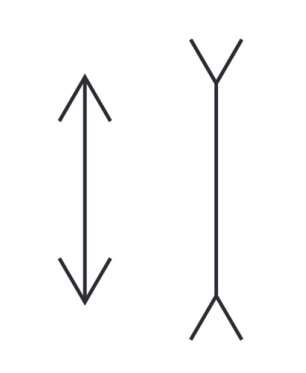
- AMuller-Lyer
- BPonzo
- CAmes room
- DMoon
49The ________ explanation is where the top object in an illusion appears bigger than the bottom object due to depth information provided by converging railroad tracks that make the top object seem further away, despite them being the same size. This explains the _______ illusion
- AConflicting cues; Ponzo
- BMisapplied scaling; Ponzo
- CConflicting cues; Muller-Lyer
- DMisapplied scaling; Muller-Lyer
50Why can't rabbits use disparity to perceive depth?
- AThey are not smart enough
- BThey do not have overlapping visual fields
- CThey have overlapping visual fields
- DTheir eyes are frontal
51Which of the following is NOT a physical aspect of sound?
- ASound waves
- BFrequency
- CAmplitude
- DPitch
52Periodic tones are made up of a variety of components. The component which is a pure tone with a frequency equal to the fundamental frequency is called the
- AHigher harmonic
- BFirst harmonic
- CSecond harmonic
- DFundamental harmonic
53Removing a harmonic from a periodic tone changes the _______ but does not change the _______
- Awaveform; rate of repetition
- Brate of repetition; waveform
- Cfundamental frequency; higher harmonics
- Dhigher harmonics; fundamental frequency
54An audibility curve indicates the threshold for hearing versus [blank_start]frequency[blank_end]
- Afrequency
55Low fundamental frequencies are associated with [blank_start]low[blank_end] pitches, and high fundamental frequencies are associated with [blank_start]high[blank_end] pitches
- Alow
- Bhigh
56Which physical aspect of sound is timbre most closely related to?
- AA tone's harmonic structure
- BA tone's pitch
- CA tone's frequency
- DA tone's amplitude
57Francine and Roald are talking to each other after their perception lecture on hearing. Francine says that she reckons the perceived pitch of a sound is indicated by the place on the basilar membrane at which the most vibration is occurring. This best lines up with which theory of pitch perception?
- APlace theory
- BTemporal theory
- CAmplitude modulation theory
- DVibration theory
58Why is the basilar membrane sometimes referred to as a frequency analyser?
- AAs the place of maximum vibration on the basilar membrane depends on frequency, it functions as a filter that sorts tones by frequency
- BAuditory nerve fibres on the basilar membrane fire in synchrony with the rising and falling pressure of the pure tone to indicate frequency
- CStereocilia located on the basilar membrane are mechanically gated and organised in height order, thus indicating which frequency occurs where
- DThe tuning curves of the basilar membrane become wider at higher frequencies, and the basilar membrane analyses this to produce the perception of pitch
59Laura has been having trouble hearing. She decides to go to a specialist, who finds that her inferior colliculi are both damaged, meaning information cannot reach this area from the ear. Assuming the rest of her pathway from the ear to the primary auditory cortex is undamaged, which structure will information travelling from the ear get up to?
- AMedial geniculate nuclei
- BSuperior olivary nuclei
- CIpsilateral cochlear nuclei
- DCochlea nucleus
60Where can the belt areas be found in relation to hearing?
- ASurrounding the core region
- BOutside of the secondary auditory cortex
- COutside of the primary auditory cortex
- DIn the lateral geniculate nucleus
61Chelsea is participating in a research experiment. The researchers are trying to determine how well people can locate sounds in the azimuth dimension. They get Chelsea to sit in a dark room and play her various sounds at various locations, each sound is played either towards the top of the room or the bottom of the room. The left-right position of the sound stays the same, and the distance of the sound from Chelsea also stays the same. After Chelsea completes the study, she receives $20 as compensation for her time. What is the main error with this experiment?
- AThis experiment is not testing the azimuth dimension, it is testing elevation
- BThe researchers did not control for individual differences in hearing between participants
- CResearchers are not allowed to provide money to people for completing research studies, as this is viewed as a form of bribery
- DTo accurately test sound localisation in the azimuth dimension, the researchers should have used a combination of binaural and monaural cues
62Sounds that fall in the cone of confusion have
- AA larger ILD than ITD
- BA larger ITD than ILD
- CThe same ILD and ITD
- DDifferent ILD and ITD
63Max is participating in a research study. The researchers want to determine the areas of the brain most responsive to pitch. Max is placed in an fMRI and listens to a pitch-evoking stimulus consisting of harmonics in a complex tone, and a noise stimulus which consists of a band of frequencies covering the same frequencies as the pitch-evoking stimulus. When the researchers look at the fMRI, what are they likely to find?
- AThe areas most responsive to the pitch-evoking stimulus will be found in the anterior auditory cortex
- BThe areas most responsive to the noise stimulus will be found in the anterior auditory cortex
- CThe areas most responsive to the pitch-evoking stimulus will be found in the posterior auditory cortex
- DThe areas most responsive to the noise stimulus will be found in the posterior auditory cortex
64Primrose is listening to a bunch of different sounds and seeing if she can determine where they are without looking at them. Primrose knows that her brain is likely to be using a number of binaural cues to help her determine the location of these sounds. Which cue will be most useful when she is trying to determine the location of high frequency sounds, and why?
- AInteraural level difference, as her head will reduce the intensity of high-frequency sounds that reach the ear farthest from the sound source
- BInteraural time difference, as her head will reduce the intensity of high-frequency sounds that reach the ear farthest from the sound source
- CInteraural level difference, as high-frequency sounds travel fastest to the ear closest to the sound source
- DInteraural time difference, as high-frequency sounds travel fastest to the ear closest to the sound source
65Milly is participating in a research study, where they are putting a mold in everyone's ears that changes the shape of the pinnae. Milly is asked to wear this mold for 20 days, and the researchers measure her ability to localise a sound along the elevation coordinate before wearing the mold, on the first day of wearing the mold, on the final day of wearing the mold, and right after removing the mold. What are the results likely to show?
- AMilly will not be able to localise sounds along the elevation coordinate while wearing the mold, as this localisation is dependent on the pinnae. When the mold is removed, she will be able to localise as normal
- BMilly will be able to localise sounds along the elevation coordinate to the same degree despite the shape of the pinnae being changed, as people use a variety of monaural cues to determine elevation.
- CMilly will still be able to localise the elevation of sounds on the first day of wearing the mold, but not to the same degree. However, after wearing the mold for 20 days, she will have improved localisation due to adaptation. When removing the mold and measuring localisation directly after this, her localisation will remain excellent.
- DMilly will still be able to localise the elevation of sounds on the first day of wearing the mold, but not to the same degree. However, after wearing the mold for 20 days, she will have improved localisation due to adaptation. When removing the mold and measuring localisation directly after this, her localisation will again be not very good, until about 20 days has passed to allow her to readapt to the new shape of the pinnae.
66Which of the following is an example of physiological evidence for sound localisation?
- AThere are neurons called coincidence detectors which only fire when both signals coincide by arriving at the neuron simultaneously; the firing representing that ITD = 0
- BThere are neurons called coincidence detectors which only fire when both signals coincide by arriving at the neuron simultaneously; the firing representing that ILD = 0
- CWhen people hear sound coming from two areas, they perceive the sound as coming from the source that reaches the ear first
- DWhen people hear sound coming from two areas, they perceive the sound as coming from the source that reaches the ear last
67Carol is watching the TV while her brother watches youtube on his phone. Her brother decides it would be funny to play the same program that Carol is watching on TV onto his phone. However, he can't get the timing to line up, and in reality, the sound coming from his phone is 1 second slower than the sound coming from the TV. Carol's dad then walks into the room with his eyes closed. The ability of her dad to recognise that the sounds are coming from different sources due to the fact that they start at different times is reliant on which principle of auditory grouping?
- AOnset time
- BLagging heuristic
- CLocation
- DInteraural time difference
68Kylie is looking at a sound spectrogram for the word "had". She identifies three frequencies at which peaks occur. What are these called?
- APhonemes
- BFormants
- CAcoustic signals
- DResonant frequencies
69When viewing sound spectrograms, the rapid shifts in frequency preceding or following formats are called [blank_start]formant transitions[blank_end], and these are associated with consonants
- Aformant transitions
70Why is it hard to design a machine that can perceive acoustic signals based on analysis of phonemes?
- AThere is no simple relationship between phoneme and acoustic signal
- BThe computational power required to design such a machine is higher than we can accommodate for with current technology
- CThe acoustic signal associated with a phoneme is too stable and doesn't provide enough nuance for computers to decipher
- DComputers are too good at perceptual constancy, thus do not perceive acoustic signals in the way humans can
71Research has highlighted that for the sounds /di/ and /du/, we perceive the /d/ in each sound as the same, despite the acoustic signal being different. This difference in acoustic signal is explained by which source of variation?
- ACoarticulation
- BCategorical perception
- CPhonemic boundary
- DPhonemic restoration
72When two VOTs are presented on either side of the phonetic boundary, what does the listener hear?
- ATwo of the same sound
- BA combination of the two sounds, for example /da/ and /ta/ combine to make /ga/
- CTwo different sounds
- DTwo combined sounds, for example /da/ and /ta/ combine to make /ga/ twice
73Imogen is watching the TV. The news reporter is talking about the weather for the next week. When she says the words "farther away", her lips move in a way that matches "farther away", but the sound glitches, so that it is similar to if somebody said "barther away". What is Imogen likely to perceive the reporter as saying?
- AImogen will not notice the glitch, and hear the reporter as saying "farther away" based on her lip movements
- BImogen will notice the glitch, and hear the reporter as saying "barther away" based on this audio
- CImogen will notice the glitch, and combine information from the visual and auditory system to perceive the reporter as saying "garther away"
- DImogen will notice the glitch, but due to her previous knowledge on commonly used words in the English language, will perceive the reporter as saying "farther away"
74In the context of phonemic restoration, the observation that showing longer words increases the likelihood of the phonemic restoration effect due to participants using the additional context provided by the longer words to identify the masked phoneme highlights the role of ___________ in speech perception
- ATop-down processing
- BBottom-up processing
- CThe brain
- DThe eyes
75Which of the following is NOT an example of information we use to help us undergo speech segmentation?
- APrior knowledge
- BShadowing
- CTransitional probabilities
- DStatistical learning
76Fran is a neuropsychologist working in a hospital and is visiting a new patient. She greets the patient, but they seem confused. When the patient starts speaking, their sentences are fluent and grammatically correct, but incoherent and difficult to understand. This patient is likely suffering from
- AWernicke's aphasia
- BBroca's aphasia
- CStroke
- DWord deafness
77Which of the following is NOT an example of evidence that indicates plasticity occurs in speech perception?
- AInfants at 6 months old can tell the difference between sounds that create all of the speech used in the world, but by 12 months they have lot the ability to discriminate between sounds that do not appear in their language
- BJapanese infants at 6 months can tell the difference between /ra/ and /la/, but cannot do this at 12 months
- CAmerican infants who were exposed to 9 months of Mandarin lessons via DVD were able to discriminate between Mandarin sounds at 12 months to the same degree as either Mandarin-speaking or 6-month-old infants
- DAs they gain experience with their native language through social interactions and hearing people speak, infants become better at discriminating between phonemes that are distinguished within their language, and worse at discriminating between phonemes that are not distinguished
Information
- Description
- Quiz on revision, created by Rachael Martin on 12/04/2021.
- Author
- Rachael Martin
- Language
- English
- Views
- 72
- Rating
- 5.0 out of 5 · 1 rating Rate this quiz