
Quiz
Sound Revision Quiz Form 2-Ms Karen Bugeja
This quiz has question types that open in the usual player.
Questions in this quiz (10)
1If the frequency increases, what will happen? You can tick more than one box.
- AAmplitude will increase
- BAmplitude will decrease
- CLoudness will increase
- DLoudness will decrease
- EPitch will increase
- FPitch will decrease
- GWavelength will increase
- HWavelength will decrease
2Label the marked spots on the diagram below

- Acompression
- Brarefaction
3Label the picture below

- Awavelength
4What will you HEAR differently if the wavelength increases?
- AThe pitch will increase
- BThe pitch will decrease
- CThe frequency will increase
- DThe frequency will decrease
- EThe loudness will increase
- FThe loudness will decrease
5The frequency limit of a human is between [blank_start]20[blank_end] and [blank_start]20000[blank_end] Hz
- A20
- B20000
6Echoes are:
- ARefraction of sound
- BReflection of sound
- CTotal internal reflection of sound
- DDiffraction of sound
7This wave is [blank_start]3[blank_end] Hz because it has [blank_start]3[blank_end] waves in [blank_start]1[blank_end] second (write in numbers not letters)
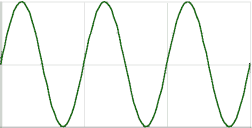
- A3
- B3
- C1
8The wavelength is the vertical distance from the equilibrium (middle)
- ATrue
- BFalse
9Sound travels when the molecules in the [blank_start]medium[blank_end] vibrates. The closer the molecules are, the [blank_start]faster[blank_end] sound travels. The fastest medium is a [blank_start]solid[blank_end] while sound does not travel in a [blank_start]vacuum[blank_end]. In the ear, a vibrating object e.g. a trumpet produces waves. Sound then travels from the [blank_start]medium[blank_end] (air) to the ear. The vibrating air enters the ear, fuelled to the [blank_start]ear canal[blank_end]. The vibrating air sets up vibrations in the [blank_start]ear drums[blank_end]. The ear drums then transmit the vibrations to the small bones called [blank_start]ossicles[blank_end], causing them to vibrate. The [blank_start]cochlea[blank_end] vibrates. These vibrations are detected by the hair lining and the [blank_start]auditory nerve[blank_end] will then detect these vibrations and send the impulses to the brain.
- Amedium
- Bear drum
- Ctransmit
- Dcochlea
- Efaster
- Fslower
- Gmore curved
- Hsolid
- Iliquid
- Jgas
- Kvacuum
- Lvacuum
- Msolid
- Nliquid
- Ogas
- Pmedium
- Qvacuum
- Rair
- Sear
- Tear canal
- Uoptic nerve
- Vcochlea
- Wossicles
- Xdrum
- Year drums
- Zear canal
- AAauditory nerve
- ABvacuum
- ACcochlea
- ADossicles
- AEcochlea
- AFear canal
- AGear drums
- AHcochlea
- AIear drums
- AJossicles
- AKvacuum
- ALauditory nerve
- AMauditory nerve
- ANcochlea
- AOear drums
- APossicles
- AQear canal
10An echo sounder ship is tested where the sea bed is known to be 60 m deep. The time between sending each ultrasonic pulse and receiving its echo was measured at 0.1s. The time for the ultrasonic wave to reach the sea bed is [blank_start]0.05[blank_end] s. To find the speed, we have to use the equation speed = distance/time, so [blank_start]60[blank_end] division by [blank_start]0.05[blank_end]= [blank_start]1200[blank_end] m/s.
- A0.05
- B60
- C0.05
- D1200
Information
- Description
- Revision quiz for sound form 2
- Author
- Karen Bugeja
- Language
- English
- Views
- 308
- Tags
- Rating
- 4.8 out of 5 · 4 ratings Rate this quiz