
Apuntes
Topic 1
Contenido del apunte (1)
Página 1
Q1)
Due to the dipole nature of water hydrogen bonds for between molecules. Hydrogen bonds are important in giving water its properties because:
hold molecules together so water is a liquid at room temperature.
h bonds create cohesion, which is important in the transport of water and dissolved substances in the xylem
means it takes a lot of energy to heat water up (high specific heat capacity) and also to turn into a gas (high latent heat vaporisation). Temperature fluctuations small in living things, sweating and transpiration take energy.
TRANSPORT AND CIRCULATION
Q2)
in water, the oxygen atom is slightly negative and the hydrogen atoms are slightly positive, because the oxygen atom is more electronegative.
Q3)
In very small organisms simple diffusion is fast enough but big organisms have a much smaller surface area to volume ratio, so there is not enough surface to serve the needs of the large volume inside by diffusion. Organisms in order of largest to smallest SA/V ratio:
Yeast
Daphnia
Goldfish
Golden retriever
Elephant
Killer Whale
CARDIAC CYCLE AND HEART RATE
Q1)
The chamber in the heart which pumps blood from the heart to the lungs is the right ventricle.
The chamber which receives blood from the vena cava is the right atrium.
The chamber which pumps blood from the heart to the aorta is the left ventricle.
Valves open and close due to pressure differences between one side and the other. (pressure gradients),
Elastic recoil of the heart muscles lowers pressure in the atria and pressure, drawing in blood.
Q2)
Daphnia are suitable for experiments about heart rate because:
they are abundant and easily obtained
they are transparent
they have a very simple nervous system
CARDIOVASCULAR DISEASE
Q1)
Factors which must be present for a blood clot to form:
fibrin
calcium ions
vitamin k
thrombin
thromboplastin
Q2)
Platelets are also needed for the clotting process.
Atherosclerosis
damage to the endothelial lining of artery
inflammatory response, white blood cells move into the artery wall
cholesterol builds up leading to the formation of an atheroma
build up of calcium salts and fibres leading to plaque formation
STRUCTURE AND FUNCTION OF CARBOHYDRATES
Q1)
They all have different monosaccharides.
lactose has glucose and galactose
maltose has glucose and glucose
sucrose has glucose and fructose
Monosaccharides
glucose -main substance for respiration, soluble, osmotic effect
galactose - soluble, osmotic effect
fructose - fruit sugar, soluble, osmotic effect
Disaccharides
lactose - milk sugar, soluble
maltose - malt sugar found in germinating seeds, soluble
sucrose - main transport sugar in plants, soluble
Polysaccharides
amylose - unbranched, alpha glucose, in spirals so compact, insoluble, no osmotic effect.
amylopectin - branched chains of alpha glucose, lots of terminal ends so digested more rapidly than amylose, insoluble, no osmotic effect.
glycogen - branched chains of glucose molecules, compact, insoluble, no osmotic effect.
STRUCTURE AND FUNCTION OF LIPIDS
Q1)
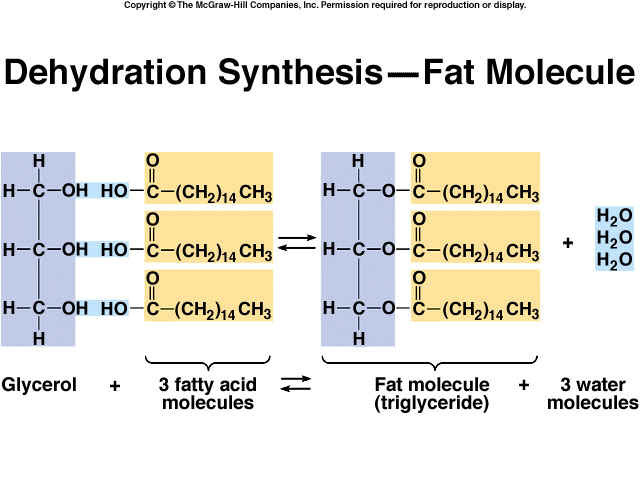
Ester bonds and glycosidic bonds are both formed from a condensation reaction and broken by hydrolysis.
Q2)
in the hydrolysis of a triglyceride molecule, a glycerol an 3 fatty acid molecules will be formed.
The difference in saturation of the fatty acids changes the structure, physical properties and biological significance of the triglyceride:
saturated (fats) - strong intermolecular forces, solid at room temp, straight chain molecule
monounsaturated (oils) - intermolecular forces weaker because of kinked shape, liquid at room temp, molecule with one kink in chain
polyunsaturated (oils) - intermolecular forces even weaker, liquid at room temp, molecule with several kinks in chain
transport and circulation
cardiac cycle and heart rate
cardiovascular disease
structure and function of carbohydrates
structure and function of lipids
Información
- Descripción
- Apunte sobre Topic 1, creado por altong1 el 28/12/2014.
- Creado por
- altong1
- Visitas
- 9
- Valoración