
Módulo 38 de 39 · Multimedia
Heating and Cooling Curves and Phase Change
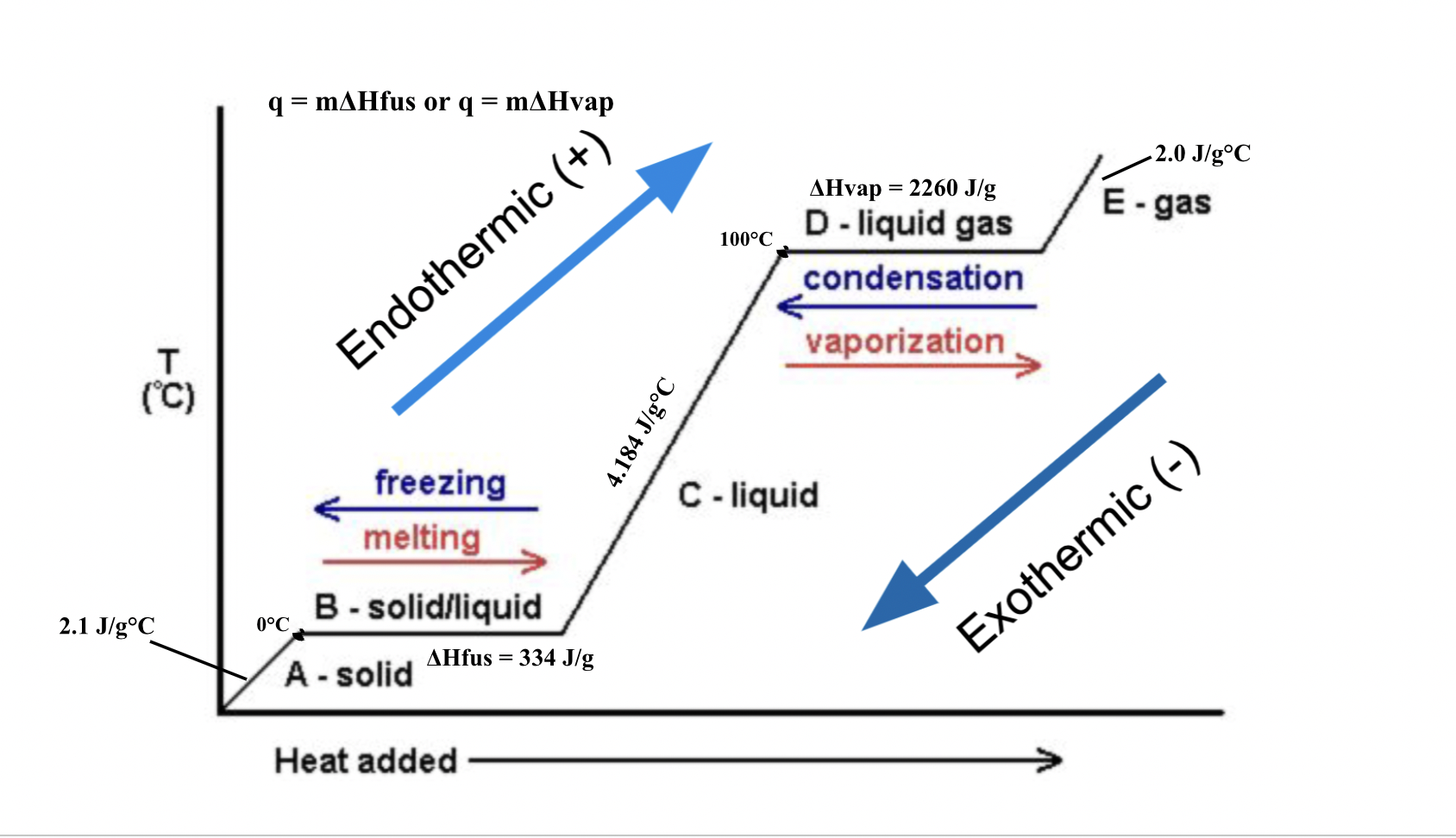
Phase Change
6 Types of Phase Change
- Melting = Fusion (solid to liquid)
- Freezing = Solidification (liquid to a solid)
- Boiling = Vaporization (liquid to gas)
- Gas to Liquid = Condensation
- Solid to Gas = Sublimation
- Gas to Solid = Deposition
Specific Heat of Water
- Solid (ice): 2.1 J/g°C
- Liquid (water): 4.184 J/g°C
- Gas (steam): 2.0 J/g°C
The heat (joules) added/removed during a phase change will break intermolecular forces if warming or allow intermolecular forces to form if cooling
- The freezing AND melting point of water is 0°C
- The boiling point of water is: 100°C
Heat of Fusion
- Heat (joules) absorbed when 1 gram of solid turns into a liquid (melting)
- For H₂O, this is 334 J/g (6.02 kJ/mol)
- If you have 1 g of ice at 0°C it will absorb 334 joules of energy before it will melt into liquid water at 0°C
- The temperature remains constant
Heat of Vaporization/Condensation
- Heat (joules) absorbed when 1 gram of liquid turns into a gas (vaporization)
- For H₂O, this is 2260 J/g (40.6 kJ/mol)
- If you have 1 g of water at 0°C it will give up 2260 joules of energy before it will solidify into ice at 0°C
- The temperature remains constant
When we do problems that involve a phase change, we use Enthalpy
- q = mΔHfus (Melting or Freezing)
- q = mΔHvap (Vaporization or Condensation)
Calorimetry Conversions
1.0 calorie = 4.184 J 1 kilocalorie = 1000 calories 1kJ = 1000 Joules