
Test
Lecture 5: Objectives and Budgeting
Este test tiene tipos de pregunta que se abren en el reproductor de siempre.
Preguntas del test (22)
1[blank_start]Marketing objectives[blank_end] are generally stated in the firm’s marketing plan and are quantifiable, such as sales, market share, profit
[blank_start]Communication objectives[blank_end] are Derived from the overall marketing plan and are based on particular communications tasks- AMarketing objectives
- BCommunication Objectives
- CCommunication objectives
- DMarketing objectives
2[blank_start]Communications[blank_end] Objectives facilitate coordination of the various groups
[blank_start]Planning and decision making[blank_end] objectives guide decision making and development of the IMC plan
[blank_start]Measurement and evaluation of results[blank_end] objectives provide a benchmark to measure success or
failure- ACommunications
- BPlanning and decision making
- CMeasurement and evaluation of results
- DPlanning and decision making
- ECommunications
- FMeasurement and evaluation of results
- GPlanning and decision making
3A SMARTT approach to creating objectives ensure that they are: Specific, measurable, maintainable, achievable, realistic, time-depending & targeting
- AVerdadero
- BFalso
4Sales Oriented Objectives;
- AAim to increase sales
- BIncrease brand awareness through social media advertising
- CRequire economic justification
- DRequired to product quantifiable results
- EAre based on the achievement of sales results
5Factors which influence [blank_start]sales[blank_end] include; competition, technology, economy, product quality, price, distribution, advertising & promotion.
- Asales
- Bpublic relations
- Ccompany reputation
6Common problems with sales objectives include;
- ASuccessful implementation requires all marketing elements to work together
- BObstacles in gaining government approval
- CAdvertising has carryover effect: Monies spent on advertising do not have immediate impact on sales
- DDifficult to determine precise relationship between advertising and sales
- EDo not offer much guidance for planning and developing promotional program
7Examples of communication objectives include:
- AProvide relevant information
- BSales goals for the year
- CCreate favourable predispositions toward the brand
- DModels wherein consumers pass through 3 stages: Cognitive, affective and behavioural
8One problem with Communications Objectives includes translating sales goals into communications objectives i.e. promotional planners have difficulty estimating what constitutes adequate levels of awareness, knowledge, liking, preference, conviction.
- AVerdadero
- BFalso
9DAGMAR stands for
- AD = Defining
- BA in both instances = Agency
- CA in both instances = Advertising
- DG = Goals
- EG = Generic
- FM = Measured
- GM = Manipulable
- HR = Results
- IR = Rectify
10DAGMAR provides that communications effects are the logical basis for advertising goals and objectives to measure success or failure
- AVerdadero
- BFalso
11A 'top-down' approach to establishing a promotional budget is when;
- AManagements sets a spending limit > Promotion budget is then set to stay within the Limit
- BPromotion budget is then set to stay within the Limit > Managements sets a spending limit
12A 'bottom-up' approach to establishing a promotional budget is when;
- AObjectives are set > Activities to achieve the objectives are planned > Management either approves or rejects the budget > Costs of promotion activities are budgeted
- BObjectives are set > Activities to achieve the objectives are planned > Costs of promotion activities are budgeted > Management either approves or rejects the budget
- CCosts of promotion activities are budgeted > Management either approves or rejects the budget > Objectives are set > Activities to achieve the objectives are planned
13[blank_start]Problem removal[blank_end] – Buyer experiences CURRENT problem; seeks a product that will SOLVE the problem
[blank_start]Problem avoidance[blank_end] – Buyer anticipates a FUTURE problem; seeks a product that will PREVENT the problem
[blank_start]Incomplete satisfaction[blank_end] – Buyer is not satisfied with current product; searches for a BETTER product
[blank_start]Mixed approach-avoidance[blank_end] – Buyer likes some things about the product but dislikes others; tries to find a product that will RESOLVE the conflict
[blank_start]Normal Depletion[blank_end] – Buyer is simply out of stock or running low; seeks to MAINTAIN regular supply of product- AProblem removal
- BProblem avoidance
- CIncomplete satisfaction
- DMixed approach-avoidance
- ENormal Depletion
14[blank_start]Sensory gratification[blank_end] – Buyer seeks extra physiological stimulation; to ENJOY product
[blank_start]Intellectual Stimulation[blank_end] – Buyer seeks extra psychological stimulation; to EXPLORE or MASTER new product
[blank_start]Social Approval[blank_end] – Buyer sees opportunity for social rewards; PERSONAL RECOGNITION through use of product- ASensory gratification
- BStimuli
- CIntellectual Stimulation
- DSocial Approval
- ESocial Availability
15According to Rossiter and Percy, VisCap stands for; Visibility, Credibility (Expertise/Objectivity), Attraction (Likability/similarity), Power
- AVerdadero
- BFalso
16Which of these is the correct order for the traditional advertising-based view of marketing communications;
- AAttitudes > Knowledge > Preference > Conviction > Purchase Behaviour
- BKnowledge > Conviction > Attitudes > Preference > Purchase Behaviour
- CPreference > Purchase Behaviour > Attitudes > Conviction > Knowledge
17[blank_start]Zero-based[blank_end] communications planning involves determining: what tasks need to be done and which marketing communications functions should be used and to what extent (Focuses on the task to be done and searches for the best ideas and media to accomplish)
- AZero-based
- BUnlimited
- CStrategy-oriented
18Which of the following fits the description for titles 1, 2, 3 and 4;
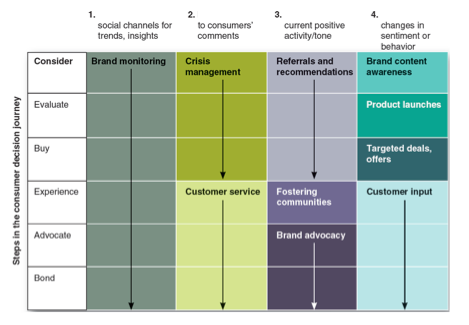
- A1 - Manipulate
- B1- Monitor
- C2 - Respond
- D2 - Rectify
- E3 - Apply
- F3 - Amplify
- G4 - Learn
- H4 - Lead
19What is the name of this theoretical issue in budget setting (sales response model);
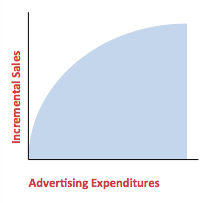
- ABell-curve depression
- BConcave-Downward Response curve
- CIncremental Increase curve
- DCurved sales expenditure
20What is the name of this theoretical issue in budget setting - (sales response model);
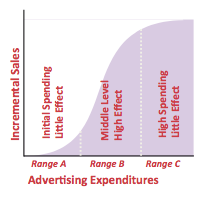
- AIncremental Curve in Sales
- BS-Shaped Response function
- CFluctuating sales expense curve
- DSales and expense life cycle
21What are the benefits of a 'top-down' budgeting approach;
- AAffordable
- BArbitrary
- CHigh employee discretion and choice
- DFocuses on percentage of sales/expenses (ROI)
22A 'bottom-up' budgeting approach is objective driven rather than being financially driven.
- AVerdadero
- BFalso
Información
- Descripción
- Law Test sobre Lecture 5: Objectives and Budgeting, creado por Dean Audicho el 13/10/2017.
- Autor
- Dean Audicho
- Idioma
- English
- Visitas
- 88
- Etiquetas
- Valoración
- Aún sin valoraciones Valora este test