
Test
Identification of Ions & Gases Quiz
Preguntas del test (19)
1The results of two tests on solid X are shown.
What is X?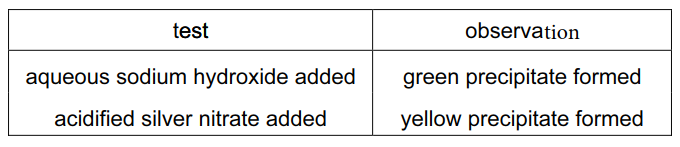
- AA copper(II) chloride
- BB copper(II) iodide
- CC iron(II) chloride
- DD iron(II) iodide
2A white solid is insoluble in water.
When it is added to hydrochloric acid, bubbles of gas are formed.
Adding aqueous ammonia to the solution formed gives a white precipitate. Adding excess
aqueous ammonia causes the precipitate to re-dissolve.
What is the white solid?- AA aluminium nitrate
- BB ammonium nitrate
- CC calcium carbonate
- DD zinc carbonate
3An element, X, is a dark grey crystalline solid at room temperature.
It has a melting point of 114°C and a density of 4.9 g/ cm3.
When heated gently it forms a purple vapour.
Where in the Periodic Table is X found?- AA
- BB
- CC
- DD
4Which two compounds give a white precipitate when their aqueous solutions are mixed?
- AA silver nitrate and sodium chloride
- BB silver nitrate and sodium iodide
- CC sodium hydroxide and copper(II) sulfate
- DD sodium hydroxide and iron(II) chloride
5Two tests are carried out to identify an aqueous solution of X.
test 1 Aqueous sodium hydroxide is added and a blue precipitate is produced.
test 2 Dilute nitric acid is added followed by aqueous silver nitrate and a white
precipitate is produced.
What is X?- AA copper carbonate
- BB copper chloride
- CC iron(III) carbonate
- DD iron(III) chloride
6Which gas relights a glowing splint?
- AA ammonia
- BB carbon dioxide
- CC hydrogen
- DD oxygen
7Which statement about aqueous sodium hydroxide is correct?
- AA When it is added to a solution containing sulfate ions, a white precipitate is formed.
- BB When it is added to a solution of copper(II) ions, a blue precipitate is formed which dissolves
in excess to give deep blue solution. - CC When it is added to a solution of iron(II) ions, a green precipitate is formed which does not
dissolve in excess. - DD When it is added to ammonium chloride, a gas is produced which turns blue litmus red.
8Aqueous sodium hydroxide is added to solid X and the mixture is heated.
A green precipitate is formed and an alkaline gas is given off.
Which ions are present in X?- AA NH4+ and Fe2+
- BB NH4+ and Fe3+
- CC OH and Fe2+
- DD OH and Fe3+
9Compound X is tested and the results are shown in the table.
Which ions are present in compound X?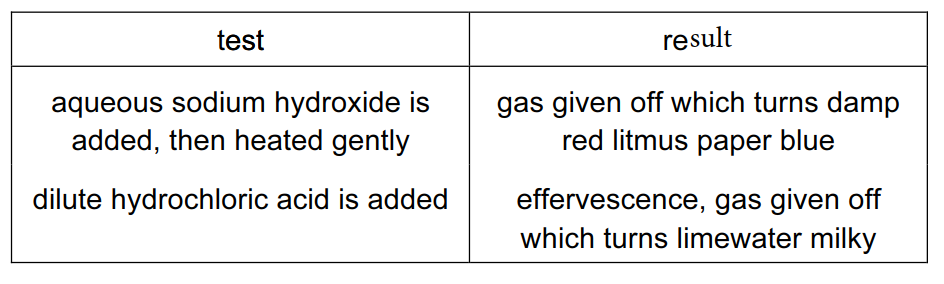
- AA ammonium ions and carbonate ions
- BB ammonium ions and chloride ions
- CC calcium ions and carbonate ions
- DD calcium ions and chloride ions
10The cations shown are identified by the colour of the precipitates formed when an excess of an aqueous solution of X is added.
What is X?- AA ammonia
- BB limewater
- CC silver nitrate
- DD sodium hydroxide
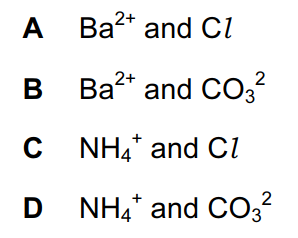
11Which of these pairs of aqueous ions both react with dilute sulfuric acid to give a visible result?
- AA
- BB
- CC
- DD
12Element X forms an acidic, covalent oxide.
Which row shows how many electrons there could be in the outer shell of an atom of X?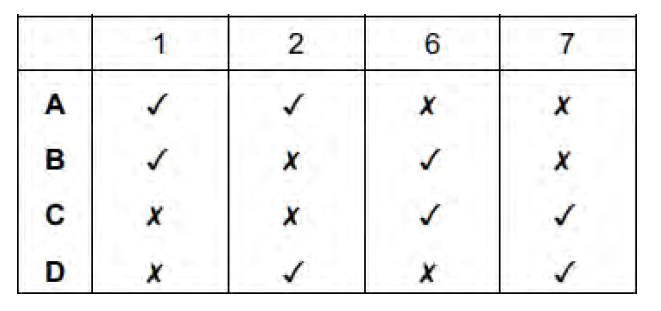
- AA
- BB
- CC
- DD
13Barium hydroxide is an alkali. It reacts with hydrochloric acid.
How does the pH of the hydrochloric acid change as an excess of aqueous barium hydroxide is added?- AA The pH decreases from 14 and becomes constant at 7.
- BB The pH decreases from 14 to about 1.
- CC The pH increases from 1 and becomes constant at 7.
- DD The pH increases from 1 to about 14.
14The results of three tests on a solution of compound X are shown.
What is compound X?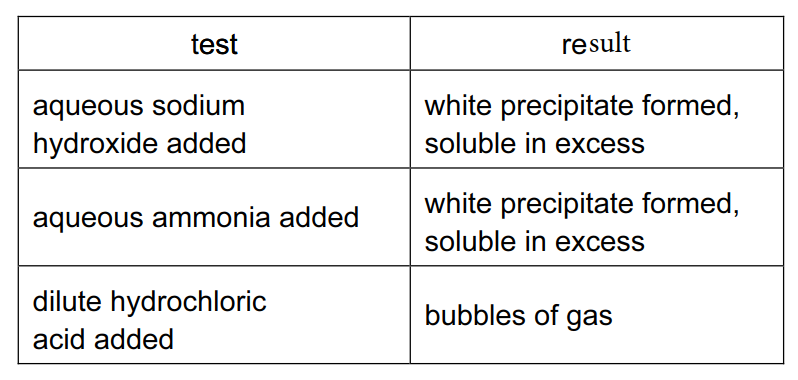
- AA aluminium carbonate
- BB aluminium chloride
- CC zinc carbonate
- DD zinc chloride
15A solution contains barium ions and silver ions.
What could the anion be?- AA chloride only
- BB nitrate only
- CC sulfate only
- DD chloride or nitrate or sulfate
16Some reactions involving sodium are shown.
Which reaction does not involve the formation of a base?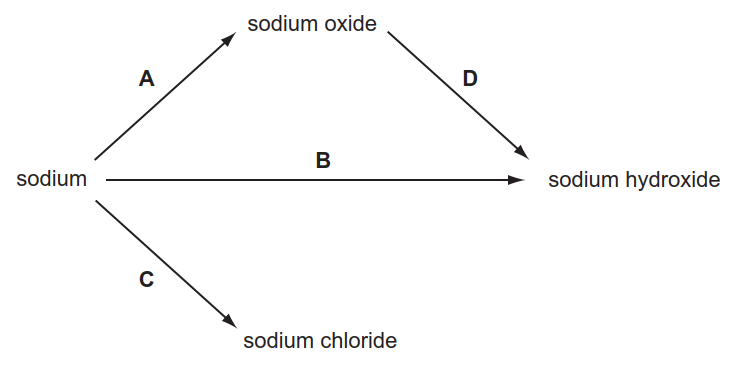
- AA
- BB
- CC
- DD.
17When sodium reacts with water, a solution and a gas are produced.
The solution is tested with litmus paper and the gas is tested with a splint.
What happens to the litmus paper and to the splint?- AA Litmus paper goes from blue to red; a glowing splint relights.
- BB Litmus paper goes from blue to red; a lighted splint "pops".
- CC Litmus paper goes from red to blue; a glowing splint relights.
- DD Litmus paper goes from red to blue; a lighted splint "pops".
18Aqueous sodium hydroxide is added to a solution of a salt. A blue precipitate is formed which does not dissolve in excess.
Aluminium foil is added to the mixture and the mixture is warmed. A gas is produced that turns damp red litmus paper blue.
What is the name of the salt?- AA ammonium nitrate
- BB ammonium sulfate
- CC copper(II) nitrate
- DD copper(II) sulfate
19An element E is burned in air. A white solid oxide is formed.
The oxide is tested with damp red litmus paper. The paper turns blue.
What is element E?- AA calcium
- BB carbon
- CC iodine
- DD sulfur
Información
- Descripción
- Quiz on tests for ions and gases
- Autor
- Jeffrey Piggott
- Idioma
- English
- Visitas
- 1.708
- Etiquetas
- Valoración
- Aún sin valoraciones Valora este test