
Spring Term 1
Diapositivas del conjunto (6)
-
- A quadratic graph is produced when you have an equation of the form y = ax² + bx + c
- b and c can be zero but a cannot
- All quadratic graphs have a line of symmetry.
- Positive quadratic graphs (where a > 0) are U-shaped and have a turning point at the bottom of the curve.
- Negative quadratic graphs (where a < 0) are shaped like the opposite of a U and have a turning point at the top of the curve.
-
- A cubic equation contains only terms up to and including x³.
- e.g. y = x³, y = x³ + 5
-
- Reciprocal graphs are drawn in the form of: y = 1/x
-
- If an equation can be rearranged to form y = mx + c, the graph will be a straight line.
- e.g. x + y = 3 is a straight line graph because it can be rearranged to form y = - x + 3
- m → gradient (steepness of the graph)
- c → y-intercept (where the line cross the y-axis)
- The origin = (0,0)
- Gradient = change in y (up) / change in x (right)
- Gradients can be:
- positive (going up)
- negative (going down)
- 0 - no change (horizontal)
- Always leave gradient as a fraction (not decimal)
- It's easier if change in x is a whole number
- Lines that are parallel have the same gradient (m)
- y = 3x + 7 and y = 3x - 8 are parallel because m (3) is the same
- Two perpendicular lines have gradients which multiple to be -1.
- the gradient of y = 2x + 1 is 2. To find the number that can be multiplied with it to get -1, you find the negative reciprocal of 2 (flip it, then add a - if positive, or + if negative)
- negative reciprocal of 2 (or 2/1, same thing) = -1/2
- however negative reciprocal of -5 (or -5/1) = 1/5 (because negative and negative is positive)
- example of a perpendicular line would be y = -1/2x + 6
- To find the equation of a straight line (given two points), you use: y₂ - y₁ / x₁ - x₁ (= change in y / change in x) for the gradient.
- Put the m into y = mx + c, then rearrange to find c
- OR
- Use the formula y - y₁ = m(x - x₁) where m is gradient, and x₁ and y₁ are one of the two points given.
-
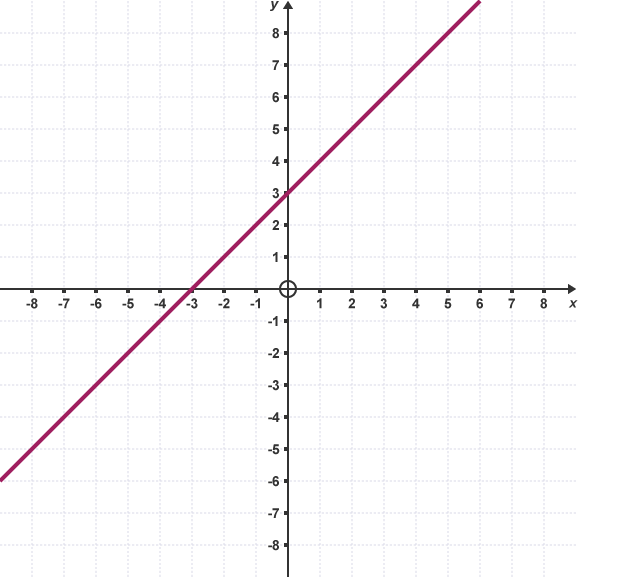
- To work out a gradient, use the scales of the axes and find how many units you go up or down for each unit you move right. It's generally a good idea to use two points on the line that are far apart.
- Using (0, 3) and (4, 7):
- To start at (0,3) and end up at (4,7), we move 4 units up (from 3 to 7) and 4 units to the right (from 0 to 4). So the gradient = change in y / change in x = 4/4 = 1
- The y-intercept = 3 because the line crosses the y axis at (0,3).
- So the equation of the line: y = (1)x + 3 (in the form y = mx + c)
-
- Find the equation of the line that goes through the points (−1, 3) and (3, 11).
- gradient (m) = y₂ - y₁ / x₁ - x₂
- 11 - 3 / 3 - - 1 OR 3 - 11 / -1 -3 (it doesn't matter which set of points are y₁ and x₁ and which are y₂ and x₂)
- gradient (m) = 8/4 OR -8/-4 = 2
- y - y₁ = m(x - x₁)
- y - 11 = 2 (x - 3) → (again, doesn't matter which set of points you pick)
- y - 11 = 2x - 6
- y = 2x + 5
Información
- Descripción
- Year 7 Maths Diapositivas sobre Spring Term 1, creado por Vanessa Andrews el 11/02/2020.
- Creado por
- Vanessa Andrews
- Visitas
- 18
- Etiquetas
- Valoración