
Enzymes
Diapositivas del conjunto (9)
-
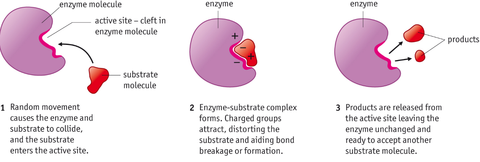
- Enzymes are globular proteins that act as biological catalysts. They speed up reactions that would otherwise occur very slowly at the temperature within the cells.
- The precise 3D shape adopted by an enzyme includes a depression on the surface of the molecule called the active site. This site may be a relatively small part of the large protein molecule. Only a few amino acids may be directly involved in the active site, with the remainder maintaining the 3D shape of the protein molecule.
-
- Either a single molecule with a complementary shape, or more than one molecule that together have a complementary shape, can fit into the active site.
- These substrate molecule(s) form temporary bonds with the amino acids of the active site to produce an enzyme-substrate complex.
- The enzyme holds the substrate molecule(s) in such a way that they react more easily.
- When the reaction has taken place the products are released, leaving the enzyme unchanged.
- Each enzyme will only catalyse one specific reaction because only one shape of substrate will fit into its precisely-shaped active site.
-
- It has been found that the active site is often flexible.
- When the substrate(s) enters the active site, the enzyme molecule changes shape slightly, fitting more closely around the substrate.
- The enzyme returns to its original shape after the reaction.
- Only a specific substrate will induce the change in shape of an enzyme's active site.
-
- To convert substrate(s) into product(s), bonds must change both within and between molecules.
- Breaking chemical bonds requires energy whilst energy is released when bonds form.
- The energy needed to break bonds and start the reaction is known as the activation energy.
- Without an enzyme, heating a substrate would provide this energy.
- The heat energy agitates atoms within the molecules, the molecules become unstable and the reaction can then proceed.
- In cells, enzymes reduce the amount of energy needed to bring about a reaction; this allows reactions to occur without raising the temperature of the cell.
-
How enzymes reduce activation energy
- The specific shape of the enzyme's active site and of its complementary substrates is such that electrically charged groups on their surfaces interact.
- The attraction of oppositely charged groups may distort the shape of the substrate(s) and assist in the breaking of bonds or in the formation of new bonds.
- In some cases, the active site may contain amino acids with acidic side chains; the acidic environment created within the active site may provide conditions favourable for the reaction.
-
- The metabolism of an organism is the sum of all the enzyme-catalysed reactions occurring within it.
- Enzymes catalyse many different types of reactions, some occurring inside cells (intracellular reactions) and others in tissue fluid, blood or other aqueous solutions in the organism (extracellular reactions).
- Sometimes large substrate molecules will be broken down into smaller units in catabolic (breaking down) reactions.
- Other enzymes catalyse anabolic (building up) reactions.
- Sometimes enzymes are simply altered, not added to or broken down.
-
Rates of enzyme-controlled reactions
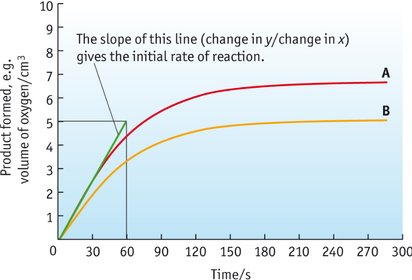
- The rate of reaction is measured by determining the quantity of substrate used or the quantity of product formed in a given time.
- If we mix a fixed quantity of enzyme and substrate, at first the reaction will proceed quickly (initial rate of reaction). However as the substrate is used up, there are fewer molecules to bind with the enzyme and the reaction slows down and eventually stops (no further increase in the product occurs).
-
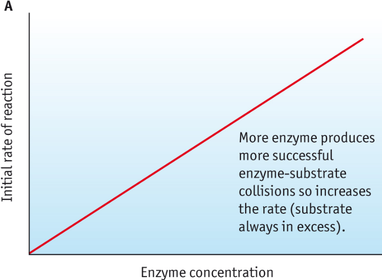
- The rate of reaction is directly proportional to the enzyme concentration because the more enzyme that is present, the greater the number of active sites that are available to form enzyme-substrate complexes.
- The increase in rate will continue in this linear fashion assuming that there is an excess of substrate.
-
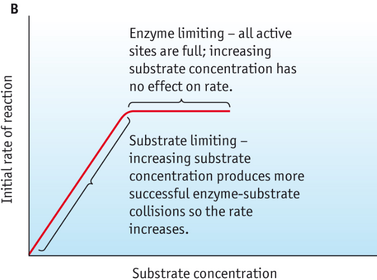
- At high substrate concentrations, it is the enzyme concentration that limits the rate of reaction.
- Every active site is occupied and substrate molecules can't enter an active site until one becomes free again.
Información
- Descripción
- A level (2 Genes and health) Biology Diapositivas sobre Enzymes, creado por Ella Middlemiss el 18/01/2017.
- Creado por
- Ella Middlemiss
- Visitas
- 4
- Etiquetas
- Valoración