
Fichas
Medicince Priniciples - Immunology

Fichas del conjunto (68)
- 1What are the cell mediated aspects of the immune system?Phagocytes; Neutrophils, Eosinophils, Basophils, Mast Cells, Macrophages and Monocytes and Dendritic cells.
Lymphocytes: T Cells, B cells and NK cells. - 2What are the four Humoral mediated aspects of the immune system?Antibodies
Complement System Proteins
Cytokines
Acute Phase proteins - 3What are the three main cells involved in mediating an allergic response?Mast Cells, Basophils and Eosinophils.
- 4Explain the function of all Phagocytes.They ingest pathogens and debris via phagocytosis.
Also ingest dead and dying apoptotic cells.
Important sources of cytokines. - 5How abundant are Macrophages and where do they migrate to?They comprise 5% of all circulating Leukocytes and migrate into peripheral tissues and differentiate into Macrophages.
- 6What do macrophages do and what are they involved in?They:
Limit inflammation
Are Long Lived
Are Involved in:
Tissue Repair
Antigen Presentation - 7What do neutrophils do and how abundant are they?They circulate in the blood
Comprise 50-70% of all circulating Leukocytes
Are Short lived
And are rapidly recruited into inflamed, damaged and infected tissues. - 8Where are dendritic cells found in both 'immature' and 'mature' states and what is their role?Immature - Peripheral tissues
Mature - Secondary Lymphoid tissues
They phagocytose antigens and play a key role in antigen presentation. - 9Where are Mast Cells found and what do they do?They reside in tissues and protect mucosal surfaces and Mediate an allergic response.
- 10Where are Basophils and Eosinophils founds and what is their role?They circulate in the blood and are recruited to the site of infection by inflammatory signals. They are the main defence system against large pathogens and also mediate allergic responses.
- 11Explain how Mast Cells, Basophils and Eosinophils work in mediating an allergic response.The granulocytes release chemicals such as histamine, heparin and cytokines which cause acute inflammation. They are the defence mechanism against large pathogens that cannot be phagocytosed.
- 12What is the main role of B cells?B cells are responsible for the production and secretion of antibodies to defend against extracellular pathogens.
- 13What are the two types of T cells and what are their roles?T Helper Cells:
Key regulators of the immune system
T Killer (Cytotoxic) Cells:
Kill virally infected host cells. - 14What are NK cells and what are their roles?NK (Natural Killer) cells are large granular lymphocytes that kill tumour and virally infected host cells.
- 15What are antibodies and antigens and what do they do?Antibodies aka immunoglobulins are proteins that are produced in response to an antigen.
An antigen is anything that can stimulate an immune response.
They provide defence against extracellular pathogens. - 16Explain the complement system i.e. How many? Where produced? Role?They are a family of approximately 30 proteins.
Produced in the liver and then circulate the blood as inactive precursors.
Can enzymatically cleave and activate others in a cascade.
Play a critical role in inflammation. - 17What are cytokines, when are they produced and what do they do?Diverse collection of small proteins and peptides
Produced in response to infection, inflammation and tissue damage
Modulate behaviour of cells
Short half life
Can act locally or systemically - 18What is the function of an interferon?Anti-Viral activity
- 19What is the function of Tumour Necrosis Factor a (TNFa)A pro-inflammatory cytokine
- 20What is the function of a Chemokine?Control and direct cell migration
- 21What is the function of an Interleukin?Various Functions
- 22Where are acute phase proteins produced?The liver
- 23What are the three functions of Acute Phase Proteins?Diagnosis
Enhance Phagocytosis
Complement system activation - 24What is the innate immune system and how rapid is its response?The innate immune system is the natural general response to every different pathogen.
Has a rapid response (minutes to hours). - 25What are the two distinct methods of communication in the innate immune system?Direct contact: Receptor : Ligand e.g MHC:TCR
Indirect: Production and secretion of cytokines e.g. Interleukins - 26What are the 4 cells of the innate immune system that are used in response to pathogens?Macrophages
Mast Cells
NK Cells
Neutrophils - 27What are the three phases of the innate immune system in response to a pathogen?1. Recognition Phase
2. Activation Phase
3. Effector Phase - 28Explain the recognition phase.Pathogens express 'signature' molecules not found in human cells - "Pathogen associated molecular patterns" PAMPs
- 29Name the four Pattern-recognition receptors to their matching PAMPs.TLR4 - LPS
Dectin 1 - Beta-glucans
NOD2 - Muramyl dipeptide
TLR7 - ssRNA - 30What do macrophages produce when they engulf apoptotic bodies?Anti-inflammatory cytokines IL-10
Pro-inflammatory mediators and present antigens on their surface - 31Define and explain "Macrophage Power" and how it is increased.Macrophage power = Killing ability
It is enhanced by cytokines produces by NK cells.
Increases production of toxins, microbicidal activity and antigen presentation. - 32What do mast cells produce and how do they identify pathogens?They produce inflammatory mediators.
They identify pathogens by the PRR on their surface through degranulation to release the mediators and gene expression to replace them. - 33What three* pro-inflammatory mediators do Macrophages, Mast cells and NK cells produce.Nitric Oxide, Prostaglandins and Histamines
Cytokines - TNFa, Interleukins, Interferons
Chemokines - 34What do Nitric Oxide, Prostaglandins and Histamines cause in the body?Vasodilation
Permeability
Pain
Smooth Muscle Contraction - 35What do Cytokines cause in the body?Permeability
Endothelial cell division - 36What do Chemokines cause in the body?Leukocyte recruitment and activation
- 37Name the three killing methods of Neutrophils.Phagocytosis
Degranulation
NETs - 38What is phagocytosis and how exactly does it work?In infected tissues, pathogens release signals that attract Neutrophils. Neutrophils use their PRRs to bind and encapsulate pathogens. They then kill the pathogens via Anti-microbial proteins or NADPH oxidase dependant mechanisms.
- 39What is Degranulation and how does it work?Degranulation is the release of anti-bacterial proteins from neutrophils granules into the extracellular matrix.
Directly kills extracellular pathogens but can cause tissue damage. - 40What are NETs and how do they work?Neutrophils release 'NETs' of their DNA into the environment which immobilize pathogens and prevent them from moving, thus facilitating their Phagocytosis.
- 41What can occur as a result of increased levels of TNFa?IBS, psoriasis, arthritis, asthma, cancer, infectious diseases and others are related to linked levels of TNFa.4
- 42Complete the following table

- 43What are the three complement pathways?Mannose-binding Lectin Pathway
Alternative Pathway
Classical Pathway - 44What is inactive C3 cleaved into?Active C3a and Active C3b
- 45What is opsonisation and what is an example of an oponin?Opsonisation is a ay of identifying the invading particle to the phagocyte.
E.g C3b - 46What are C3a and C5a known as and what do they do?Anaphylatoxins which promote inflammation. They activate Mast Cells.
- 47Name four examples of Secondary Lymphatic tissue.Tonsils and adenoids
Lymph nodes
Large Intestine (Peyers patches)
Appendix - 48What is the adaptive immune system and how quick is the response?It is the learned response to millions of different pathogens and is able to recognise and respond to them.
The response is slow and can take days. - 49What are the cells that need to be able to: Recognise Find Activate and Respond to a pathogen?T Cells and B Cells
- 50Why is the adaptive immune system so slow?Its response is individual to each pathogen and it is responsible for creating immunological memory.
- 51How many antigenic epitopes can T and B Cells bind to?One - T and B Cells only express one antigen receptor which can only bind to once specific antigenic epitope.
- 52Which of these is a T Cell and which is a B Cell?

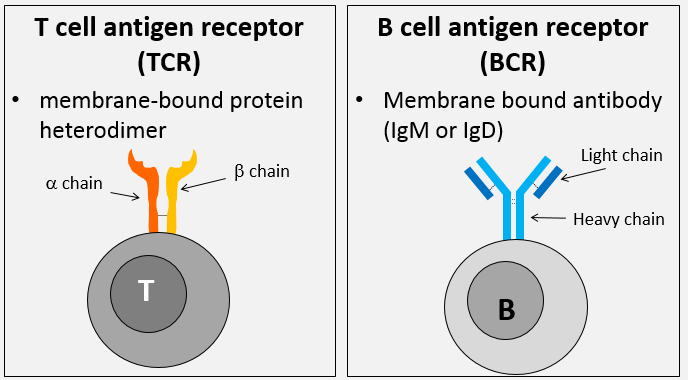
- 53Each heavy and light chain region on a B cell has a variable and constant region. What are the 5 different antibodies and their heavy chains.• IgM : m heavy chain
• IgG: g heavy chain
• IgA : a heavy chain
• IgE : e heavy chain
• IgD : d heavy chain - 54Where are Mature Dendritic cells, pathogens, antigens and debris trapped?2nd Lymphoid Tissues
- 55How do T and B cells enter 2nd Lymphoid tissues?Trans endothelial migration
- 56What are the two signals that B Cells require to be activated?BCR + Antigen
T cell help - 57T cells can only recognise antigens presented by __________?MHC proteins/HLAs
- 58What are the two classes of MHC and where are they expressed?MHC class I - expressed on ALL nucleated cells. Present peptide antigens to cytotoxic T cells.
MHC class II - Expressed only on professional Antigen Presenting Cells. Present peptide antigen to helper T cells - 59CD8+ and CD4+ are proteins expressed to what cells respectively?CD8 goes with T cytotoxic cells to form CD8+ T cells.
CD4 goes with T helper cells to form CD4+ T Cells. - 60What can active B cells differentiate into?Plasma Cells (effector B cells)
- 61What is IgG? How abundant is it? What can it do?IgG is the most abundant antibody in Plasma.
It can actively transport across the placenta.
It has 4 subtypes: IgG1-4 - 62What is IgA? How abundant is it? What can it do?2nd most abundant Ig type
Monomeric form – blood
Dimeric – breast milk, saliva, tears, mucosal secretions - 63What is IgD? How abundant is it? What can it do?It has extremely low levels in blood.
Unknown function.
Is surface bound. - 64What is IgE? How abundant is it? What can it do?Extremely low levels normally
Produced in response to parasitic infection and allergic responses - 65What is IgM? How abundant is it? What can it do?Surface bound monomer = BCR
1st Ig type produced during an immune response (present only in plasma/secretion) - 66How do antibodies activate the complement pathway?Through C+C2+C4, which activates when it comes into contact with stable forms of IgM.
- 67How do phagocytes bind to opsonised pathogens?Phagocytes express Fc receptors that bind to the constant region of Igs.
- 68What are memory cells and when are they produced?Memory cells (Memory Th/Tc/B) are generated during the initial response to an antigen.
They are small long lived cells that are primed and ready to respond to the same antigen.
Información
- Descripción
- Fichas sobre Medicince Priniciples - Immunology, creado por Kyla Michie el 28/10/2017.
- Creado por
- Kyla Michie
- Visitas
- 33
- Etiquetas
- Valoración