
11281967
Descripción

Creado por Veton Vishka2

|
Creado por Veton Vishka2
hace casi 9 años
|
|
| Pregunta | Respuesta |
| trait | -A trait is any readily-identifiable, stable quality that characterises an individual from other individuals |
| traits serve 3 main functions | -To summarise -predict -and explain a person’s conduct |
| predominant assumptions of trait approaches : 1 | permanence over time: Our personality traits remains relatively stable over time. |
| 2: | Permanence across situations Our personality traits remain relatively stable over situations. |
| 3: | Behaviour altering: Personality influences behaviour |
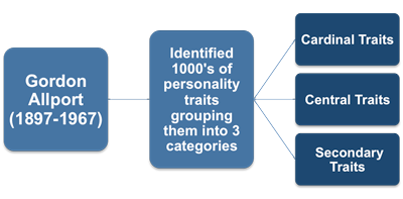
| allports trait theory | |
| Gordon Allport: Lexical Hypothesis | Cardinal Traits: life-revolving, dominant trait. (high breadth, low situational variance) Central Traits: qualities which characterise daily interactions. Secondary Traits: traits exhibited under certain situations. (low breadth, high variance) |
| allports values scale | Allport & Odbert (1936) searched the dictionary and identified 18,000 words, of which 4,500 were separate personality traits. e.g. show-off show-boat sociable outgoing |
| Evaluating Allport: 1 | -Major contribution: first to discuss the limitations of trait approaches. i.e. personality has a limited impact on behaviour in certain situations, so cannot be used to always predict behaviour. |
| 2 | -No standardised measure developed - the 4500 words described could never be used to describe personality adequately. |
| cattells theory: factor analysis | -Utilised a ‘new’ (at the time) approach known as factor analysis to come up with his theory -Factor Analysis: statistical technique for the reduction of data. -Factor analysis attempts to look for simple patterns within all of allports 4500 traits, e.g. how many of the 4500 are actually looking at the same trait. |
| continued | -Cattell realised that a number of the personality traits described by Allport were the same, meaning that the 45500 words found could be reduced using factor analysis -Came up with 16 personality factors |
| testing | -Cattell made a distinction between source and surface traits. -Surface traits are very obvious and can be easily identified by other people - whereas source traits are less visible to other people and appear to underlie several different aspects of behavior. -Cattell regarded source traits are more important in describing personality than surface traits. |
| evaluation 1: | Developed a comprehensive, empirically-based trait theory of personality. Therefore acknowledged the complexity of the personality construct. |
| 2 | Cattell used maths to show that personality could influence behaviour. E.g. those factors highest up the list most important determinants of behaviour. |
| 3 | his 16fp test has been widely used |
| eysenck giant 3 model | -Also known as the ‘PEN’ model – one of the most influential theories of personality ever -Developed using a combination of factor analytic and empirical approaches. -Is a hierarchical model, with three levels. |
| 3 supertraits | -Neuroticism (Unstable, anxious, easily upset) -psychoticism (Impersonal, unsocialised, cruel) -extraversion (Outgoing, sociable, energetic) |
| extraversion | -Extraversion characterises people based on their orientation toward external sources of stimulation from the environment versus an orientation inward at the opposite extreme |
| psycoticism | -includes a disposition toward psychosis and a degree of sociopathy |
| Neuroticism | -Neuroticism is basically a measure of emotional stability-instability. |
| distribution | -Extraversion and neuroticism – these are normally distributed (most people fit in the middle). -psychoticism has a positive skew |
| evaluation | -Research shows differences between extraverts and introverts. -Neuroticism related to behaviour and mental health. -There is also some biological evidence for neuroticism and extraversion. -Evidence for psychoticism is less clear |
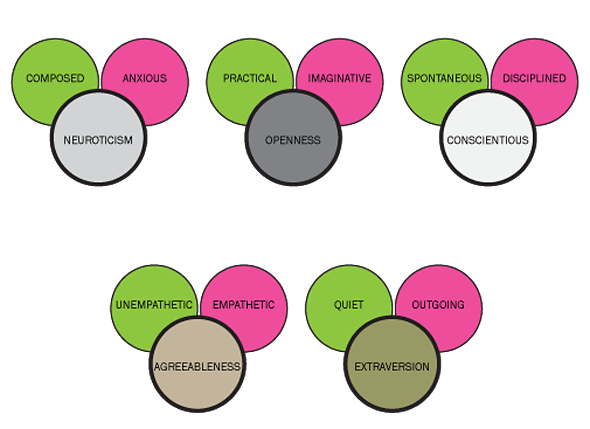
| the five factor model costa and mcrae | |
| continued | -Becoming increasingly accepted that five traits best describe personality structure. -However, debate as to what the five ‘supertraits’ are. |
| Lexical Approach & Support for the FFM | -1st came Allport’s 4500 trait names, &from this, Cattell produced his 16PF. -Fiske (1949) re-analysed the same data, -and reported five factors. |
| History of the FFM | -Tupes and Crystal (1961) were researchers on a USA airforce base -Had officer cadets complete personality questionnaire based on 16PF. -However, found 5 rather than 16 factors which were stable over 8 different samples. -Warren Norman – a friend of T&C – gave his students personality questionnaires, and also found 5 factors. |
| Goldberg’s Big Five Model | -Used lexical and factor analysis to develop the Big Five Model (BFM) -Lexical analysis: asked people (and others) to describe themselves. -Factor analysis: self- and peer-reports. Came up with a descriptive (phenotypic) and hierarchical model. |
| Goldberg’s Five Dimensions: | -Extraversion/introversion -Friendliness/hostility -Conscientiousness -Neuroticism/emotional stability -Intellect |
| The Five Factor Model(Costa & McRae) | The five factors are: -Openness; -conscientiousness; -extraversion; -agreeableness; -neuroticism. -Each factor lies on a continuum along which individuals are placed. |
| info | -There are six facets to each of the five factors. Therefore gives a causal, rather than descriptive, explanation. -Similar to the description put forward by Eysenck. |
| Evaluating the ‘Big 5' | -Generally accepted to be 5 factors, but what these factors actually are is disagreed. -Indeed, researchers have called for the approach to be falsified. -How should the factors be described (i.e. titled)? E.g. agreeableness conformity, likeability. -Some uncertainty what each of the factors actually do/look it. -Is data-driven (exploratory factor analysis), meaning it is not based in theory. |
¿Quieres crear tus propias Fichas gratiscon GoConqr? Más información.