
Fichas
GCSE AQA Physics - Unit 3
Fichas del conjunto (72)
- 1Fill in the missing words: X-rays form part of the ________________ _____________. They have _____ wavelengths and can cause _____________.Electromagnetic Spectrum
Short
Ionisation - 2Is an X-ray a transverse wave or a longitudinal wave?Transverse wave
- 3What are the advantages of X-Rays?X-Rays are transmitted by healthy tissue.
X-Rays are absorbed by metal and bone to produce shadow pictures. - 4What can X-rays be detected with to form an image electronically?Charge-Coupled devices
- 5Ultrasounds are sound waves of frequencies greater than...20 000Hz.
- 6Is an ultrasound wave a transverse wave or a longitudinal wave?Longitudinal wave
- 7Give some examples of the use of Ultrasound in medicine.- Pre-natal scanning.
- Imaging of damaged ligaments and muscles.
- Imaging of kidneys and destruction of kidney stones. - 8What is reflection?When light changes direction as it hits a surface.
- 9What is refraction?When light crosses an interface (a boundary between two transparent media of different densities) and it changes direction.
- 10What is the refractive index?The degree to which a material slows the speed of light.
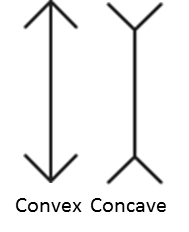
- 11What are the two main types of lenses, and what are their features?Converging Lens (convex lens) - Thickest at the centre.
Diverging Lens (concave lens) - Thinnest in the centre. - 12Fill in the missing words: A light ray that enters a lens at its centre is ______________. This is called the ____________ ______ of the lens.Undeviated
Principal Axis - 13What is the focal length (f)?The distance between the centre of the lens and the focus (real or virtual)
- 14The image produced by a convex lens is...- Real (on the other side of the lens)
- Inverted
- Smaller (for distant objects) or Magnified (for closer objects) - 15The image produced by a concave lens is...- Virtual (on the same side as he object)
- Upright (not inverted) - 16How can you work out the magnification of a lens?Magnification = Image Height / Object Height
- 17Fill in the missing gaps: For a given focal length, the greater the refractive index, the _________ the lens (i.e. _________).Flatter
Thinner - 18The Eye - Fill in the missing gaps - Part 1: The ________ refracts most of the light whilst the _______ (opening in the ______) adjusts the light intensity.Cornea
Pupil
Iris - 19The Eye - Fill in the missing gaps - Part 2: The _____ provides further refraction before the image is formed on the light-sensitive ________. The _______ _______ carries this information to the brain.Lens
Retina
Optic Nerve - 20What muscles control the shape of the eye lens?Ciliary Muscles
- 21Label this picture of an eye:
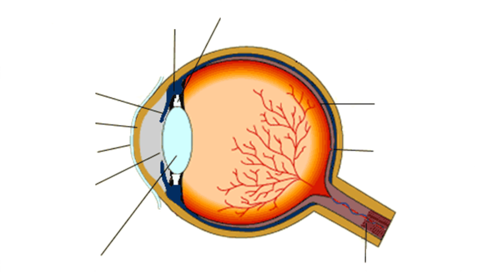
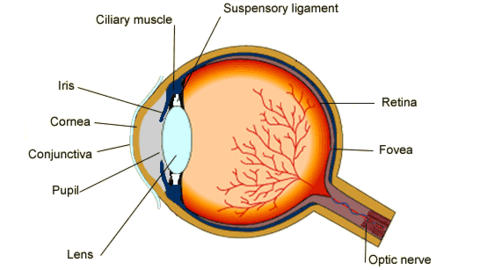
- 22What are the two types of defective vision, and what are they caused by?Long sight - caused by the eyeball being too short and unable to focus on near objects.
Short sight - caused by the eyeball being too long and unable to focus on distant objects. - 23In a magnifying glass, the image is...virtual, upright and enlarged.
- 24Fill in the missing gaps: As ultrasonic waves pass from one ________ or ___________ into another, they are __________ ___________ at the ___________.Medium
Substance
Partially Reflected
Boundary - 25What are the two special cases involving the refraction of light?1. The angle of refraction is equal to 90°, the light ray travels on the boundary between between glass and air. The angle of incidence is then called the critical angle (c).
2. The angle of incidence is greater than the critical angle. In this case total internal reflection takes place. No refraction occurs so no light escapes from the glass. - 26What is a laser (apart from a really cool thing that shoots aliens)?A device that amplifies light to produce a very intense and very narrow beam.
- 27When are lasers used in eye surgery?- To repair damaged retinas
- To remove diseased or damaged cells by cutting, cauterising or burning the tissue. - 28What is the centre of mass (C of M) of an object?The point through which the whole mass of the object is considered to act. It can be thought of as the point where all the mass is concentrated.
- 29What is the frequency of oscillation?The number of times the mass of a pendulum swings back and forth every second.
- 30What is a moment?The turning effect of a force around a fixed point called a pivot.
- 31What two things can you do to increase the size of the moment?- Increase the value of the force.
- Increase the perpendicular distance. - 32What is a lever?A device that acts like a force multiplier or a distance multiplier.
- 33Give two examples of the application of levers:- Lifting a wheelbarrow.
- Opening a tin of paint with a screwdriver. - 34When an object isn't turning, there must be a balance between...The total moments of the forces turning the object in a clockwise and anticlockwise direction.
- 35What is the last answer known as?The law of moments.
- 36Why would an object topple over?If the line of action of the force (e.g. its weight) lies outside its base.
The weight of the object causes a turning effect, which makes the object topple. - 37What is pressure?The force that acts over a particular surface area.
- 38Fill in the missing gaps: Liquids are virtually ________________, and the ____________ in a liquid is transmitted ___________ in all directions.Incompressible
Pressure
Equally - 39The pressure in a liquid can be used to work machinery and is known as...hydraulics.
- 40Fill in the missing words: Any object moving with a constant speed in a _________ path is ______________ _____________ towards the centre of the circle.Circular
Continuously accelerating - 41What is the centripetal force?The force that acts on a body moving in a circular path and is directed towards the centre which the body is moving.
- 42An increased radius will __crease the centripetal force. An increased mass/velocity will __crease the centripetal force.De(crease)
In(crease) - 43What provides the centripetal force when a car goes round a bend?The tyres
- 44Fill in the missing gaps; when a current flows through a wire a ___________ _______ is produced around the wire.Magnetic field
- 45What is the right-hand rule.
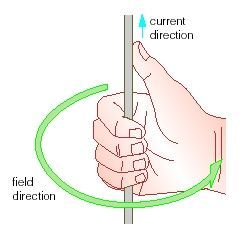
- 46What is the motor effect?The force a current-carrying wire experiences when placed in a magnetic field.
- 47What is Fleming's Left-hand Rule used to identify?The direction of the force (from the motor effect).
- 48Fleming's Left-hand Rule: The first finger points in the direction of the ____________ _______. The second finger points in the direction of the ____________. The thumb points in the direction of the _____________.Magnetic Field
Current
Movement - 49Put your hand in Fleming's left-hand Rule position.It should look like this...
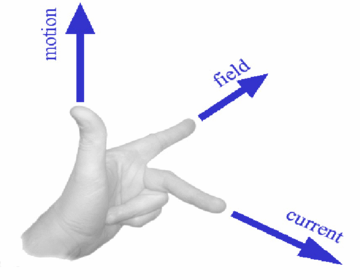
- 50Fill in the missing gaps: Electromagnetic induction uses ___________ to produce a __________.Movement
Current - 51What happens if a conducting wire, or coil of wires is moved though or 'cuts' through a magnetic field?A potential difference (p.d.) is induced across the ends of the wire.
- 52What would happen then if the coil of wire formed part of a complete circuit?An electrical current would be induced.
- 53Induced currents are used in a bicycle...dynamo.
- 54How can the size of the potential difference (p.d.), and hence the current, be increased?- Increasing the speed of the movement of the magnet or coils.
- Increasing the strength of the magnetic field.
- Increasing the number of turns on the coil. - 55What do transformers do?A transformer changes electrical energy from one potential difference to another potential difference.
- 56What are transformers made up of?Two coils, called the primary and secondary coils, wrapped around a soft iron core.
- 57How does an alternating current flowing through the primary coil of the transformer create an alternating current in the secondary coil?The alternating current creates a changing/alternating magnetic field in the iron core, causing a potential difference to be induced in/across secondary coil.
- 58The potential difference across the primary and secondary coils of a transformer are related by the equation...Vp/Vs = Np/Ns
Vp = Potential difference across the primary coil in Volts.
Vs = Potential difference across the secondary coil in Volts.
Np = Number of turns on the primary coil.
Ns = Number of turns on the secondary coil. - 59A step-up transformer has ____ turns in the secondary coil than the primary coil. The potential difference across the secondary coil is ________ than that across the primary coil.More
Greater - 60A step-down transformer has _____ turns in the secondary coil than the primary coil. The potential difference across the secondary coil is ________ than that across the primary coil.Fewer
Less - 61Switch mode transformers are much _________ and __________ than traditional transformers and operate at a much ________ frequency, often between __kHz and ___kHz.Lighter (and) smaller
Higher
50(kHz and) 200(kHz) - 62Give some examples of the application of switch mode transformers...Mobile Phones
Digital Cameras
Laptops
- 63What is 1 second in 'µs' (Used for ultrasound calculations)1 second = 1 000 000 µs
- 64Why do x-rays provide a better quality of image than ultrasound?They have a shorter wavelength.
- 65What is the power of a lens measured in?Dioptres (D)
- 66What is the focal length measured in?metres
- 67For a lens, the greater the refractive index...the flatter it can be.
- 68What is the shape of the eye lens like when focusing on near objects?Fat, more curved
- 69What is the shape of the eye lens like when focusing on distant objects?Thin, less curved
- 70What are the three factors affecting the centripetal force?The mass of the object
The speed of the object
The radius of the circle in which it is travelling - 71How can you increase the centripetal force?Increase the:
Mass,
Speed
OR
Radius of circle in which it is travelling. - 72What is pressure measured in?Pascals (Pa)
Información
- Descripción
- Get ready for the final chapter in the epic GCSE AQA Physics trilogy. The Sun has hit its White Dwarf stage, Lord Nova has won. Now Dr.Physics must bring his band back together for one final battle to save Physika! Friendship dies and true love lies, night will fall and the dark will rise, as a good physicist goes to war...
- Creado por
- James Jolliffe · mar 2015
- Actualizado
- 25 nov 2018
- Visitas
- 2.596
- Etiquetas
- Valoración