
Fichas
All F322 OCR definitions!
Fichas del conjunto (62)
- 1Molecular FormulaThe actual number of atoms of each element in a molecule, with any functional groups indicated.
- 2Empirical FormulaSimplest whole number ratio of atoms of each element in a compound.
- 3Homologous SeriesCompounds that have the same functional group and general formula
- 4Functional GroupA group of atoms responsible for the particular characteristics of the reaction of a compound.
- 5Chain IsomersA regular isomer - similar chemical properties, different physical properties
- 6Positional IsomersFunctional group attached to a different carbon atom - different physical properties, possible different chemical properties.
- 7Functional Group IsomersArranged into different functional groups - Very different physical and chemical properties
- 8StereoisomersSame structural formula, different arrangement in space
- 9E/Z IsomerismWhen a double bonded carbon has two different atoms or groups bonded to it, e.g. H and CH3
- 10Cis/Trans IsomerismSame as E/Z, but cannot be used if there are more than two different groups bonded to the carbon atoms (other than hydrogen)
- 11Atom EconomyMolecular mass of desired product/sum of molecular masses of all products x100
- 12Percentage YieldActual Yield/Theoretical Yield x100
- 13SaturatedNo double bonds
- 14HydrocarbonsMolecule made up of hydrogen and carbon ONLY
- 15UnsaturatedContains double bonds
- 16Complete CombustionForms carbon dioxide and water
- 17Incomplete CombustionForms carbon monoxide and water
- 18Fractional DistillationCracking of large hydrocarbons into smaller fractions that are more useful.
- 19Efficient CombustionUse shorter branched chains to avoid knocking in engines and make combustion more efficient.
- 20IsomerisationHeating straight chain alkanes witha catalyst whilst they are stuck on AlO - Alkanes will join back together as shorter chained, branched isomers
- 21ReformingConverting alkanes into cyclic hydrocarbons using a catalyst made of platinum.
- 22Fossil FuelsFinite resources including coal, oil and natural gas that produce greenhouse gases that are usually harmful.
- 23BioethanolMade from the fermentation of sugar from crops such as maize. It is said to be carbon neutral, but the actual production process and making of the equipment will change that.
- 24BiodieselMade from renewable fats and oils, can be carbon neutral but is also cancelled out by the production of the machinery.
- 25Heterolytic FissionTwo different substances are formed - a positive cation and a negative anion
- 26Homolytic FissionWhen two radicals are formed from two non radicals.
- 27RadicalA particle with an unpaired electron. Very reactive.
- 28InitiationFree radicals are produced
- 29PropagationFree radicals are used up and created in a chain reaction.
- 30TerminationFree radicals are joined together which cancels them out as they form full molecules
- 31Free Radical SubstitutionHydrogen atom is substituted by a radical Cl or Br.
- 32AlkeneUnsaturated hydrocarbon
- 33Addition ReactionWhere two molecules combine to form one bigger molecule
- 34Substitution ReactionWhen one functional group of a compound is replaced by another.
- 35Sigma BondWhen two s orbitals overlap, giving the highest possible electron density between the two nuclei. Single covalent bond.
- 36Pi BondWhen two p orbitals overlap, forming one bond above and one below.
- 37Double BondCannot rotate, which causes E/Z isomerism.
- 38Addition PolymersWhen alkenes have joined together at the double bonds to make long chain polymers.
- 39Advantages of PolymersVery unreactive.
Some can be biodegradable.
Can be used as a heat source for electricity.
Can be recycled. - 40Disadvantages of PolymersToo unreactive - most aren't biodegradable.
Often buried in landfill.
Burning often produces toxic gases that have to be neutralized before being released. - 41Electrophilic Addition ReactionDouble bonds are opened up and atoms are added to the carbons.
- 42ElectrophileElectron pair acceptor - attracted to areas where there are lots of electrons
- 43NucleophilicAttracted to places with low electron density.
- 44Hydrogen + Alkene (Hydrogenation)Makes an alkane.
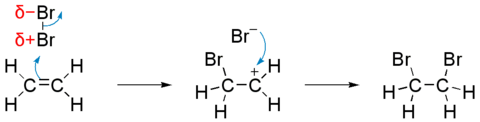
Needs a nickel catalyst and 150 degrees. - 45Alkene + Bromine (Bromination/electrophilic addition)Shake with bromine, orange to colourless colour change.
Also done with chlorine and iodine. - 46Alkenes + HBr (Electrophilic Addition)If the alkene is unsymmetrical two isomers are formed.
Heterolytic fission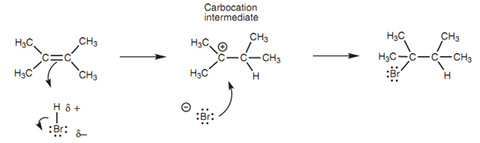
- 47Ethanol ManufactureSteam hydration - ethane is hydrated by steam at 300 degrees with a solid acid catalyst.
Fermentation - Yeast in anaerobic conditions with glucose. Needs purification. - 48Primary AlcoholOH is attached onto a carbon with 1 carbon attached to that.
- 49Secondary AlcoholOH is attached to a carbon with two carbons attached.
- 50Tertiary AlcoholOH is attached to carbon with 3 carbons attached.
- 51Alcohol and WaterAlcohol is soluble in water as the OH allows it to form hydrogen bonds between itself and the water.
As an alcohol increases in size, the ability to mix with water decreases.
Hydrogen bonding gives high boiling points as they are strong and hard to break. - 52Alcohol UsesEthanol - Alcoholic drinks.
Methylated spirits - Industrial solvent.
Ethanol - Fuel.
Unleaded petrol - Contains methanol.
Methanol is used as a feedstock for organic chemical synthesis. - 53Dehydration ReactionsEliminate water to form alkenes.
Acid catalyst and 170 degrees. - 54EsterificationAlcohol added to a carboxylic acid makes an ester.
Strong acid catalyst required. - 55Simple Alcohol OxidationBurn them in a combustion reaction.
Forms CO2 and H20. - 56Primary Alcohol OxidationAlcohol - Aldehyde - Carboxylic Acid.
Use Potassium Dichromate.
Orange to green colour change. - 57Secondary Alcohol OxidationAlcohol - Ketone.
Use Potassium Dichromate.
Orange to green colour change.
Reflux. - 58Tertiary Alcohol OxidationDo not react with potassium dichromate.
No colour change.
Can only oxidise via combustion. - 59CFC'sStable, volatile, non-flammable and non toxic.
- 60Hydrolysis (Halogenoalkanes)Use warm NaOH or KOH and reflux it.
C-Br bond breaks heterolytically.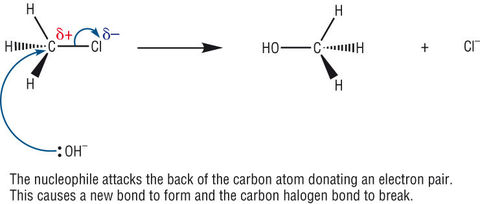
- 61Hydrolysis Speed of HalogenoalkanesHydrolysis speed is based on carbon-halogen bond strength.
The further down the group you go, the faster they hydrolyse. - 62Silver Nitrate Halide TestAdd sliver nitrate to the mixture, and the silver ions will react with the halide ions.
Use a black cross drawn under a flask containing the mixture to measure rate of reaction.
Información
- Descripción
- Fichas sobre All F322 OCR definitions!, creado por Becky Emmerson el 01/06/2015.
- Creado por
- Becky Emmerson
- Visitas
- 23
- Etiquetas
- Valoración