
Fichas
Exam 3
Fichas del conjunto (69)
- 1What is the purpose of myoglobin vs hemoglobin?Myoglobin: monomeric, stores oxygen in muscles
Hemoglobin: heterotetrameric, transports oxygen, found in red blood cells - 2What does heterotetrameric mean (what is hemoglobin's strcutre?)4 subunits (tetra), 2 alpha and 2 beta subunits (hetero). Also called "dimer of dimers"
- 3What is a dimer?molecular complex consisting of 2 identical molecules linked together
- 4What is myoglobins structure?monomeric (1 subunit), all alpha helices
- 5What happens to the structure of hemoglobin when oxygen binds?moves from T state to R state = center of hemoglobin collapses in
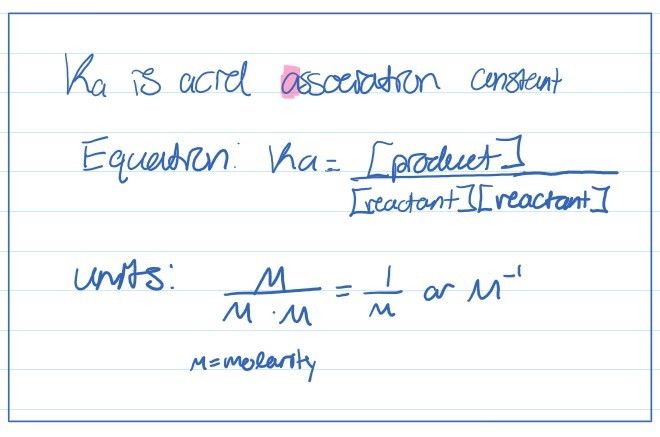
- 6What is Ka? Equation? Units?
- 7Why don't we utilize Ka?using 1/M is not useful, doesn't really mean anything
- 8What do we use instead of Ka and why?
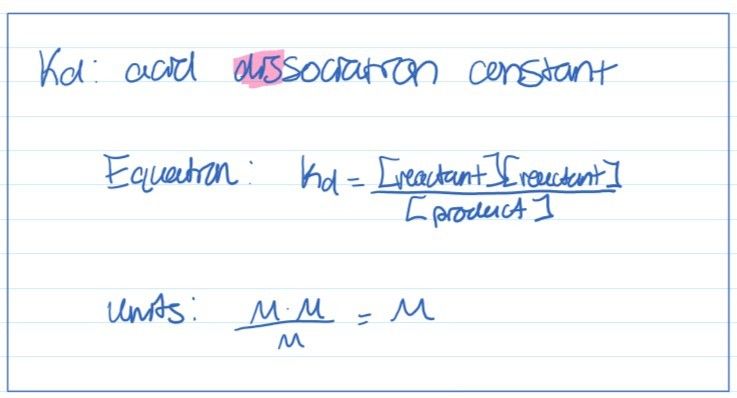
- 9What is the conceptual meaning of the value of Kd?The value of Kd is the concentration of the ligand that results in 50% saturation of the protein.
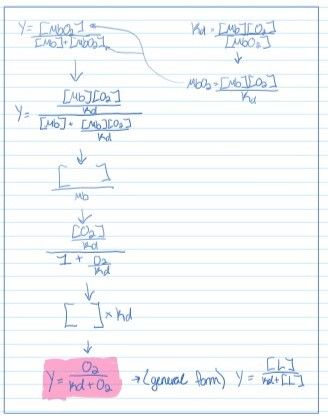
- 10What is the equation for fraction bound?
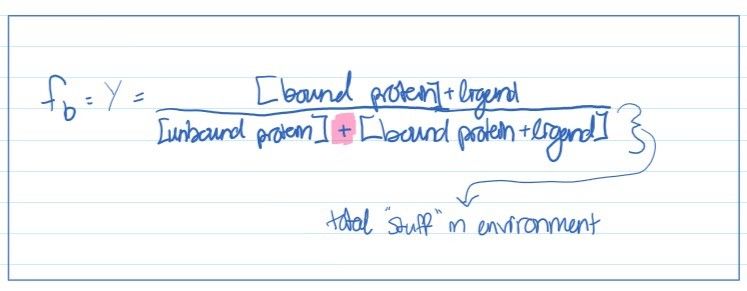
- 11What is the fraction bound equation for myoglobin?
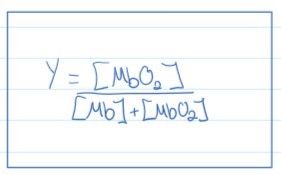
- 12Know how to convert the Mb fraction bound equation into the one that lets us understand the comceptual meaning of Kd
- 13What does a saturation curve look like?
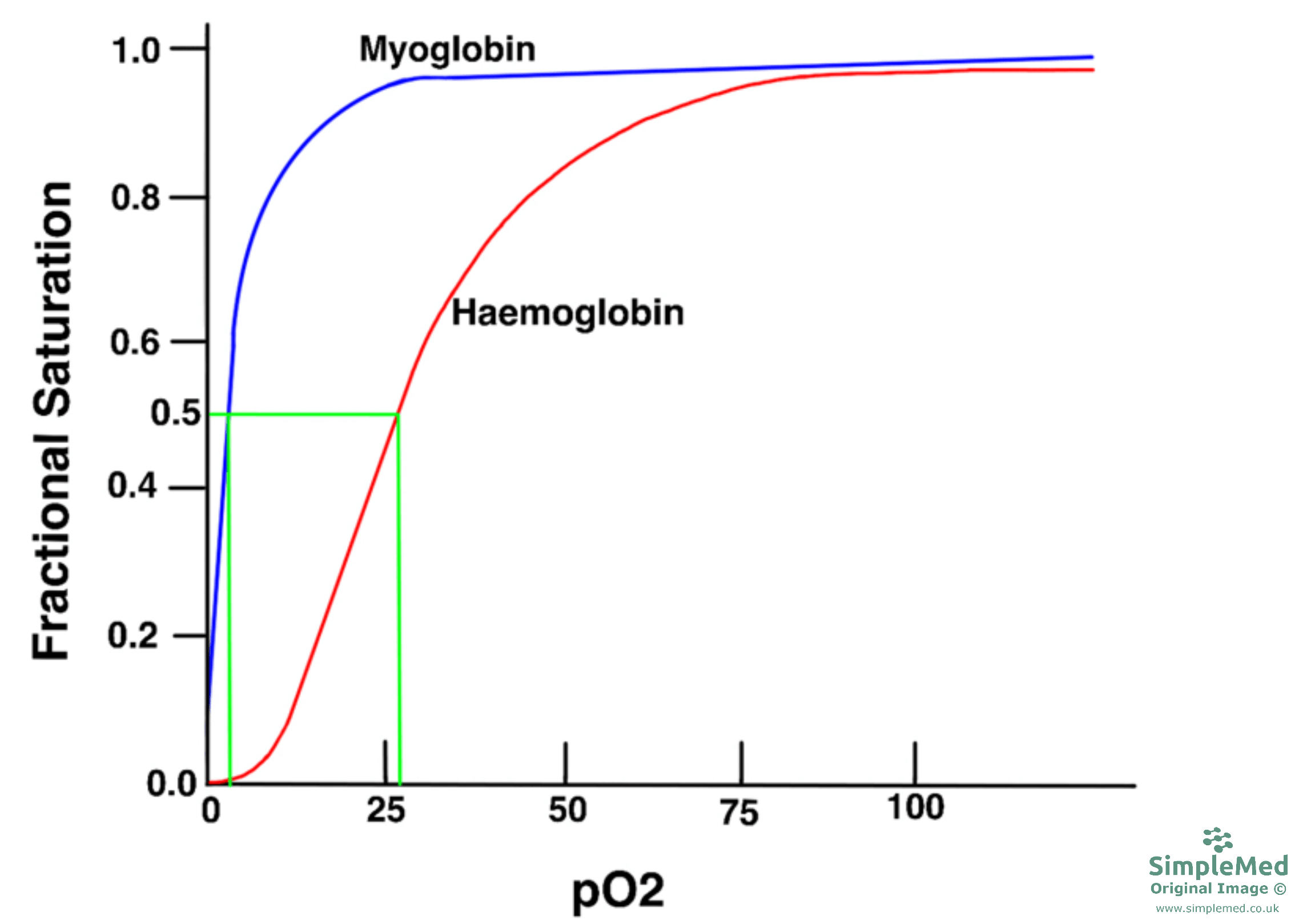
- 14What does a steeper saturation curve mean?higher bond affinity: Kd (50% saturation) is reached at a much lower concentration (ligand and protein really want to bind)
Low Kd = High affinity - 15Write the equilibrium equation for myoglobinMb + O2 <---> MbO2
- 16What are the equilibrium conditions needed for that equilibrium equation?Very low [Mb] and very high [O2]
- 17What does the saturation curve of myoglobin and hemoglobin tell you about their affinities to oxygen? How is this functional in the body?Myoglobin has a much steeper curve, meaning it holds onto oxygen better. This works in the body because Mb only releases oxygen into tissues in extreme conditions, while Hb is able to let go of oxygen more easily in the blood stream
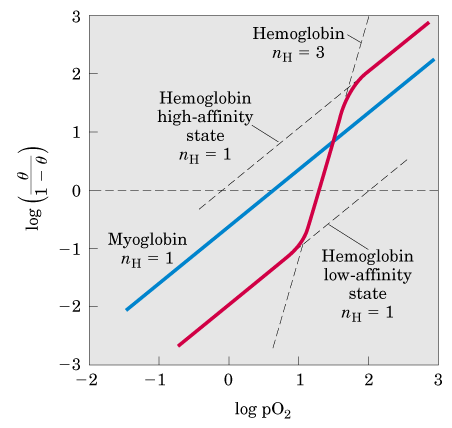
- 18What is an important factor of a hill plot? What does it tell us?The nH value (slope). Lines on a hill plot tell us the cooperativity, nH, of a protein's ligand binding.
- 19How do we tell where Kd of a binding state is on a hill plot?where the protein's line passes the 0 on the y axis
- 20What is the equation for Fraction bound over fraction unbound?Y = [L]^n /Kd -- (take log to find n) -->
log fb/funb = nlog[L] - logKd - 21What is infinite cooperation? What would the value of nH be for Hb if binding was infinite?if a protein and ligand bound to full saturation with no intermediates in between. nH would be 4 for infinite binding in Hemoglobin
- 22understand how to read a hill plot for hemoglobin and myoglobin
- 23What are the 4 conformational changes that occur in hemoglobin when binding O2?1. iron atom shifts into the plane of the porphyrin ring
2. porphyrin ring becomes linear
3. F8-His moves closer to polyporphyrin ring
4. F8-helix shifts over plane of porphyrin ring (makes residues at alpha-Beta interfere) - 24Why is there only 2 states available for hemoglobin? What is this effect called?There are only 2 options available for the beta and alpha subunit bonding. This is called the cogwheel effect because the steric hinderance of the subunits only allow for certain interactions to form.
- 25What is the Bohr effect? How does it effect hemoglobins affinity for O2?A decreased association of Hb with O2 in environments with low pH. This is because the T state of Hb favors H+ and CO2, so environments of high H+ (acidic) will release oxygen to take up CO2 and H+.
- 26How is the structure of Hb affected by the Bohr effect?Protonation of T state termini strengthens stability of T state
- 27What type of saturation curves do hemoglobin and myglobin have?Hemoglobin = sigmoidal
Myoglobin = hyperbolic - 28Mb and Hb oxygen binding is a homotropic system - what does that meanOxygen is the ligand for these proteins AND the things that changes their shapes (modulator)
- 29What does His-F8 do in a protoporphyrin?coordinates the oxygen (stabilzes)
- 30How does BPG bind? What does it do? Why is it important?Heterotropic allosteric binding (binds to and stabilizes T state)
Reduces hemoglobin affinity for O2
Regulates level of affinity (fetuses = low BPG, high altitudes = High BPG) - 31Q7: What are 4 qualities of enzymes?-efficient (fast), some are proficient (mastery)
- Highly specific (geometry and stereochemistry)
- Catalyze complex mechanisms
- Can be regulated - 32What is a rate constant?The proportionality of a chemical reaction to the concentration of the reactants
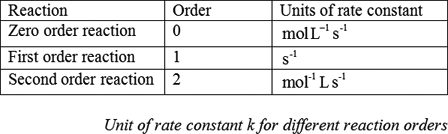
- 33List the units of the rate constants
- 34What is the speed of reactions without catalysts?slow as hell
- 35What are cofactors?a non-protein structure bound to an enzyme that is necessary for catalysis
- 36What are the two types of cofactors?metal ions and organic molecules (coenzymes)
- 37What are coenzymes?organic molecules that recruit substrate to the enzyme (carriers), loosely bound to enzyme. ex. vitamins, biotin, coenzyme A
- 38What is a class 1 enzyme?Oxidoreductases: transfer electrons
- 39What is a class 2 enzyme?Transferases: transfers functional groups
- 40What is a class 3 enzyme?Hydrolases: catalyze hydrolysis of bonds using water
- 41What are class 4 enzymes?Lyases: catalyzes breaking of C-C, C-N, and C-O bonds without using water (uses elimination, which leaves double bonds and rings)
- 42What is a class 5 enzyme?Isomerases: change stereochemistry
- 43What is a class 6 enzyme?Ligases: Forms new bonds by condensation coupled to ATP cleavage
- 44What is a class 7 enzyme?Translocases: moves molecules/ ions across membranes
- 45What are the 4 mechanisms of enzymes?Covalent catalysis, metal ion catalysis, entropy driven, acid-base
- 46What does acid-base catalysis do?transfers a proton
- 47What is the difference between specific and general acid/base catalysis?specific: enzymes only use the OH- and H3O- in water
general: use weak acids and bases - 48what is covalent catalysis?covalent bond forms between enzyme and substrate, usually activates the substrate in some way
- 49What is metal ion catalysis?Metal ion stabilizes/ orients substrate, weak bonding
- 50Do enzymes bind substrates tightly?NO, they bind the altered form tightly
- 51Know how to read an enzyme catalysis chart
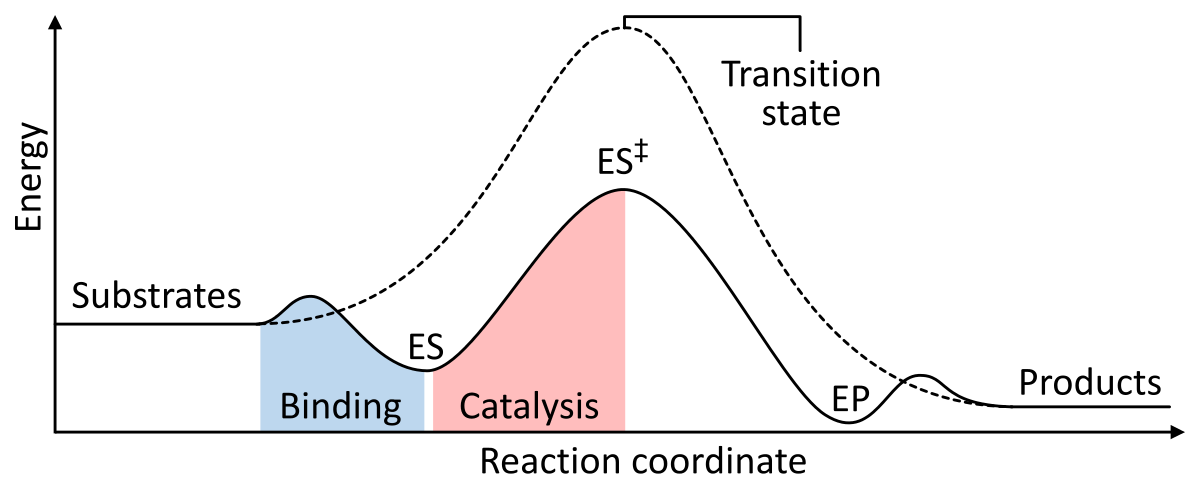
- 52What is the energy between transition state and ES t+?Delta G transition
- 53What is the energy between the ES ground state and substrate energy?Delta G ground state
- 54What does a large delta G transition mean?higher affinity for the transition state
- 55What is the rate law for first order reactions? SecondR = k(obs)[A]
R = k(obs)[A][B] - 56What is the half-life of a first order reaction? Second?t1/2 = ln2/k(obs)
t1/2 = 1/k(obs)[A] - 57What is the steady state equation?v = kcat[Etotal][S]/ Km + [S]
Kcat = k2
ALSO: v = k2 [E][S] / (k2+k-1 /k1) + [S] - 58What is the equilibrium equation?v = vmax[S]/ Kd + [S]
- 59What is the michaelis-menten equation?v = vmax[S]/ Km + [S]
- 60What is the michaelis-menten constant?substrate concentration at which at half the maximum velocity can be reached
- 61what is Kcat?catalytic turnover; the max amount of substrate that can be converted per unit time by one enzyme. Upper limit for 1st order processes (ES -> E+S)
Kcat = vmax/ [Etotal] - 62What is kcat/Kmcatalytic efficiency: ratio showing how effective an enzyme is on a particular substrate. Lower limit for 2nd order binding to occur
Also measures specificity - 63what is the general equation catalytic efficiency?Kcat/Km -> (Kcat/Km)[E][S]
- 64What is catalytic efficiency for steady state?K2 = K-1
Kcat/Km = K1 - 65What is catalytic efficiency for equillibrium?k-1>>>k2
Kcat/Km = k1 * k2/ k-1 - 66what is rate enhancement?Factor by which reaction goes faster
Kcat/Kuncat - 67How do competitive inhibitors affect ES?increases Km (need more L to outcompete)
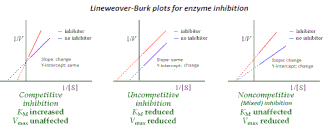
- 68How do uncompetitive inhibitors affect ES?Both Km and Vmax decrease
- 69How do mixed inhibitors affect ES?can bind ES or E, graph will vary
Información
- Descripción
- Fichas sobre Exam 3, creado por izzy manche el 29/10/2022.
- Creado por
- izzy manche · oct 2022
- Actualizado
- 12 dic 2022
- Visitas
- 5
- Valoración