
Fichas
11.) Syntax 1
Fichas del conjunto (44)
- 1What is syntax?Syntax is the (study of the) structure of sentences.
• I love my linguistics tutorial.
• *My linguistics tutorial love I.
• *Tutorial my I linguistics love. - 2How can we describe what grammar is?1) Syntax
2) A (mental) system
(a native speaker’s tacit knowledge of their language)
3) A book containing grammatical rules
4) An approach (e.g. prescriptive/descriptive; traditional; pedagogical…) - 3name all word classes! synonyms for word classes?Noun, Verb, Adjective, Adverb, Preposition,
Determiner (the, a, an, this, these, my, some)
Conjunctions (and, but, that, if, because..)
Pronouns (I, you, me, myself, it..)
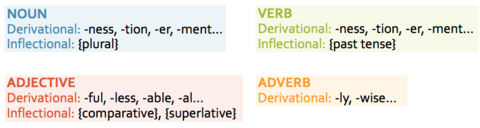
Parts of Speech, Syntactic classes, syntactic categories - 4How do we decide which word class a word belongs to? 3 criteria for classification• Semantic (what does the word mean?)
• Morphological (what does the word look like?)
• Syntactic (how does the word ‘behave’ grammatically in a sentence?) - 5Semantic criteria Problems?What is the meaning of the word?
Problems with classification according to semantic criteria:
What do prepositions denote? What do determiners denote?
• Nouns, pronouns, prepositions etc. can all denote places
(e.g. Madrid, here, in/on…)
How do we then decide which word class the word belongs to? - 6Morphological criteriaWhat morphemes are typical of that word class? How do the words look?
- 7Problems with classification according to morphological criteria:• Could be misleading:
-ly for adverbs? Slowly OK, but friendly?
• One morpheme could productively occur with different word classes:
-er in nouns (worker), verbs (to lower), adjectives (smaller), adverbs (faster)...
• One morpheme might not be compatible with every member of a word class:
-s for plurals for nouns? Trees OK, but *childs? *Foots? *Milks? *Informations? - 8Syntactic criteriaWhere does the word go in a sentence? What words does it occur next to?
• Determiners precede nouns and adjectives (the bottle, a tasty cake...)
• Prepositions occur before noun phrases (on the table, in the classroom...)
• Verbs come after noun phrases (The dog chased the rabbit, the sky is blue...) - 9Problems with classification according to syntactic criteria:Words don’t always occur where you would expect them to occur according to prescriptive rules:
• Stranded prepositions? (What are you looking at? --> doesn’t precede NP)
• Adjectives can follow nouns (I heard something interesting, the people present...) - 10What should we do now?We have criteria to help us categorise words into classes, but there are always problems
--> Criteria are not conclusive (schlüssig) on their own
--> Used jointly, they can allow us to draw conclusions
Even with these criteria, some words are difficult to categorise - 11[The] rain started to pour.Determiner
syntactic criteria (no semantic meaning) - 12Sandra [slowly] opened the door.Adverb
slowly...adverb...morphologica/syntactic/semanticl - 13Was it the cat who [knocked] the glass [on] the floor?Verb:
morphological/semantic (because it describes what we’re doing)
preposition:
syntactic/semantic - 14My aunt [lives] in [Paris.]Verb:
morphological/syntactic/semantic
Noun:
semantic/syntactic (because after preposition) - 15You have to walk [fast], otherwise you will miss [your] bus!Adverb:
.semantic/syntactic
determiner:
.syntactic
if ‘your’ before the noun: determiner
if ‘your’ instead: pronoun - 16What is a phrase?A syntactic unit above the word level, but not a clause
- 17What different kinds of phrases do we have?• Noun phrases (NP) – the computer, a really tall building, London...
• Verb phrases (VP) – survive, win a prize, passed the exam, is afraid...
• Adjectival phrases (AP, sometimes AdjP) – green, very fast, absolutely great...
• Prepositional phrases (PP) – on the phone, in the garden...
• Adverbial phrases (AdvP) – slowly, sometimes, very rarely, rather often... - 18What is the head of a phrase?• Every phrase has a head
• Most important element
• Element that indicates what is being described - 19The happy child ate the very tasty cake rather quickly.• Noun phrases (the happy child; the very tasty cake)
• Verb phrase (ate the very tasty cake rather quickly)
• Adjectival phrases (happy; very tasty)
• No prepositional phrases
• Adverbial phrases (very; rather quickly) - 20What is a clause?• A syntactic unit above the phrase level
• Every clause contains a predicate (typically a verb) - 21Two types of clause:main clause: can be used independently
-must have a finite verb (i.e. tense must be expressed)
subordinate clause: only in combination with a main clause
-does not need a finite verbs (so it can be finite or non-finite) - 22Examples of main clauses:• My mother went to church.
• Sam’s brother plays football every Saturday.
• The director of studies for the department of social sciences is an extremely intelligent, yet somewhat shy woman with many impressive credentials. - 23Examples of subordinate clauses:• My mother didn’t go to church because she was ill. • Driving to work one day, Wendy had an idea.
• I saw you talking to that guy. - 24A sentence can be...Simple: There is just one (main) clause
Compound: There are two or more main clauses (coordinated with and/or/but, etc.)
Complex: There is a main clause and one or more subordinate clauses - 251) Identify the clauses in the following sentences. How many are there? 2) Is the sentence simple, compound, or complex? If you speak to me like that one more time, I’ll get really angry.• Clauses: 2
If you speak to me like that one more time: subordinate clause
I’ll get really angry: MAIN CLAUSE • Sentence type: Complex - 261) Identify the clauses in the following sentences. How many are there? 2) Is the sentence simple, compound, or complex? I couldn’t think of a better sentence for this task.• Clauses: 1
I couldn’t think of a better sentence for this task: MAIN CLAUSE
• Sentence type: Simple - 271) Identify the clauses in the following sentences. How many are there? 2) Is the sentence simple, compound, or complex? Some people find linguistic analysis easy, but it is more difficult for others.• Clauses: 2
Some people find linguistic analysis easy: MAIN CLAUSE
but it is more difficult for others: MAIN CLAUSE • Sentence type: Compound - 281) Identify the clauses in the following sentences. How many are there? 2) Is the sentence simple, compound, or complex? The woman smiled, rubbing her hands together deviously• Clauses: 2
The woman smiled: subordinate clause
rubbing her hands together deviously: MAIN CLAUSE • Sentence type: Complex - 291) Identify the clauses in the following sentences. How many are there? 2) Is the sentence simple, compound, or complex? The acting chairman of both the board of directors and the electoral committee was a man of great ambition and determination, yet also of arrogance and sometimes recklessness.• Clauses: 1 MAIN CLAUSE
• Sentence type: Simple - 30What are constituents? How can we identify the constituents of a sentence?-> Structural units that can make up a larger unit
->The ‘building blocks’ of language
--> Constituency tests! - 31What constituency tests do you know?• Pronominalisation (Substitution)
• Movement
• Coordination
• Gapping
• Sentence fragments - 32What's a pro-form?
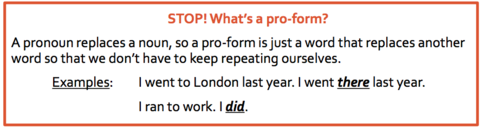
- 33Pronominalisation: eg. [The child] ate the ice-cream.Replace the chunk of language with a pronoun / pro-form.
The child ate the ice-cream. She ate the ice-cream. - 34Movement eg. with childPut the constituent in another position in the sentence.
(This could be using it-clefts, passive voice, etc)
The child ate the ice-cream.
The ice-cream was eaten by the child. It was the child who ate the ice-cream. - 35CoordinationAdd another element of the same type by using coordination (and, or, but, etc)
The child ate the ice-cream.
The child and the adult ate the ice-cream. - 36Gapping eg. with: The child has eaten the ice-cream.Try to leave out the constituent.
(This time we’ll try to test for a different constituent)
The child has eaten the ice-cream.
The child has eaten the ice-cream, hasn’t she? (eaten the ice-cream) - 37Sentence fragment eg. The child ate the ice cream.The constituent can be used on its own to answer a question. (Back to our original example now!)
The child ate the ice-cream.
Who ate the ice-cream? The child. - 38Ordering of elements We tend to order elements in a way within phrases. Noun Phrase?
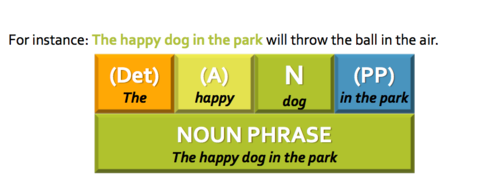
- 39Ordering of elements Verb Phrase?
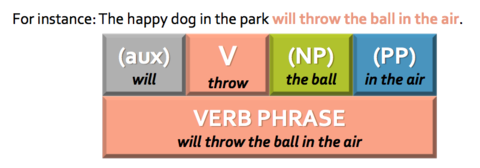
- 40We can put phrases together to make larger phrases. How is that called? example?We call this merging.
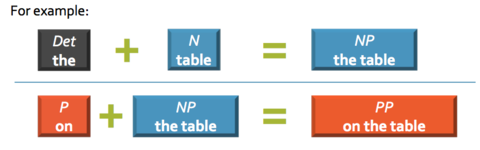
- 41Clause: Robert likes the tree in the garden. how merged?
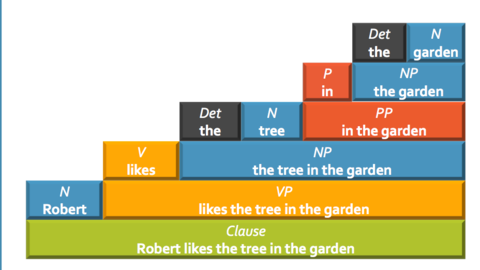
- 42Make a tree diagram for The man drank the water.
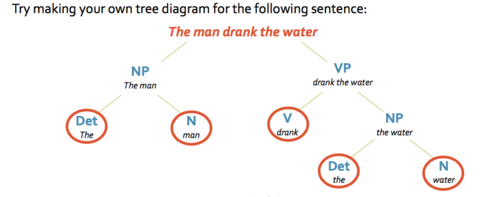
- 43How can we display ambiguity? Example: The Italian food criticWe can use tree diagrams to highlight syntactic ambiguity.
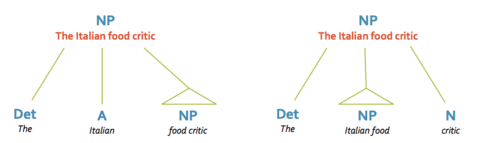
- 44What is recursivity?->Repetition of the same structure
->This leads to embedded construction
For example:
I live in a little house at the end of the road on the top of the hill by the lake in the middle of the forest...
Información
- Descripción
- (Syntax) Linguistics Fichas sobre 11.) Syntax 1, creado por Lisza Neumeier el 03/12/2016.
- Creado por
- Lisza Neumeier
- Visitas
- 27
- Valoración