
Fichas
ocr gcse computing - chapter 4
Fichas del conjunto (44)
- 1What is binary?Binary is a number system that uses just 0's and 1's.
It is used to represent data and instructions.
Modern computers use binary because it is easy to represent two states in simple electronic circuits. - 2What is a bit?One digit in a binary number.
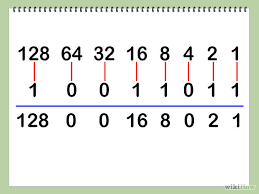
- 3How to convert binary into denary (basic numbers)?Put each digit in the binary number under the columns of the numbers 1, 2, 4, 8, 16, 32, 64, 128.
Add up the numbers that have 1's underneath. - 4What is a byte?One 8-digit binary number.
8 bits = 1 byte - 5How many bytes are in a kilobyte?1 kilobyte = 1024 bytes
- 6How many kilobytes in a megabyte?1 megabyte = 1024 kilobytes
- 7How many megabytes are in a gigabyte?1 gigabyte = 1024 megabytes
- 8How many gigabytes in a terabyte?1 terabyte = 1024 gigabytes
- 9How do you convert denary into binary?Write out the number columns of 1, 2, 4, 8, 16, 32, 64, 128, and write 1 under the numbers that add up to get the denary number. Write 0's on the rest to get the 8 digit number.
If a number is larger than 255, then it will not fit into being an 8-digit binary number, then it is an overflow. - 10How do we add binary numbers?In the same way that we add denary numbers - in column addition while carrying overflow numbers.
- 11How do binary numbers add?1+1 = 0
1+0 = 1
0+0 = 0
1+0+1 = 10
1+1+1 = 11 - 12What is an overflow?What a solution to a binary addition seems to have more than 8 digits.
If a computer only stores 8 bit values, then the last bit will be lost. - 13What are hexadecimal numbers?A way of representing numbers in a computer.
Used as binary numbers can be too long to remember.
Each nibble (4 binary digits) is represented by 1 hexadecimal digit. - 14What are the hexadecimal digits?
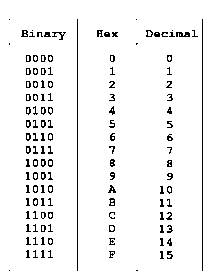
- 15How do you convert hexadecimal numbers to denary?Use the chart.
Or, right down the binary for each hexadecimal number and convert that into denary. - 16How to convert between hexadecimal and binary?convert the binary number into nibbles, and use the chart to write down which hexadecimal number matches which nibble.
- 17What are character sets?The list of codes and matching characters that a computer can recognise.
When a characters, e.g. 'd', is types in, the computer looks up the corresponding code and uses that to register and display the character.
The code is stored in binary. - 18How does ASCII represent data?ASCII uses 7 digits to represent the characters, so has128 characters in total.
- 19How does extended ASCII represent data?Using 8 bits, so has 256 characters in total.
- 20How does unicode represent data?Using 16 bits, providing over 65, 000 possibilities.
Unicode also gives the first 128 characters the codes they would have in ASCII, so ASCII could be classed as a subset of unicode. - 21How are ASCII characters organised?Increase from 'A' to 'Z', and from 'a' to 'z'.
Sorted by their numeric code values. - 22How are images stored in the computer?Stored as binary.
One image will be stored as many binary values. - 23What is metadata?Data about the data stored in the same file as the image.
It is helps the computer work out how to convert the binary into an image. - 24What is a pixel?one 'dot' in an image.
The width and height of an image is measured in pixels.
The smaller the pixels in the image, the higher the quality. - 25How many bits are used for one pixel?this is determined by how many colours each pixel represents:
1 bit = two colours
2 bits = 256 colours
8 bits = 256 colours
16 bits = 2^16 - 26What is the relationship between bpp (bits per pixel) and an images colour depth?The more bpp, the higher the colour depth, and the more bits needed to store the data.
high colour = 16 bpp
true colour = 24 bpp - 27What is resolution?The number of pixels per unit (e.g. inches)
A higher resolution, the higher the quality of the image.
The more pixels per unit, the more data to be stored - 28what happens when an image is enlarged on a screen?When an image is enlarged, the actual size of the image stays the same, but instead the pixels get bigger, so the image becomes more blocky and of a lower quality.
- 29What is pixelated?When an image is enlarged and seems to become blocky
- 30What does data in sound files include?Audio codec
Sample rate
Also include metadata about the sound file - 31What is audio codec?Software that compresses and decompresses digital audio signals.
- 32What is the sample rate?The number of samples of audio carried per second.
Measures in Hz. - 33What is analogue?Audio in a format of continuous vibrations that are analogous to the original sound waves.
Sound is in this form, so when it needs to be transferred to a computer, it needs to be digitally sampled. - 34What is digital audio?A digital representation of the audio waveform for processing, storage or transmission.
Used on CD's, DVD's as well as file stores on a computer. - 35What is a sample interval?The amount of time between each audio sample is taken.
The higher the sample interval, the lower the sample rate. - 36What are the effects of a low sample rate?very few samples taken,
Poor match between original sound and sample sound,
Small file size is required,
Poorer quality of sound. - 37What are the effects of high sample rate?Many samples are taken,
Good match between original sound and sampled sound,
Larger file size is required,
Higher quality of sound. - 38What is bit rate?The amount of space used for each sample.
- 39What does a higher bit rate mean?More accurate sampling at each point - better quality
more data needs to be stored - larger file size
e.g. mp3 = 128 kbits per s
CD = 1411.2 kbits per s - 40What happens when a computer is instructed to run a program?It is directed to a specific location in memory that holds the first instruction.
The CPU fetches the instruction and decodes it to find out what to do next. - 41What two parts are instructions in?Operator , operand
The CPU cannot tell the difference between data and instructions and simply deals with what it finds according to what it expects to find. - 42What does the operator represent?The instruction part -
represents the operation in binary. - 43What does the operand represent?The data part -
represents the data that the operator uses in binary. - 44What is an accumulator?A special register in the CPU used to store the results of any calculation.
Información
- Descripción
- GCSE Computer Science Fichas sobre ocr gcse computing - chapter 4, creado por Alice Lang el 07/03/2017.
- Creado por
- Alice Lang
- Visitas
- 4
- Valoración