
Data Representation and Number Systems
239 resources created by 207 users
This Data Representation and Number Systems page on GoConqr gathers community-made quizzes, mind maps, flashcards, notes and slide sets, from binary, denary and hexadecimal to images, sound, compression and error detection. It's built for school students revising GCSE, IGCSE or A-level topics, and for teachers after ready-made material. There are over 1,700 resources here, including more than 100 quizzes, over 900 mind maps and over 600 flashcard decks. Pick a topic, try a quiz to find your gaps, then make your own revision set.
Top Data Representation and Number Systems resources
-
48 cardsGCSE Computing - 4 - Representation of data in computer systems What is the Base-10 number system known as?
-
25 questionsFile type extensions quiz What type of media file is a JPEG?
-
Mind map Data Representation
-
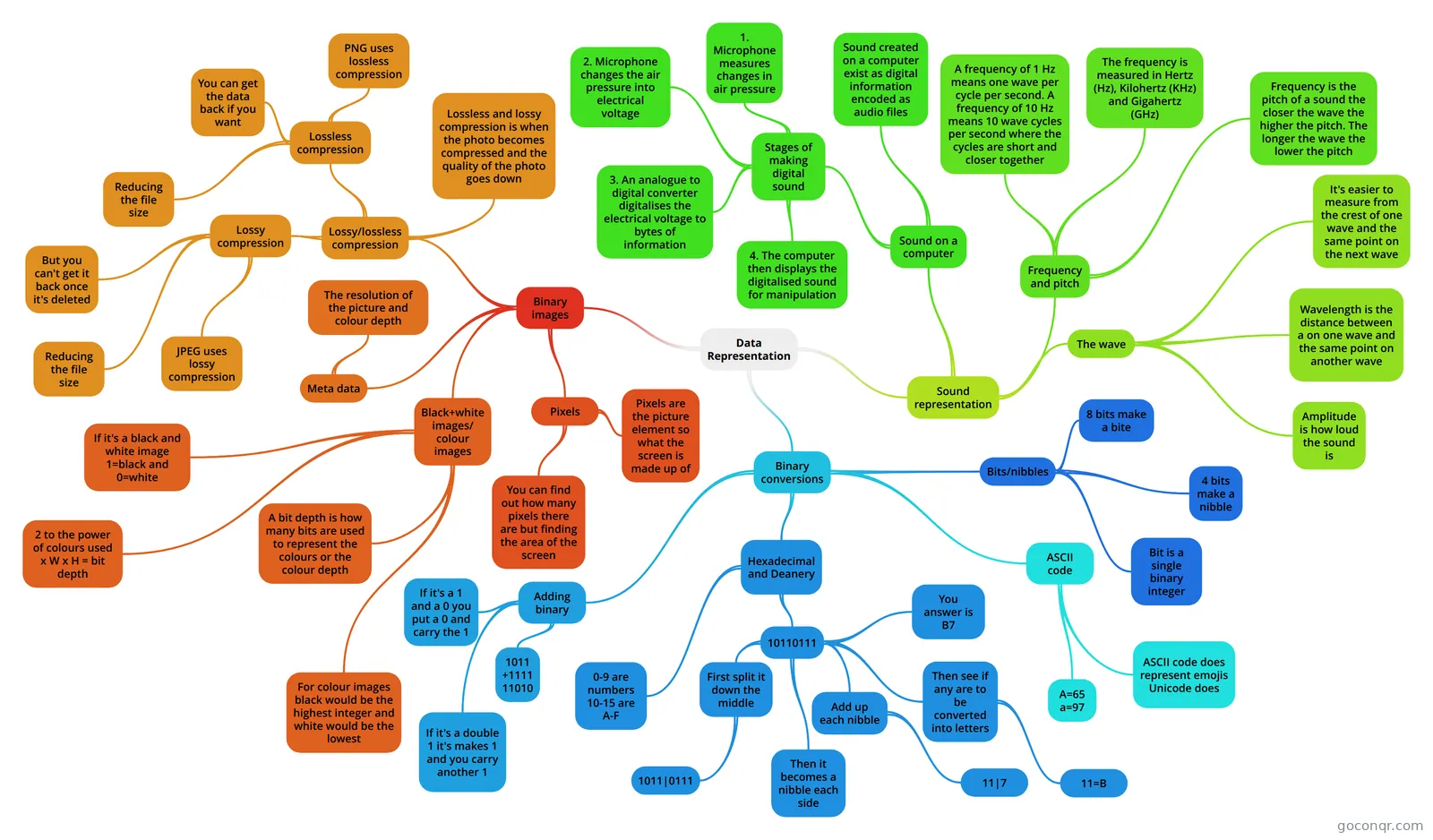 Mind map Data Representation GCSE Computing, Mind Map on Data representation, created by Melissa Norwood on 12/03/2017.
-
Mind map GCSE AQA Computer Science - Data Representation All of data representation for AQA comp sci
-
10 questionsComputing Numbers Quiz Which numerical system is being used in this example? 4B=75
-
Mind map GCSE Computer Science: Data Representation
-
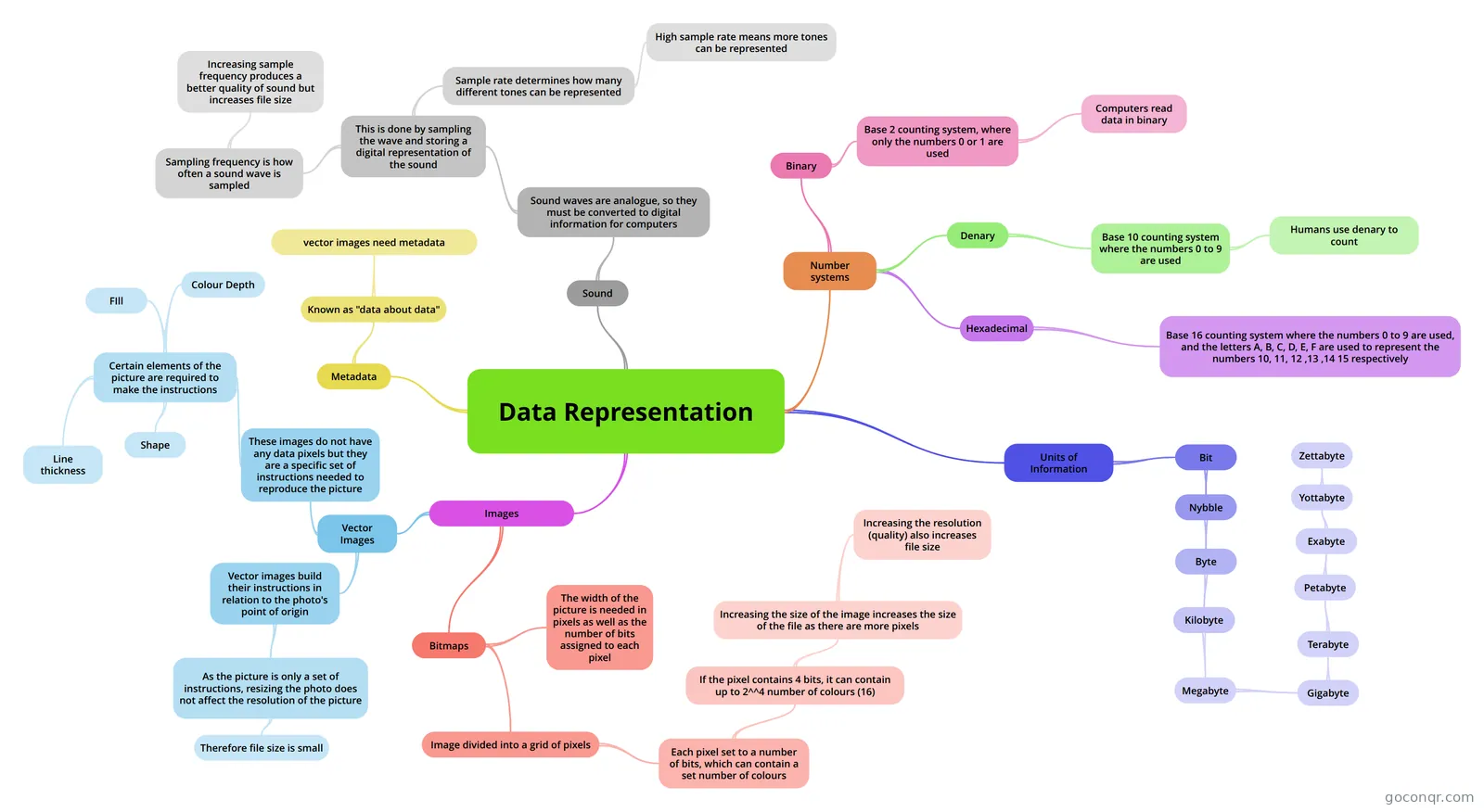 Mind map Data Representation
Quizzes
See all 46 quizzes-
25 questionsFile type extensions quiz What type of media file is a JPEG?
-
10 questionsComputing Numbers Quiz Which numerical system is being used in this example? 4B=75
-
16 questionsAssignment 1 The decimal number system consists of the symbols 0-10.
-
10 questionsGCSE CS Data Quiz (Binary shifts)
-
24 questionsBinary & Hexadecimal
-
10 questionsBINARY if the binary numbers are (128 . 64 . 32 . 16 . 8 . 4 . 2 . 1) what makes up 45 in binary?
-
6 questionsYear 7 and 8 Test Year 7 and 8 test
-
6 questionsHedges quiz 1100 - 1000 = 100 1101 - 1000 = 101 When subtracting binary do you treat it like any other maths sum (for i...
Mind maps
See all 90 mind maps-
Data Representation
-
Data Representation GCSE Computing, Mind Map on Data representation, created by Melissa Norwood on 12/03/2017.
-
GCSE AQA Computer Science - Data Representation All of data representation for AQA comp sci
-
GCSE Computer Science: Data Representation
-
Data Representation
-
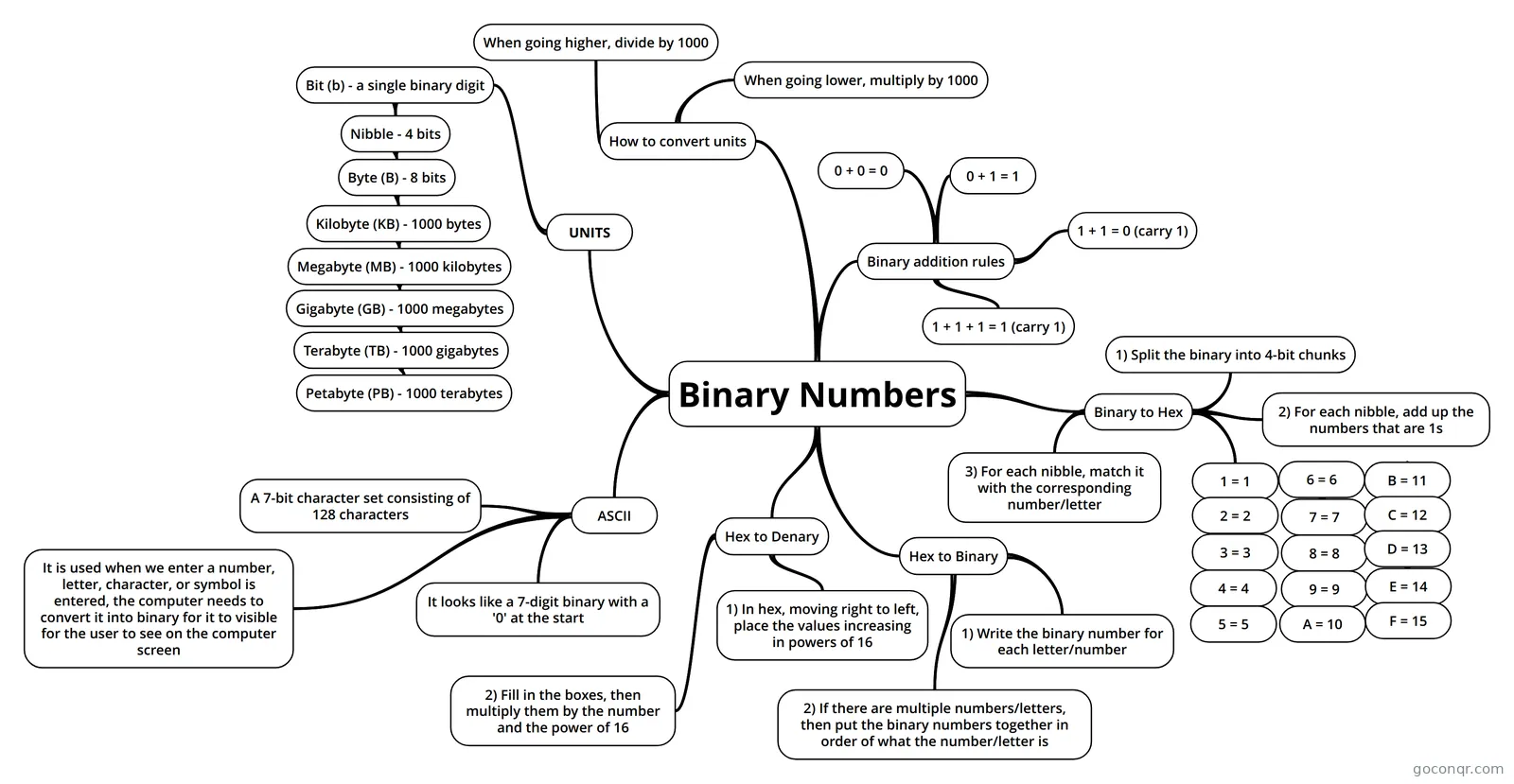 Binary Numbers
-
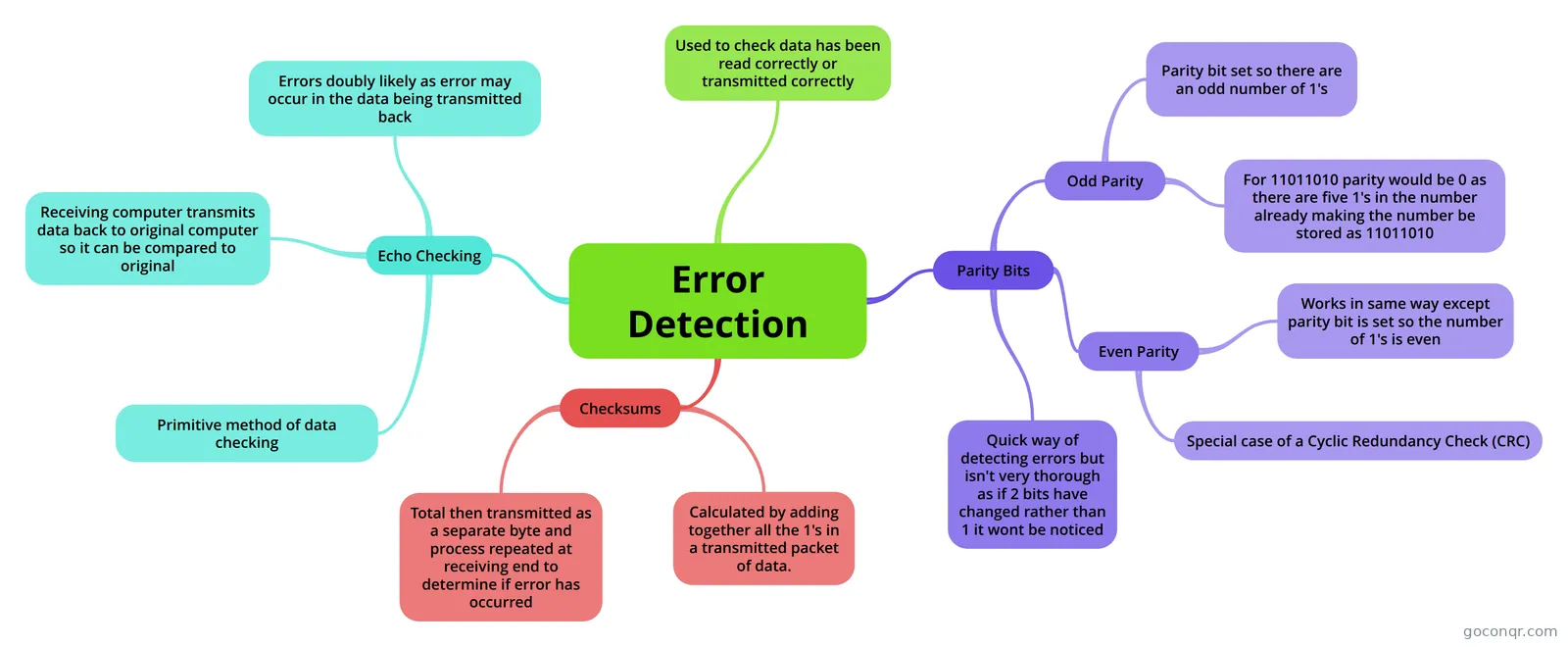 Error Detection
-
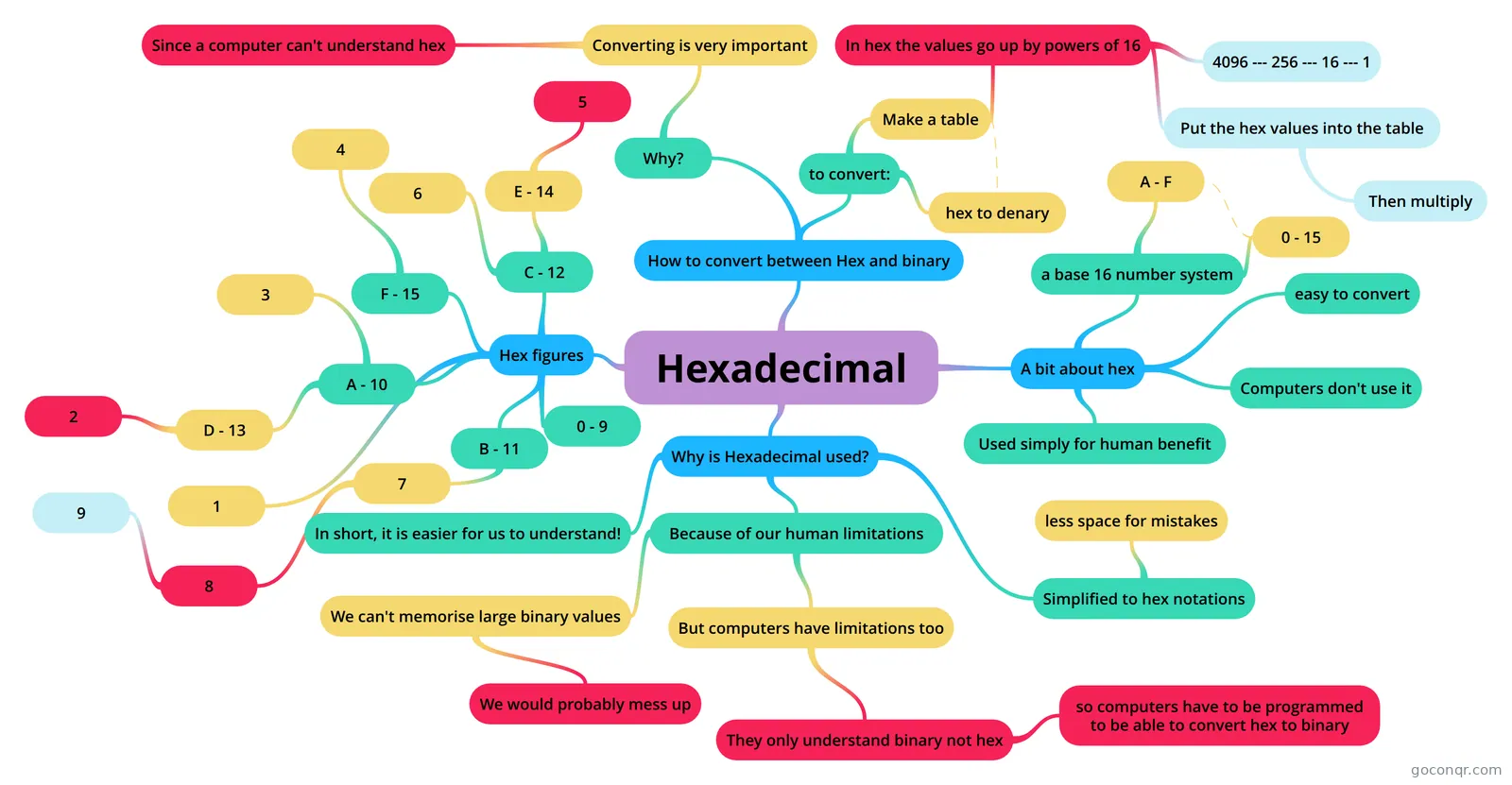 Hexadecimal
Flashcards
See all 94 flashcards-
48 cardsGCSE Computing - 4 - Representation of data in computer systems What is the Base-10 number system known as?
-
13 cardsComputer Science Assessment 3/11/21 Assessment Flash Cards
-
9 cardsHex 1: Hex & Denary Hex Number System
-
6 cardsHex 2: Hex & Binary Convert Binary to Hex
-
4 cardsNumbers-Den, Bin and Hex Values of Denary
-
6 cardscomputing State the binary representation of the denary number 87.
-
5 cardsHexadecimal
-
4 cardsUnicode and ASCIi What is ASCII?
Notes
-
Binary Conversion Binary Conversions The Binary Numbering System In everyday life, we normally use a numbering system that is constructed on multiples of ten. We call this numbering system the Base-10 or decimal numbering system. Base-...
-
Representing sound Representing sound Resources - Learn more about this topic: https://www.bbc.co.uk/education/guides/zpfdwmn/revision/3 (basic level) https://teachwithict.weebly.com/binary-representation-of-sound.html (inter...
-
Logic Gates and Truth Tables George Boole introduced a form of notation to describe binary statements in 1847Digital devices of systems use only two values which can be expressed in several wayshigh or lowtrue of falseon or offLogic gates are usu...
-
Lossy and Lossless Information Lossless and Lossy Compression Compression reduces the number bits of the file making the storage capacity lower and the data transfer of the file quicker. This is useful because more data...
-
Logic gates, rough notes Data representation systemtruth table - demonstrated logic , can demonstrate loginc gates.Logical oprator- 'and, 'or' 'not' Logic gate - semiconducter, digital device, 2 input, one outputdigital device hold 2 values -...
Slides
More Computing and ICT (programming, computer science, digital skills, educational technology) topics
About Data Representation and Number Systems
GoConqr OriginalWhat the resources cover
The unit starts with number systems. You will find quizzes and decks on binary, denary and hexadecimal, plus conversion practice such as Binary/Denary Conversion and Adding Binary. The mind map on hexadecimal explains why hex is used and how to convert between hex and binary. Two flashcard decks, Hex 1: Hex & Denary and Hex 2: Hex & Binary, break conversions into steps, such as splitting a byte into two nibbles.
Beyond numbers, the maps cover units of data (bit, nibble, byte), bitmap images made of pixels, sound, and file formats. Others look at compression, lossy and lossless, and at error detection with parity bits. There are also resources on ASCII and Unicode.
Where to start
- Read the mind map GCSE AQA Computer Science - Data Representation for an overview of the whole topic.
- Work through the units of data in the mind map Bits and Bytes.
- Practise conversions with the quiz Binary and Denary conversions, then move on to hexadecimal.
- Learn the steps for hex with the two Hex flashcard decks.
- Move on to images, sound and compression once the number work feels steady.
Using quizzes and maps together
Read a map first, then test yourself. If a quiz exposes a gap, go back to the matching map or deck and look at that branch again. The quiz GCSE CS Data Quiz (Binary shifts) is a good check on logical shifts. The File type extensions quiz checks whether you know a JPEG from an MP3 or an AVI.
Where this unit sits
This unit belongs to the Computer Systems strand of Computing and ICT. Most of what is listed is aimed at school students, with names like GCSE Computer Science, IGCSE ICT and A-level Computing appearing across the resources. Teachers can use the slide sets, notes and quizzes as ready-made starting points.
Choose one topic from the list above, open its map and see how much you can recall before trying the quiz.
Frequently asked questions
Which resource should I open first?
Start with the mind map GCSE AQA Computer Science - Data Representation. It gives a quick tour of storage units, images, sound, compression and number systems. After that, move to a quiz such as Binary and Denary conversions to test what you remember.
What do the hexadecimal resources include?
There is a mind map on why hex is used and how to convert between hex and binary, two flashcard decks (Hex 1: Hex & Denary and Hex 2: Hex & Binary), several quizzes, and a few sets of notes. Together they cover both directions of conversion.
Are these resources free to use?
Yes. Every resource listed here is free to open, study and take, with no account needed. They were made by GoConqr users rather than by GoConqr itself. A free account also saves your quiz scores and lets you create your own quizzes, mind maps, flashcards and notes.
Which exams do the resources suit?
The listed resources mention GCSE Computer Science, GCSE Computing, GCSE ICT, A-level Computer Science, A-level Computing, IGCSE ICT and IGCSE Computer Science. Nearly all of the material is at school level, so check that a resource matches your own course.
Is there anything on images, sound and compression?
Yes. Mind maps explain bitmap images as grids of pixels, and there are flashcards on the representation of images and sound. Separate decks and a slide set cover lossy and lossless compression, and a slide set covers graphic file calculations.
What if I cannot find a topic I need?
Try a nearby title, since many resources are named Data Representation but cover different parts of the topic. You can also make your own mind map, quiz or flashcards for the missing topic with a free account.