
7999543
Descripción

Fichas por Thomas Davis, actualizado hace más de 1 año

|
Creado por Thomas Davis
hace más de 9 años
|
|
| Pregunta | Respuesta |
| Single-Cell Recordings | Animals: Extensively used in a variety of visual and auditory tasks Humans: Occasionally used in treating epilepsy of the medial temporal lobe (MTL) |
| Stages of Memory | Encode: identify the visible target Compare: compare mental representation of the target with the representations of items in memory Decide: does target match one of the memorized items? Respond: Make the correct decision |
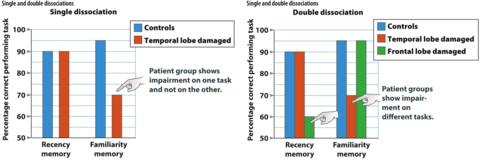
| Lobe Damage and Cognitive Dissociation (testing memory) | |
| Deep Brain Stimulation | Surgical implants of a microelectrode directly in the brain (Can help manage Parkinson's) |
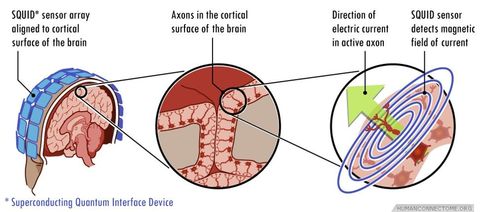
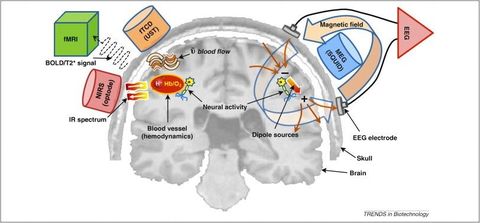
| Magnetoencephalography | Averages the recorded magnetic fields from synaptic activity that are perpendicular to the current |
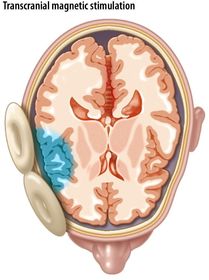
| Transcranial Magnetic Stimulation | Used to briefly disrupt cognitive processing Greater impact on surface cortical areas |
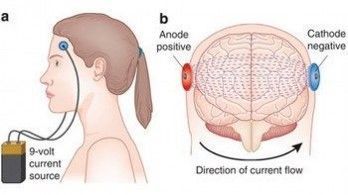
| Transcranial Direct Current Stimulation | Low-level currents that result in action potentials under the anodes |
| Magnetic Resonance Imaging | In a normal state, orientation of spinning protrons is random MRI magnetic field aligns the orientation protons Applying a radio frequency pulse shifts the proton axes in a predictable manner and puts them in an elevated energy state When the pulse is turned off, the MRI detects the energy released when the protons reorient to the magnetic field |
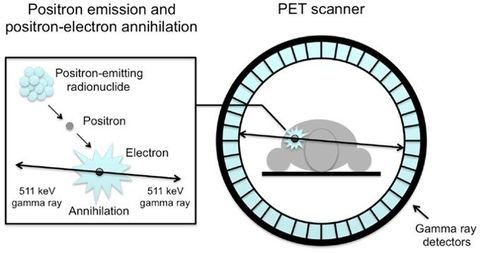
| Positron Emission Tomography | Measures blood flow, oxygen use, and sugar (glucose) metabolism |
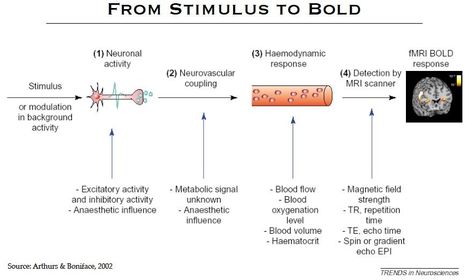
| Functional Magnetic Resonance Imaging | Blood Oxygenation Level Dependent (BOLD) Signal This is an indirect measure of neural activity. |
| Computed Tomography | CT/CAT Multiple X-rays used to get 3-D structure of the brain |
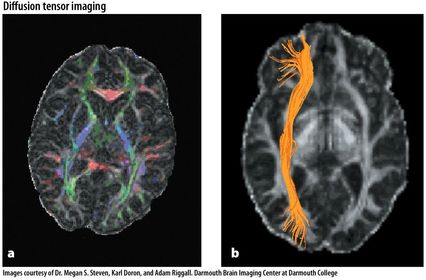
| Diffusion Tensor Imaging | DTI Uses magnetic resonance scanner to measure white matter pathways (the density and motion of water in the axons) |
| Tools for Measuring Neural Activity | |
| Cognitive Approach | Studies mental activity as an information-processing problem Information depends on internal representation Mental representations undergo transformation |
| Word Superiority Effect | More accurate identifying a target letter if it is presented in a word |
| Angiogram | Provides image of arteries in the brain by taking an x-ray after injecting a dye |
| Stroop Task | Read the color of the presented word, not the color the word spells |
| Epilepsy | Excessive and abnormally patterned activity in the brain |
| Pharmacological Studies | Administration of a drug that mimics the effects of a neurotransmitter (promotes or inhibits transmission; agonist or antagonist) |
| Gene Knockout Procedures | Allows scientists to explore the consequences of the lack of expression of a single gene in order to determine its role in behavior |
| Multiunit Recording | Recording many individual neurons simultaneously |
| Electroencephalography | Electrodes embedded in a cap used to record electrical potentials at the scalp |
| Event-Related Potential | A tiny signal embedded in an ongoing EEG triggered by a stimulus. By averaging the traces, a signal reflecting neural activity can be extracted that is specifically related to the event that provoked it |
| Electrocortogram | Like an EEG, but the electrodes are placed directly on the surface of the brain |
| Block Design Experiment | Neural activity is recorded over a "block" of time during which a participant is shown a stimulus or performs a task |
¿Quieres crear tus propias Fichas gratiscon GoConqr? Más información.