
8573806
Descripción

Fichas por Katie Flaherty, actualizado hace más de 1 año

|
Creado por Katie Flaherty
hace más de 9 años
|
|
| Pregunta | Respuesta |
| Lipids def. and examples? | Lipids: molecules in cells that are water-insoluble (hydrophobic) but soluble in organic solvents e.g. - Triacylglycerol’s (fats and oils) - glycerophospholipids and other membrane lipids - steroids and cholesterol |
| Triacylglycerol’s? | Triacylglycerol’s are neutral fats involved in dietary and storage processes: •Hydrophobic molecules – cluster together in the cell (storage) •Form droplets in water or aqueous environment •Important energy storage molecules • 1 glycerol and 3 fatty acid chains |
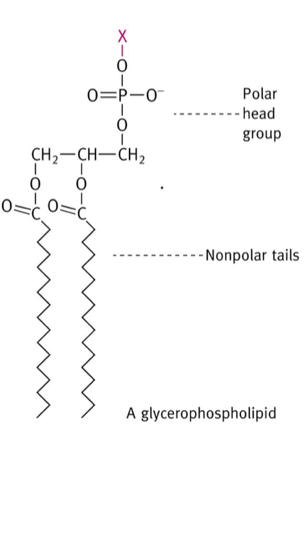
| Glycerophospholipid structure? |
1 glycerol, 2 fatty acid chains, phosphate group and amino alcohol attached to P-group
Image:
Picture1 (image/png)
|
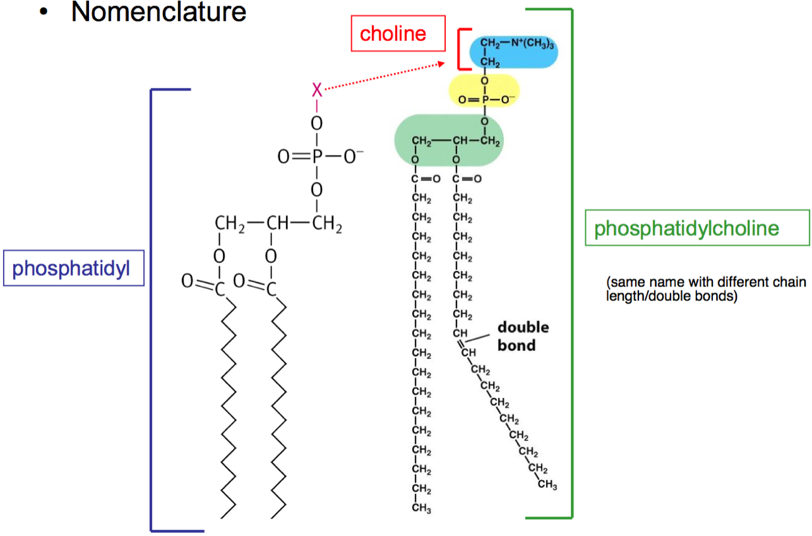
| Nomenclature of Glycerophospholipids? |
Image:
Picture1 (image/png)
|
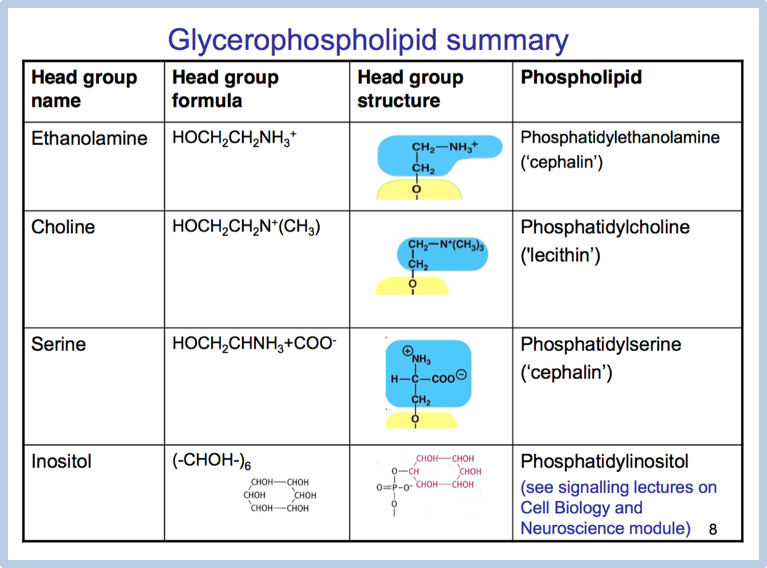
| Glycerophospholipid, four common types and their structures? |
Image:
Picture1 (image/png)
|
| Sphingomyelin structure? | - Based on Sphingosine (rather than glycerol) which is quite like glycerol but has a permanent hydrocarbon chain -a fatty acid, phosphate and a polar head group (choline) is added to sphingosine to make sphingomyelin |
| Where is sphingomyelin found? | it is found in myelin sheaths of neurons - its an important membrane phospholipid |
| 2 types of membrane lipids? | 1. Phospholipids - Glycerol based – glycerophospholipids - Sphingosine based – sphingomyelin 2. Glycolipids/glycosphingolipids - Sphingosine based – no phosphate, carbohydrate polar head group |
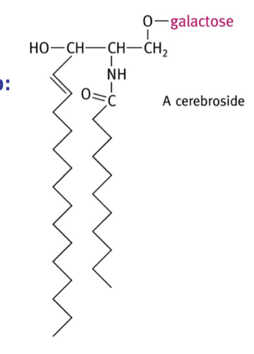
| Structure and function of a cerebroside? | -based on sphingosine, no phosphate with a single sugar head (glucose or galactose) - important in brain cell membranes |
| Structure and function of Gangliosides? | -sphingosine based, no phosphate with oligosaccharide head group -ABO blood group determinants |
| What can the structures of the fatty components of membranes be and what difference does it make to MP? | 1. Saturated – only single c-c bonds 2. Mono saturated – one double c=c bond (if naturally occurring the fatty acid is nearly always in cis configuration) the double bond largely lowers MP 3. Polyunsaturated – two or more c=c bonds, melting point even lower |
| Effect of kinks in the hydrocarbon tail chain from double c=c bonds? | cause looser packing of fatty acid tails, reducing van der waals interactions and increasing fluidity |
| How do bacteria respond to change in external temp? | they vary the proportion of unsaturated fatty acids in the membrane in response to external temp |
| Effect of cholesterol on a membrane? | - the rigid structure inserts between phospholipids – this modulates membrane fluidity - at high temperatures, it ‘stiffens’ the membrane by filling the space between unsaturated FA’s - at low temperatures it increases fluidity by preventing FA tails from packing too closely |
| Phosphatidylinositol function in cell membrane? | for intracellular signalling and anchoring of carbohydrates and proteins |
¿Quieres crear tus propias Fichas gratiscon GoConqr? Más información.