
Fichas
Systems Software Revision
Fichas del conjunto (130)
- 1FILE SYSTEMS: What does TCP stand for?Transmission Control Protocol
- 2INTERNETWORKING: What does IP stand for?Internet Protocol
- 3FILE SYSTEMS: What does ISP stand for?Internet Service Provider
- 4INTERNETWORKING: What does ARP stand for?Address Resolution Protocol
- 5INTERNETWORKING: What are the 7 layers of the ISO/OSI Model from bottom to top? (Hint: Please DoNoT SPA / PDNTSPA)Physical
Data Link
Network
Transport
Session
Presentation
Application - 6INTERNETWORKING: What are the four layers of the TCP/IP Network Model? (Hint: LNTA)Link
Network
Transport
Application - 7INTERNETWORKING: What does FTP stand for?File Transfer Protocol
- 8INTERNETWORKING: What does SNMP stand for?Simple Network Management Protocol
- 9INTERNETWORKING: What does SMTP stand for?Simple Mail Transfer Protocol
- 10INTERNETWORKING: What does DNS stand for?Domain Name System
- 11INTERNETWORKING: What information does IP contain?Addressing information but also some control informaiton
- 12What are the 14 sections of a IP Datagram? (Hint: VITTIFFTPHSDOD)Version
IHL
Type of Service
Total Length
Identification
Flags
Fragment Offset
Time to live
Protocol
Header checksum
Source address
Destination address
Options
Data - 13INTERNETWORKING: What is the Version part of an IP Datagram responsible for?Indicating the version of IP currently being used
- 14INTERNETWORKING: What is the IHL part of the IP Datagram used for?Indicating the datagram header length in 32 bit words
- 15INTERNETWORKING: What is the type-of-service part of an IP Datagram responsible for?How an upper layer protocol would like a current datagram to be handled and assigns datagram importance level
- 16INTERNETWORKING: What is the total length of the IP Datagram responsible for?Specifying the length (in bytes) of the entire IP packet including the data and the header
- 17INTERNETWORKING: What is the Identification part of the IP Datagram used for?Identifying the current datagram. Used to help piece the datagrams together
- 18INTERNETWORKING: What is the flags part of an IP Datagram used for?3 bits of which the first two signify whether the packet can be fragmented
- 19INTERNETWORKING: What is the fragment offset part of the IP Datagram used for?Indicating the position of the datagram relative to the beginning and original datagram. Allows for reconstruction
- 20INTERNETWORKING: What is the time-to-live part of an IP Datagram used for?Counter decrements to zero at which point the datagram is discarded. Stops packets looping endlessly.
- 21INTERNETWORKING: What is the protocol of the IP Datagram used for?Indicates to the upper layer protocol layer receives packets after IP processing is complete
- 22INTERNETWORKING: What is the header checksum used for?Used for ensuring IP integrity
- 23INTERNETWORKING: What is the source address used for?Specifies the ending node
- 24INTERNETWORKING: What is the destination address in an IP Datagram?Specifies the receiving node
- 25INTERNETWORKING: What is the options part of an IP Datagram used for?Allows for support of various features including security
- 26INTERNETWORKING: What is the data part of the IP Datagram responsible for?Containing the upper information / the actual data
- 27INTERNETWORKING: How many bits is an IP address?32 bits
- 28INTERNETWORKING: How many octets is an IP address split into?4 octets
- 29INTERNETWORKING: What are the maximum and minimum number for an IP address octet?0 is the minimum
255 is the maximum - 30INTERNETWORKING: What are the two main parts an IP address is split into?Network and Host
- 31INTERNETWORKING: What is an IP address?An integral scheme for the process of routing IP
- 32INTERNETWORKING: Why is 127 not allowed to be used for the first octet of an IP address?It is reserved for loopback and diagnostic functions
- 33INTERNETWORKING: How many octets are for the network part of class A, B and C?A = 1
B = 2
C = 3 - 34INTERNETWORKING: What are the default subnet addresses for classes A, B and C?A = 255.0.0.0
B = 255.255.0.0.
C = 255.255.255.0
Remember that each N is replaced with 255 and each H is replaced with 0 for the format of the address - 35INTERNETWORKING: What are the ranges for the 1st octet range for classes A, B and C?A = 1-126
B = 128 - 191
C = 192-223 - 36INTERNETWORKING: What is TCP used for?Delivery of an unstructured stream of bytes identified by the sequence numbers
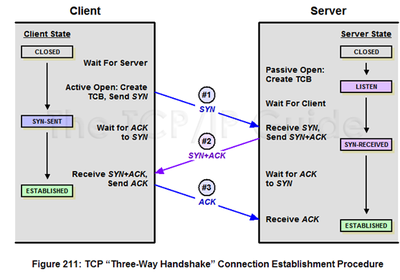
- 37INTERNETWORKING: How does TCP establish a connection between a client and a server?Three way handshake
- 38INTERNETWORKING: What are the processes of a three way handshake?
- 39INTERNETWORKING: What are the 12 parts of the TCP segment? (Hint: SDSADRFWCUOD)Source port
Destination port
Sequence number
Acknowledgement number
Data offset
Reserved
Flags
Windows
Checksum
Urgent pointer
Options
Data - 40INTERNETWORKING: What are the source and destination ports responsible for in a TCP Segment?Source - points at the upper layer source receiving TCP services
Destination - points at the upper layer destination - 41INTERNETWORKING: What are the sequence and acknowledgment numbers used for in a TCP segment?Sequence - the number assigned to the first byte of the data in the current message to identify initial sequences
Acknowledgment - Contains the sequence number of the next byte of data the sender expects to recieve - 42INTERNETWORKING: What is the flags part of the TCP segment used for?Carrying various information including ACKnowledgment and SYNchronisation
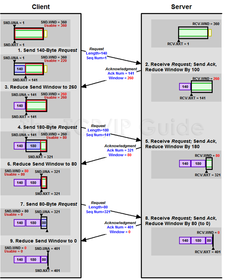
- 43INTERNETWORKING: What is the window of the TCP segment used for?Acts essentially as a progress bar so that the client knows how many bytes of information they are still expected to recieve
- 44INTERNETWORKING: Why is control flow used?
- 45INTERNETWORKING: What are the 8 parts to an ethernet frame?Preamble
Start-of-frame delimiter
Destination address
Source address
Length/type
Data
Pad
Frame Checking Sequence - 46INTERNETWORKING: What is the preamble of an ethernet frame used for?Alternating pattern of ones and zeros that tells receiving stations that a frame is coming.
- 47INTERNETWORKING: What is a start of frame delimiter used for in an ethernet frame?Indicating the leftmost bit in the leftmost byte is the destination address
- 48INTERNETWORKING: What is the destination and source address used for in an ethernet frame?Destination - Identifying which station should receive the frame
Source - Identifies the sending station - 49INTERNETWORKING: What is the length/type used for in an ethernet frame?Indicates either the MAC-client data bytes or the frame type ID
- 50INTERNETWORKING: What is an frame checking sequence in an ethernet frame?Checking for damaged frames from redundancy check value
- 51FILE SYSTEMS: What is a file system?System for managing files stored on a computer hard disk
- 52FILE SYSTEMS: How many bytes is in a sector?512 bytes are in a sector
- 53FILE SYSTEMS: What is an offset?A time delay
- 54FILE SYSTEMS: What is metadata?Data about the data
- 55FILE SYSTEMS: What information is stored in metadata?Name of the file
Date modified
File owner
File permissions, etc. - 56FILE SYSTEMS: What is a disk file systems?Storing data on multiple disk. Enables media to be stored randomly and accessed in order requested by application without regarding sequential order
- 57FILE SYSTEMS: What is a network file systems?Is a file system that acts a client for remote file access protocol.
- 58FILE SYSTEMS: What does a flash file systems need to consider?Special abilities, performance and restrictions of flash memory devices
- 59FILE SYSTEMS: What does FAT stand for?File Allocation Table
- 60FILE SYSTEMS: What is a file allocation table?Table that consists of a file system descriptor sector, file allocation block table and plain storage space.
- 61FILE SYSTEMS: What is a directory?An array of 32-byte records
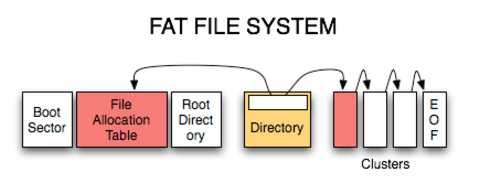
- 62FILE SYSTEMS: What are the 5 parts of a FAT File System? (Hint: BFRDC)
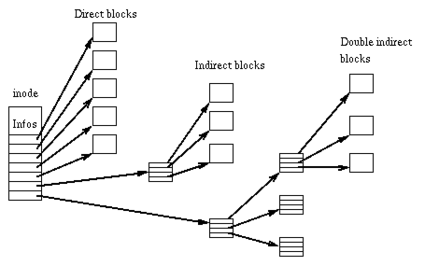
- 63FILE SYSTEMS: What is an iNode?
- 64JAVA: What is a class?A template used to create objects
- 65JAVA: What is an object?An instance of a class
- 66JAVA: What is a java bytecode?Is the machine language instruction set for Java Virtual Machine
- 67JAVA: What is a JVM?Java Virtual Machine
- 68JAVA: What does JVM execute?Java bytecode
- 69JAVA: Where does all computation in the JVM centres occur?On the stack because the JVM has no registers for storing arbitary values.
Everything must be pushed onto the stack before it can be used in a calculation. - 70JAVA: What are opcodes?Java commands or operations
- 71JAVA: What does JIT stand for and what is it?Just In Time
Compiling not interpreting is used in most JVM's to achieve greater speed - 72JAVA: What does the JVM verify before it is executed?1. Branches are always to valid locations
2. Data is always initialised and referenced are always type-safe
3. Access to private or package private data and methods is rigidly controlled - 73JAVA: How can you make a java application portable?Make sure JVM is installed on the machine
- 74JAVA: What does API stand for?Application Programming Interface
- 75JAVA: What is an opcode preffix?The data type of what the operand is for
- 76JAVA: What is a try statement used for?To catch specific errors within the code if one is illegal
E.G. IOException - 77JAVA: What is a catch statement used for?To catch the try statement errors or Handle exceptions that match exception arguments
- 78JAVA: What does the finally statement do?Perform code based on when the try statement is thrown.
Always executed to clean up even if execution is aborted - 79JAVA: What is a thread?Individual and separate unit of execution that is part of a process
1 thread per task - 80JAVA: How many threads does a program have?At least one or more
- 81JAVA: What does the diagram for the interaction for the program and the hardware look like?
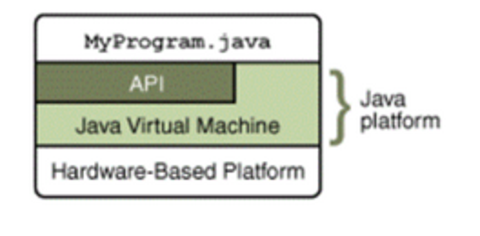
- 82JAVA: Why do threads share resources?To work together to accomplish a common goal
- 83JAVA: When do threads run?Only when needed, can provide better performance.
- 84JAVA: What are the four separate states for Java Threads? (Hint: NRBD)New - just started but not created
Runnable - created, started and able to run
Blocked - created started, but unable to run due to waiting for an event
Dead - Thread has finished or been stopped - 85JAVA: What are the priorities levels for threads?MIN_PRIORITY
NORM_PRIORITY
MAX_PRIORITY - 86JAVA: How can you also throw an exception within a program?Throw Exception with type
- 87JAVA: Can multiple threads be run at the same time?Yes as long as they are performing different tasks
- 88JAVA: What does RPC stand for?Remote Procedure Call
- 89JAVA: What is the difference between a timer and a thread?Parallel code execution must be finished before next execution of same code
- 90JAVA: What does the diagram for thread states look like?
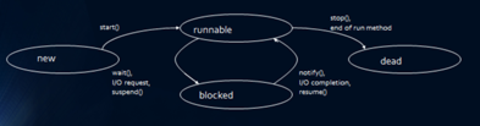
- 91JAVA: What is an RPC?Allows a computer program to cause a subroutin/procedure/function to execute in another address space
- 92JAVA: When is an RPC initialised and when are the processes involved?By the client which sends a request message to the remote server to execute a specified procedure with supplied parameters.
The server sends a response to the client and application continues process.
When the server is processing the call, the client is blocked unless the client sends an asynchronous request to the server such as XHTTP call. - 93JAVA: What does RMI stand for?Java Remote Method Invocation
- 94JAVA: What is the purpose of RMI?Perform OO equivalent of RPC with support for direct transfer of serialised Java classes and distributed garbage collections
- 95JAVA: What are the sequence of events during an RPC?o The client calls the client stub. The call is a local procedure call, with parameters pushed on to the stack in the normal way.
o The client stub packs the parameters into a message and makes a system call to send the message. Packing the parameters is called marshalling.
o The clients local OS sends the message from the client machine to the server machine.
o The local operating system on the server machines passes the incoming packets to the server stub.
o The server stub unpacks the parameters from the message. Unpacking the parameters is called un-marshalling.
o Finally, the server stub calls the server procedure. The reply traces the same steps in the reverse direction. - 96MEMORY MANAGEMENT: What does memory hierarchy mean?A layered memory system that composes the computer system.
- 97MEMORY MANAGEMENT: What do the higher and lower layers contain?Higher - Fast and low capacity memory
Lower - slow and high capacity memory - 98—Memory Hierarchy
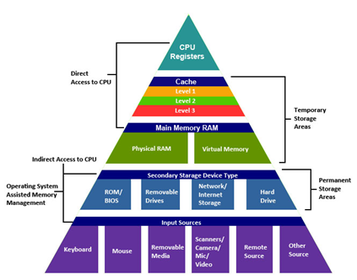
- 99MEMORY MANAGEMENT: How does the memory manager efficiently manage memory?1. Keeping track of which parts of memory are in use
2. Allocating memory to processes
3. Deallocating memory to processes - 100MEMORY MANAGEMENT: How can memory allocation be represented?Bitmaps and Linked Lists
- 101—Five processes and three holes for allocation
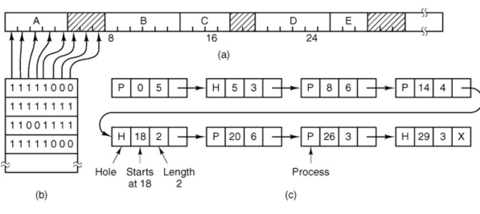
- 102MEMORY MANAGEMENT: Describe the first fit memory allocation algorithmFirst In First Out
Use first hole big enough - 103MEMORY MANAGEMENT: Describe the Next fit memory allocation algorithmUse next hole big enough
- 104MEMORY MANAGEMENT: Describe the Best fit memory allocation algorithmSearch list for smallest hole that's big enough
- 105MEMORY MANAGEMENT: Describe the Worst fit memory allocation algorithmSearch list for biggest available hole
- 106MEMORY MANAGEMENT: Describe the Quick fit memory allocation algorithmSeparate lists of commonly requested sizes
- 107MEMORY MANAGEMENT: What is pagination and page frames?Computer memory is divided into small partitions that are all the same size called page frames
- 108INTERNETWORKING: What does OSI mean?Open Systems Interconnection
- 109MEMORY MANAGEMENT: What is the major issue with pagination?The page can be extremely large and mapping must be fast
- 110MEMORY MANAGEMENT: What are the contents of the page table contents?Resident bit - true if the page is in RAM
Frame address - integer field used to store additional information about each page
Reference bit - set by the simulator when page is used
Dirty bit - set by the simulator when page is changed
Ram Allocated - count of the pages with the resident - 111MEMORY MANAGEMENT: What are the three limitations to pagination?1. Can still have internal fragmentation
2. Memory reference overhead
3. Memory required to hold page table can be significant - 112MEMORY MANAGEMENT: What is segmentation?Partitions in memory into logically related data units of various sizes
- 113MEMORY MANAGEMENT: Describe the FIFO page replacement algorithm?First In First Out
Simplest page replacement algorithm
Most recent arrival at the back
When a page needs to be replaced the page at the front of the queue (the oldest) is selected - 114MEMORY MANAGEMENT: Describe the Second chance page replacement algorithm?Looks at the front like FIFO does
Checks if the resident bit is set for that page before swapping out - 115MEMORY MANAGEMENT: Describe the clock page replacement algorithm?Keeps a circular list of pages in memory with the iterator pointing the the last examined page in the list
If the R bit is set to 0 the new page is put in place. - 116PROCESS MANAGEMENT: What is the producer consumer problem?How should the communication protocol required for these two processes (consumer, producer) be defined.
- 117PROCESS MANAGEMENT: What does the producer do to the bufferInsert information
- 118PROCESS MANAGEMENT: What can the consumer do to the buffer?Remove information
- 119PROCESS MANAGEMENT: What is a semaphore?An integer variable to control access to critical regions.
- 120PROCESS MANAGEMENT: What are the two operations for a semaphore?Wait and Signal
- 121PROCESS MANAGEMENT: Why should semaphores be atomic?So they cannot be interrupted by a process whilst another process is currently in the critical region
- 122PROCESS MANAGEMENT: What is a mutex?A binary semaphore.
Needs to be initalised to 1 on start up - 123PROCESS MANAGEMENT: How can semaphores be used to solve the deadlock problem?Guard a single resource from multiple parallel processes.
- 124PROCESS MANAGEMENT: When does a deadlock occur for semaphores and how is it solved?When two or more processes are waiting for access to the same resource which is guarded by semaphores.
Solved by scheduling algorithms - 125PROCESS MANAGEMENT: What is a priority level scheduling algorithm for semaphores and what is the main problem with it?Processes are organised highest to lowest with higher processes getting priority.
Lower levels could be starved. - 126PROCESS MANAGEMENT: What is the shortest job next scheduler and what is the main consequence of it?An algorithm to decide which process is the shortest and goes next.
Longest jobs could be higher importance and be starved - 127PROCESS MANAGEMENT: What is the round robin scheduler?A time sharing algorithm for each process. Using FIFO queue
- 128PROCESS MANAGEMENT: What is a multi-level priority queue scheduler?Similar to priority queue except the processes can shift priority.
But higher processes must be empty before processes from lower priority queues are allowed to run - 129What is an operating system?An integrated set of programs which as an intermediate between user and the computer hardware.
- 130What is system software?A class of software that manages the hardware resources such as secondary memory, display devices, printers, communication links and other peripherals
Información
- Descripción
- 6 comp sci Fichas sobre Systems Software Revision, creado por cocacolai el 22/05/2014.
- Creado por
- cocacolai
- Visitas
- 118
- Etiquetas
- Valoración