
Fichas
software engr
Fichas del conjunto (72)
- 1what is the study of the processes of system changeprogram evolution dynamics
- 2What are lehmans laws in order1. continuing change
2. increasing complexity
3. large program evolution
4. organizational stability
5. conservation of familiary
6. continuing growth
7. declining quality
8. feedback system - 3purpose of lehmans laws?they can be applied to all large systems as they evolve
- 4what is lehmans law of continuing changea program that is used in a real world environment must change or become progressively less useful in that environment
- 5what is lehmans law 2?increasing complexity: as an evolving program changes, its structure tends to become more complex
- 6what is lehmans law 3large program evolution: program evolution is a self regulating process. system attributes such as size, time between releases, and number of reported errors is invariant for each release
- 7what is lehmans law 4organizational stability: over a programs lifetime, its rate of development is approximately constant and independent of the resources devoted to system development
- 8what is lehmans law 5conservation of familiarity: over the lifetime of a system, the incremental change in each release is approximately constant
- 9what is lehmans law 6continuing growth: the functionality offered by systems has to continually increase to maintain user satisfaction
- 10what is lehmans law 7declining quality: quality of system will appear to be declining unless they are adaped to changes in their operational environment
- 11what is lehmans law 8feedback system: evolution processes incorporate multi-agent multi-loop feedback system and you have to treat them as feedback systems to achieve significant product improvement
- 12what are 3 types of maintenance repair1. fault repair
2. software adaptation
3. functionality addition or modification - 13what are the 4 maintenance cost factors1. team stabiltiy
2. contractual responsibility
3. staff skills
4. program age and structure - 14what are 5 principles of agile methods1. customer involvement
2. incremental delivery
3. people not process
4. embrace change
5. maintain simplicity - 15what is agile managementAgile project management is an iterative approach to managing software development projects that focuses on continuous releases and incorporating customer feedback with every iteration
- 16what are some problems with agile methods- can be difficult to keep intrest of customers who are involved
team members may be unsuited to the intense involvement
- maintaining simplicity requires extra work - 17plan driven vs agileplan driven is based around seperate development stages with outputs planned in advance.
in agile, specification, design, implementation, and testing are interleaves and outputs are decided during process - 18what is extreme programmingbest known and widely used agile method
- new versions may be built several times per day
increments delivered every 2 weeks - 19what are some practices of extreme programming- incremental planning
- small releases
- simple design
-test first development - 20what is refactoringprogramming team look for possible software improvements and make these improvements even where there is no immediate need for them
- 21what are the 3 phases in scrum1. initial phase is planning
2. series of sprint cycles
3. project closure/wrapup - 22what is role of scrum masterprotect development team from external distractions. arranges meetings, tracks backlog, records decisions, communicates with customers
- 23benefits of scrum?q-customers see on time delivery
- trust between customers and developers - 24what are some characteristics of distributed systrems-resource sharing
-openness
-concurrency
-scalability
-fault tolerance - 25disadvantages of distributed systems?-complexity
-security
-manageability
-unpredictabiltity - 26what are 3 layers of layerd application architecture?- presentation layer: concerned with presenting results to users
- application processing layer: concerned with providing application specific functionality
-data management layer - 27what is peer to peer arch?- decentralized systems where computations may be carried out by any node in the network
- 28p2p is an example of what object?distributed
- 29semicentralized vs decentralized?decentrazlized is spread out with nodes everywhere, and main nodes conneced.
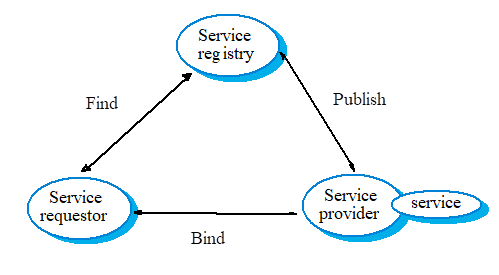
- semicentralized has a main server and many interconnected nodes within - 30draw web services diagram
- 31what is web services? how does it work?- it is a an example of distributed object
- its services are: provider independence
- public advertising
- smaller, more compact applications - 32what are the key service standard in web service- SOAP : Simple Object Access Protocol
- WSDL: Web Services Description Language
- UDDI: Universal Description, Discovery and Integration - 33draw an automotive system
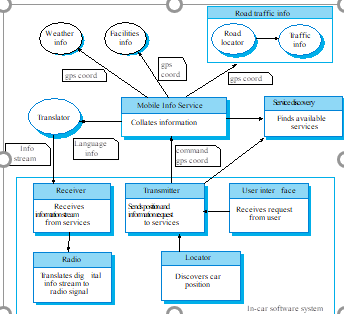
- 34what is cloud computinginternet based computing where shared resources, software, and info are provided to computers and other devices on demand
- 35cloud computing is a what type of shiftparadigm shift following the shift from mainframe to client server
- 36what companies play role in cloud computinggoogle
salesforce
zoho
yahoo
rackspace
microsoft
amazon - 373 categories of services provided by cloud?- infrastructurs as a service (IaaS)
-platform as a service (PaaS)
- Software as a Service (SaaS) - 38public cloudsells services to anyone on the internet (Amazon web services)
- 39private cloudnetwork or data center that supplies hosted services to a limited number of people
- 40what is Infrastructure as a Service (IaaS)(amazon web services) - provides virtual server instances with unique IP addresses and blocks of storage on demand
- 41what is Platform as a Service (PaaS)set of software and product development tools hosted on providers infrastructure
- 42Software as a Service (SaaS)vendor supplies hardware infrastructure, the software product and interacts with user through front end portal
- 43what is software cost estimationpredicting the resources required for a software development process
- 44what are the 4 software cost components?1. hardware and software costs
2. travel and training costs
3. effot costs (dominant factor)
4. overheads cost- building, heating, lighting - 45what are the 5 software pricing factors1. market oppurtunity
2. cost estimate uncertainty
3. contractual terms
4. requirements volatility
5. financial health - 46what is market oppurtunity in software pricingaccepting low profit on 1 project may give oppurtunity for more profit later
- 47what is cost estimate uncertaintyan organization may increase its price if unsure of cost estimate
- 48contractual terms in software pricingcustomer may be willing to allow developers to retain ownership of source code and reuse it
- 49requirements volatility in software pricingafter contract is awarded, high prices may be charged for changes to requirements
- 50financial health in software pricingdevelopers in financial difficulty may lower their price to gain contract
- 51what are productivity measures- size related measures based on some output from software process (lines of source code)
- function related measured based on estimate of functionality of the delievered software - 52measurement problems-estimating size of measure
-estimating total number of programmer months which have elapsed
-estimating contractor productivity and incorporating this estimate in overall estimate - 53what are 4 estimation techniques1. algorithm cost modelling
2. expert judgement
3. estimation by analogy
4. pricing to win - 54algorithmic code modelling- formulaic approach based on historical cost info. and which is generally based on size of software
- 55expert judgementone or more experts in both software development and application domain use their experience to predict software costs
pros: cheap
cons: inaccurate if no experts - 56estimation by analogycost of a project is computed by comparing project to a similar project in same application domain
pros: accurate if data available
cons: impossible if no comparable project - 57pricing to win- project costs whatever customer has to spend on it
pros: you get contract
cons: costs do not accurately reflect work required - 58what does cocomo stand forCOnstructive
COst
MOdel - 59what are the five points of SLOC1. only source lines that are delivered are included, test drivers and other support is excluded
2. source lines are created by project staff
3. one SLOC is 1 logical line of code
4. declarations are counted as SLOC
5. comments are not counted as SLOC - 60list the 5 scale drivers1. precedentedness
2. development flexibility
3. architecture/risk resolution
4. team cohesion
5. process maturity - 61maximum level of reduction in cocomo25%
- 62effort equationEffort = 2.94 * EAF * (KSLOC)^E
- 63duration equationduration = 3.67*(Effort)^SE
- 64memorize human needs hierarchy model
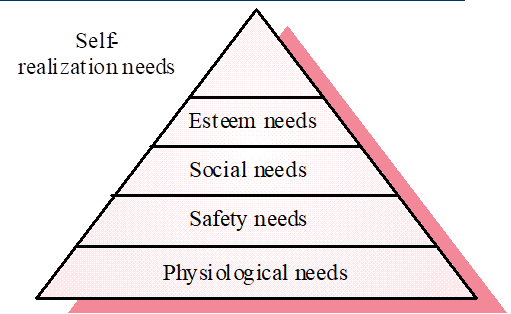
- 65what are 3 needs motivation is based on?1. basic needs (food, sleep)
2. personal needs (respect)
3. social needs (to be accepted ) - 66what is the most important self selection factorattitude
- 67what are the 5 levels in people capability maturity model1. initial
2. repeatable
3. defined
4. managed
5. optimizing - 68what is 1st stage in CMMinitial: ad hoc people management
- 692nd stage in CMMrepeatable: policies developed for capability improvement
- 703rd stage in CMMdefined: standardized people management across organization
- 71managedquantitative goals for people management in place
- 72optimizingcontinuous focus on improving individual competence and workforce motivation
Información
- Descripción
- Computer Science Fichas sobre software engr, creado por Umair Hafeez el 09/05/2018.
- Creado por
- Umair Hafeez · may 2018
- Actualizado
- 10 may 2018
- Visitas
- 1
- Valoración