
Fichas
Chapter 1 & 2- Intro to Project Management and the environment in which projects operates
Fichas del conjunto (73)
- 1ProjectTemporary endeavor (well-defined beginning and end) to produce a unique product, service or result (that can last even after project closure)
- 2Deliverableany unique and verifiable (you can metrify) product, result or capability to perform a service. The output of a process, phase or project.
- 3Business Valuethe net quantifiable benefit derived from a business endeavor
- 4Project Business valueThe benefit resulted from a specific project to its stakeholders
- 54 fundamental factors to initiate a project- meet regulatory, legal or social requirements
-satisfy stakeholders' requests/needs
-implement/change business or technological strategies
-create/improve/fix products, processes or services - 6Project initiation contextMust be in line with organizational objectives and production of value of a project
- 7A project isA means to successfully deal with regulatory requirements, business needs, change processes, creation of new products or services
- 8PMBOKbase to create methodologies, policies, procedures, rules, tools, and techniques necessary to project management (set of best practices to project management)
- 9methodologysystem of practices, techniques, procedures and rules
- 10A project canhave repetitive elements but it's unique due to its key features and objectives
- 11stakeholderAnyone/any entity impacted/interested in the project
- 12Project ManagementApplication of knowledge, skills, tools and techniques to project activities to meet project requirements.
It is:
- way to create benefits and value
- means to maintain competitiveness - 13Programgroup of related projects, subsidiary programs, and program activities managed coordinately to obtain benefits not available by managing them individually
- 14Portfolioprojects, programs, subsidiary portfolios and operations (ongoing at the same time and not necessarily related) managed as a group to achieve strategic objectives
- 15Big (mega) project- benefits go over 1bi
- impacts over 1 mi people
- takes over 1 year to be finished - 16ways to manage a project- autonomously
- as part of a program
-as part of a portfolio - 17the goal of project and program managementdo things right
- 18the goal of portfolio managementdo the right projects and programs
- 19Project life cycleSet of phases that a project passes from its start to completion. It includes all phases required to create a product, service, result and those can be overlapping: start, preparation, execution, finish
- 20product life cycleset of sequential and non overlapping phases: initiation, design, launch, manufacture, obsolescence
- 21Project life cycles can bePredictive or adaptative
- 22Predictive (waterfall) life cycleproduct or deliverables are defined at the beginning of a project (scope managed carefully)
- 23Adaptative life cycleproduct is developed over multiple iterations and the details are defined for each iteration as the iteration begins
- 24Development life cycles-predictive
-iterative
-incremental
-adaptative
-hybrid - 25predictive development life cyclescope, time, cost determined early. Most of the things are pretty much written in rock.
This approach, however, results in plenty of rework and thus increased cost. - 26iterative development life cyclescope determined early; time and costs modified as understanding increases. Activities are performed in Iterations. At the end of each iteration, a ‘usable’ deliverable is created. This approach is used for projects that are large or complex, where risks are high, the scope is not completely known upfront and is discovered as the project progresses.
- 27incremental development life cyclesuccessively add functionality within a predetermined timeframe. the deliverables are created in a series of incremental steps, but the ‘usable’ deliverable is available only at the end of the lifecycle.
- 28adaptative (agile or change driven) development life cyclethe scope is defined and approved before the start of an iteration. This a bit advanced version of iterative and incremental life cycles where scope unknowns are high. The main difference is that the duration of the iterations is very small.
- 29Hybrid development life cyclecombines predictive and adaptive
- 30Difference between project and development life cyclea project lifecycle is the broadest on the timescale, and it contains multiple phases. one or more of the phases may include the development of a product, service, or result and this is done by choosing a corresponding development lifecycle.
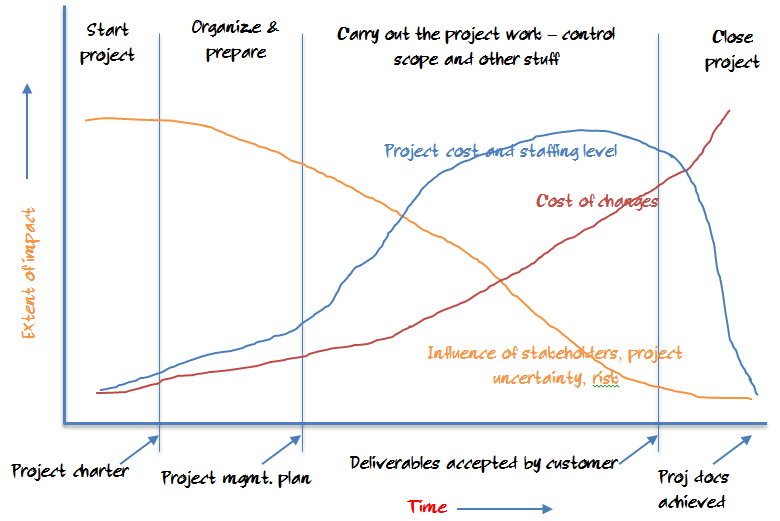
- 31Factors that increase throughout the project life cycle and then, decrease sharplycost and resource levels/usage
- 32Factors that decrease throughout the project life cycle-uncertainty about the project
-stakeholders influence/ability to change project output
- stakeholders ability to change the cost of the project - 33Factors that increase throughout the project life cycle and remain high at the end- probability of successfully completing the project
- cost of changes
-cost of repairing defects - 34Quality controlset of activities to ensure the quality of products/systems. Done at the end of the process
- 35Quality assuranceset of activities to ensure quality in the development processes. Done throughout the process. Cheaper than quality control because prevents rework
- 36Characteristics of a project life cycle
- 37WPD Work Performance DataRaw observations and measurements. Comes out of executing process group
- 38WPI Work Performance InformationWPD analyzed. Comes out of monitoring and controlling process group.
- 39WPR Work Performance GroupOne of the Outputs from the monitoring and controlling process group. WPI represented physically or electronically.
- 40TailoringSelecting the appropriate project management processes, inputs, tools, techniques, outputs and life cycle phases to manage a project
- 41Project management business documentsBusiness case and project benefits management plan. They are:
-Interdependent
-developed iteratively
-maintained throughout the whole project life cycle - 42Business casedocumented explanation on how economically viable the project is and used as a basis for the authorization of further project management activities. Project sponsor is accountable for the development or, at least, to bring in the information. PM can develop it but isn't responsible for gathering the info required for it.
- 43Elements of the business case-Objectives
-reason for project initiation
-analysis of the current state
-recommendations
-evaluations - 44project benefits management plandescribes:
- how and when project benefits will be created
- how benefits will be measured and sustained - 45Elements of the project benefits management plan- target benefits
-strategic alignment
-timeframe for realization
-benefits owner
-metrics
-assumptions
-risks - 46Criteria that the initiation documentation must meetAll high level business and compliance requirements included in the initiation documentation must meet customer expectations
- 47Project charter ("project birth certificate")document issued by the project sponsor that formally authorizes the existence of a project and provided the PM with the authority to apply organizational resources to project activities
- 48project management planthe document that describes how the project will be executed, monitored and controlled
- 49Difference between the business case and project charterThe business case is developed for the purpose of evaluating if it is worth doing something or not. It is a justification for spending resources (people, time, money) to do something. A Project Charter gives formal authority to the Project Manager to undertake the project. The subtle difference is that the first is a sales pitch to investors or management whereas the second forms part of the formal project documentation.
- 50EEF Enterprise environmental factorsConditions, not under the project team control, that influence, enhance, constrain or direct the project. Can be internal or external. Typically input for many processes (mostly planning processes).
- 51Internal EEF-culture, structure and governance model (ex: mission, vision, management style)
-infrastructure
-geographic resources and facilities location
-IT (ex: software)
-resources availability (ex: hiring and acquisitions restrictions)
-employee skills - 52external EEF-market conditions
-social and cultural manners (ex: politics)
- legal restrictions
-academic research
- physical conditions (ex: clima)
-monetary conditions (ex: tax rate)
-governmental standards (ex: laws)
-business database (ex: risk sector studies, benchmarking results) - 53OPA Organizational Process AssetsPlans, processes, policies, procedures, and knowledge bases specific to and used by the performing organization (ex: EL PMO Governance Model and ADP Pesquisa)
- 54Systema set of components working together as parts of a mechanism or an interconnecting network, producing a result unachievable by each component alone.
- 55System principles-dynamic
-can be optimized
-can have its elements optimized
(not at the same time)
-non-linear - 56Organizational systeminteraction of multiple factors within an organization that creates its own unique system
- 57governance frameworkset of rules, policies, procedures, norms, relationships, systems and processes that determines and influences the behavior of organizations members
- 58Governance domains and functionsdomains: alignment, risk, performance, and communication.
functions: suspervision, control, integration and decision making. - 59PMOan organizational structure that standardizes governance processes related to project management. Integrates project info and data to evaluate how strategic objectives are being met.
- 60types of PMO- supportive
-controlling
-directive - 61supportive PMOconsultative role. Little control over project related things
- 62controlling PMOsupports and defines methodologies, tools, and procedures. Medium control.
- 63directive PMOControls projects. PMs are subordinated to it. High control.
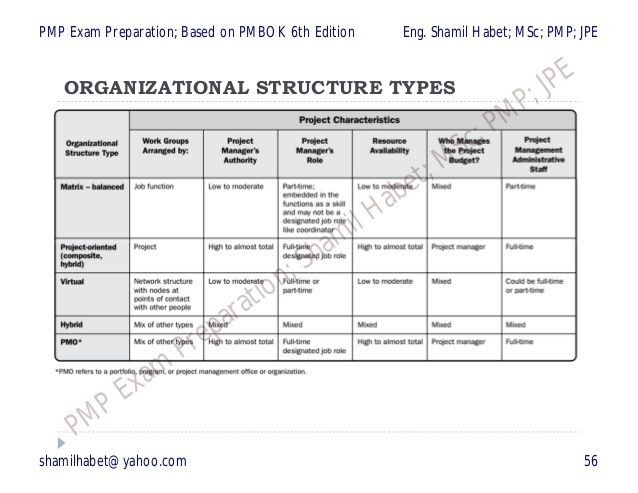
- 64influence of organizational structure types on projects
- 65Project phasescollection of logically related activities that culminates in the completion of one or more deliverables. The phases can be defined and named no meet project needs. Generically, it is: Start, preparation, execution, finish
- 66Phase gatereview at the end of a phase to define if the project can continue to next phase or if it has to go with changes or, even, if it should be ended.
- 67Project management processesa systematic set of activities directed toward causing an end result where one or more inputs will be acted upon to create one or more outputs (SIPOC)
- 68project management process grouplogical grouping of project management processes in the way that the project moves from initiation to closing. They are 5: initiation, planning, execution, monitor and control, closure
- 69Project management knowledge areaan identified area of project management defined by its knowledge requirements and described in terms of its component processes, practices, inputs, outputs, tools and techniques.
Knowledge areas are designed to group processes which have common knowledge characteristics. This means that knowledge areas are divided to keep the same type of skill set (or knowledge) in one group. - 70ITTOinputs, Tools & Techniques, outputs
- 71Difference between Project Management Process Groups and Project PhasesProject phases relate to a life cycle. Process groups represent related processes that are performed at different stages of a project, throughout its lifecycle. Processes are repeated in each phase of the project. We plan each phase, execute and close it. Monitoring & controlling is a continuous activity - we do the same with the project overall but those are different things
- 72Life cycle models, development life cycles, frameworks based on a development life cycle and approachesmodels: predictive and adaptative development life cycles that belong to these models: waterfall - predictive, iterative, incremental adaptative
frameworks based on those life cycle models: SCRUM, SDLC, V, Spiral
approaches: Agile, Lean, TQM - 73relationship between process group and knowledge areathere is no relationship between knowledge area and process group. Every knowledge area will have processes from every process group.
In knowledge areas, processes are grouped according to their similarities on the subject.
Información
- Descripción
- key concepts of PMI's PMBOK chapter 1
- Creado por
- kelly nascimento
- Visitas
- 91
- Etiquetas
- Valoración