
Fichas
Chapter 17: Economic growth and the economic cycle
Fichas del conjunto (154)
- 1What is meant by the term ''economic growth'' ?An increase in the economy's potential level of real output, and an outward shift movement of the economy's production possibility frontier
- 2What is meant by ''GDP''Gross Domestic Product
- The value of output of goods and services produced in the UK during one year
- Primary, secondary and tertiary services
- Real versus nominal output
- Can be viewed as being national income, national output or aggregate demand - 3What is GDP per capita ?GDP divided by the population (GDP per head)
- 4Define short-run economic growthShort term growth is measured by the annual % change in real national output
- This is mainly driven by the level of aggregate demand but is also affected by shifts in SRAS - 5Define long-run economic growthShown by an increase in trend potential GDP and is illustrated by an outward shift in a country's long run aggregate supply curve (LRAS)
- 6How is short-run economic growth shown on a production possibility frontier ?NOT as a shift
Shown by the movement from a point inside the PPF to a point on the PPF
Short-run growth makes use of SPARE CAPACITY - 7How is long-run economic growth shown on a PPF ?Shown by the movement from a point on the PPF to a point on the new PPF following an outward shift.
- Long-run growth increases total productive capacity - 8Define potential growthThe overall capacity of the economy
(What the economy could produce if it used all its resources) - 9Define actual growthThe annual percentage increase in output
- 10Define nominal growthThe growth in output not including any adjustment for price changes expressed as 'current prices'
- 11Define real growthGrowth in GDP adjusted to take account of changes in the price level- expressed as 'constant prices'
- 12What is the 'output gap'The difference between the actual level of GDP and the estimated long-term trend value. If actual GDP is below the trend line this is a negative output gap.
- 13How is economic growth measured ?Measured by the % annual increase in real national output
- 14Define real national outputThe total of all the goods and services produced in an economy over a particular time period.
- 15How can real national output be calculated ?By subtracting the rate of inflation from the increase in nominal national output over the period of time
- 16What does an increase in real national output imply ?Aggregate demand has risen faster than the rate of price inflation and therefore the economy is experiencing positive economic growth
- 17Define NOMINAL national outputReal national output X average price level for the year in question
- 18What is the calculation for the approximate change in real national output ?Rate of change of nominal national income -
rate of inflation - 19The change in real national output measures what about the economy ?Economy's rate of growth
- 20The change in NOMINAL income does what about the growth rate ?Overstates the growth rate
- 21Define national income/ national outputThe flow of new output produced by the economy in a particular time period
e.g. 1 Year - 22In order to produce the flow of national output, the economy must possess what ?1) National capital stock
2) Stock of human capital - 23What is national capital stock ?- Part of the stock of national wealth
- All physical assets owned by us
- Includes capital goods, raw materials and social capital - 24Define social capitalThings owned by the state, excluding consumer goods which is included in national wealth
- 25What happens to national capital stock over time due to capital consumption ?Depreciates
- 26How do we maintain the size of the capital stock so that the stock is capable of producing exactly the same size of national income the following year ?Part of the current years national output must be replacement capital goods
- 27What is the consequence of not spending on replacement investment ?National capital stock shrinks in size
negative economic growth occurs and the PPF shifts inward - 28What does positive economic growth generally require from investment ?Investment that takes place above the replacement investment level as extra investment is needed to enlarge the capital stock
- 29What is net investment ?Spending which increases the availability of fixed capital goods or means of production and goods inventories
- 30Define gross investmentThe sum of replacement investment and net investment
- 31What are the 2 main things that net investment causes ?1) Increase in the size of the capital stock
2) Facilitates long-run positive economic growth - 32How is negative economic growth expressed ?As a negative percentage
- 33Define gross national productSame as GDP but also includes output produced in other countries
e.g. residents living in other countries working for a Multinational corporation - 34Define gross national incomeMeasures the total value of national income, including that generated in other countries
- 35What is net income from abroad ?The difference between inward and outward profit flows
- 36What is included in GNI but excluded from GDP ?Net income from abroad
- 37Which is a better measure of standard of living of UK residents, GDP or GNI ?GNI
- 38Which is a better measure of productivity ? GDP OR GNI ?GDP
- 39Is net income from abroad usually positive or negative ? What does this show ?Positive
- Shows that the country has invested in and accumulated assets in other countries over time. - 40Which is usually larger, GNI or GDP ?GNI
- 41For most developing countries, which usually exceeds the other ? GDP or GNI ? Why ?GDP usually exceeds GNI
Due to profit outflows and interest payments to developed world Multinational corporations and banks - 42Sum up the main differences between GNI and GDP1) GNI is a better measure of standard of living
2) GDP is a better measure of productivity
3) GNI is generally large than UK GDP
4) In developing countries, GDP usually exceeds GNI - 43How can market price data (nominal data) be turned into real data, for example, to show real GDP ?By subtracting the rate of inflation from the nominal data
For GDP, a deflator can be used by doing the calculation
Nominal/ Real = deflator / 100 (previous figure) - 44The rate of growth of an economy depends on what 5 main things ?1) Technology- as technology improves, countries can use their existing resources more productively
2) Capital goods- investment in capital goods increases productivity and leads to future growth
3) Savings- saving enables investment by providing the funds for firms to invest
4) Resources- the more resources an economy has, the more effectively it uses its natural resources, the more it can grow
5) Investment in people- the more that countries invest now, the more likely it is that they will grow in the future. Better training and better research may lead to future economic growth. - 45Explain the endogenous growth theory(incorporates the causes of technical progress into the theoretical explanation of the growth process)
- Governments can create supply-side conditions that favour investment and technical progress
- These conditions include external economies for businesses, often in the form of infrastructure, and a judicial system which protects patents and other intellectual property rights, and which enforces the law of contract - 46What is a better measure of improved human happiness than economic growth ?Economic development
- 47Economic development is measured by: (4 marks)1) Improvements in living standards that reduce poverty and human suffering
2) Greater access to resources such as food and housing required for basic human needs
3) Greater access to opportunities for human development: education and training
4) Environmental sustainability & regeneration, through reducing resource depletion and resource degradation - 48Define resource depletionOccurs when finite resources are used up
- 49Define resource degradationMaking things worse
e.g. pollution of air - 50Define sustainable economic growthUsing renewable resources.
Using technologies which minimise resource degradation - 51What are the main benefits of economic growth ? ( 2 marks )1) Higher incomes may lead to better material welfare, health, education and opportunities
2) Poverty may be reduced as extra tax revenue raised may be used to, e.g. Increase benefits, spend on schemes to train the unemployed - 52What are the main problems with economic growth ( 5 marks )1) Income growth may be achieved by some groups being exploited and suffering from poor living standards and working conditions
2) Additional income may not be used to benefit households directly, e.g. may be spent on military hardware
3) Income may be kept by a few, leading to bigger differences between high income and low income groups
4) How beneficial economic growth is depends on how sustainable it is. If an economy is growing by depleting non-renewable resources and/or creating pollution, future generations may not be able to benefit from the same rate of economic growth
5) A steady rate of economic growth may be more beneficial than one that fluctuates. This is because it makes it easier to plan and is likely to encourage investment - 53What is the main trade-off in terms of maximising the economy's growth rate, measured by GDP Growth ?Maintaining and improving environmental quality and maximising the economy's growth rate.
- 54What are the 3 main components of economic welfare ?1) Economic welfare derived from goods and services purchased in the market economy
2) Economic welfare derived from public goods and merit goods collectively provided by the state
3) Economic welfare derived from the quality of life factors, including - external benefits and intangibles - external costs and intangibles. - 55What two measures of economic growth are usually used to measure standards of living ?GDP AND GNI
- 56GDP and GNI only capture which of the 3 components of standard of living ?the first 2
It ignores the intangible factors, including the value that people place on leisure time, living close to work, externalities generated from the production and consumption of national income which affect people's welfare and quality of life. - 57What are the main positive externalities provided by the environment ? ( 3 marks )- Beautiful views
- Clean air
- Water-retaining and CO2 absorbing properties of forests - 58What are the some of the main negative externalities of the environment ? (4 marks)- Traffic congestion
- Acid rain pollution
- Rising sea levels
- Climate deterioration caused by global warming - 59If the pursuit of economic growth leads to the destruction of positive externalities of the environement, this is an example of what situation ?A conflict between the government's objective and environmental objectives
- 60A welfare loss may be shown as an increase in national output, what does this falsely indicate ?An apparent welfare gain
- 61Give an example of when an increase in national output might ignore a welfare lossStresses and strains of producing an ever higher national output can lead to a loss of leisure time, make people more ill
This will show up in the national accounts as extra consumption of healthcare. - 62How does the extra time motorists spend in traffic hams caused by increased traffic congestion contribute to economic growth ?- Increased expenditure on petrol and garage services
- 63What are 'regrettables' ?Goods which fend off some of the adverse effects of a deteriorating environment, such as breathing masks and flood protection barriers.
- 64What is exponential growth ?Accelerating rates of population growth and resource use
- 65What might limit a government's ability to achieve high employment levels and continuing economic growth ?The environment, in terms of raw material and energy shortages.
- 66What was the 1970s gloomy prediction of how the world would be running out of oilExponential growth of oil consumption and exponential depletion of known oil reserves
- 67Draw a typical economic cycle*Include potential growth line* above both trend and actual growth
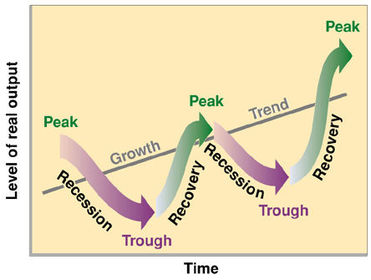
- 68What is the economic cycle ?The fluctuation of real output above and below the trend output line
- 69Fluctuations in economic activity occur in which 2 main ways ?1) Seasonal fluctuations
2) Cyclical fluctuations - 70What are seasonal fluctuations largely caused by ?Changes in climate and weather
e.g. effect of very cold winters closing down the building trade and seasonal unemployment in travel and tourism - 71Cyclical fluctuations divide into what categories ?1) Short economic cycle ( business cycle and trade cycle )
2) Long cycles (long waves) which arguably extend over approximately 60 years. - 72Long cycles are caused by what main factors ?1) significant improvements in technical progress causes firms to invest in new technology, triggering a long term boom
2) When these innovating technologies become fully used, long booms slow down until the next burst in technical activity creates another boom - 73In an economic cycle, what fluctuates considerably from year to year ?Economy's growth rate
- 74Economic cycles, between 4 and 12 years, are caused primarily by what ?1) Fluctuations in aggregate demand
2) Supply-side factors e.g. supply shocks (in recent years included) - 75From an economy's trend output, what can be calculated ?The economy's long-term growth rate
- 76What rises and falls in the different phases of the economic cycle ?Actual output
- 77Define short-term growthmeasured by the % change in real GDP over a 12 month period, varying in different phases of the economic cycle.
- 78What happens in a cycle's upswing ?Growth is positive
- 79What is the economy's trend (potential) growth rate ?The rate at which output can grow on a sustained basis without putting upward or downward pressures on inflation.
- Measured over a period covering more than one (preferably several) economic cycles. - 80Before 2000, the UK's trend growth rate was judged to be about what ?2.25% per year.
- 81Although a 2.25% growth rate seems low, why is it good compared to NICS such as China ?Similar to long-run growth rates of other developed economies in Western Europe and North America
- The absolute increase in real output delivered by a 2.25% growth rate may exceed that delivered by a (10%) growth rate in a poorer country. - 82What effect ensures that a 2.25% growth rate meant that average UK living standards doubled every generation or so?Compound interest effect
- 83What effect explains why the trend output line becomes steeper from year to year, moving along the line ?The compound interest effect
- 84Define recessionA fall in real output for 6 months or more
- 85Before 2008, how many recessions had there been in the UK since the 1970s ?2
- 86Both recessions raised unemployment to what figure ?Around 3 million
- 87Both recessions were followed by what periods in the rest of the 1980s and 1990s ?Periods of recovery and boom
- 88What are the characteristics of a recoveryEconomy picks up
demand is increasing
firms begin to invest - 89What are the characteristics of a boom ?More confidence in the economy
investment is high but beginning to be shortages of supply
e.g. labour - 90What are the characteristics of a recession ?- Falling demand
- rising stocks of unsold goods
- some firms close
- unemployment rises
- Two successive quarters of negative GDP growth - 91What are some causes of a recession ?1) Lack of aggregate demand e.g. due to lack of investment perhaps due to lack of confidence in the economy and higher interest rates deferring borrowing. Contraction government policies such as by increases taxes or intervening at the wrong time to slow up a boom and end up causing a recession.
2) Supply-side shock e.g. higher energy prices shifting aggregate supply to the left leading to higher prices but less output - 92What is a doubled-dip recession (W RECESSION) ?A situation where the economy appears to be recovering from recession but is quickly dragged into another downturn.
- 93What is a U shaped recession ?Long and deep recession such as the ones experienced in the 1980s and 1990s
- 94What is 'flat-lining' ?When growth is slightly positive (around 1% on an annual basis) but insufficient to constitute a proper economic recovery
- 95What is the UK government's definition of an economic cycleThe beginning and ending when there are no output gaps
- 96What was 2002 and 2007 the tail end of ?Tail-end of a long economic boom from the 1990s
- 97When did the mild cycles of most of the 1990s and the early 2000s end ?2008
- 98What were the main causes and characteristics of the 2008 recession ?- Caused by US and UK banks lending to high-risk borrowers in what was called the 'sup prime market'. This left them exposed when borrowers could not repay. Profits fell and banks assets lost worth.
- Banks became wary to lending to households, firms and to other banks; called the CREDIT CRUNCH
- Hit sectors such as leisure, tourism and consumer durables and construction.
- Less demand for property and fall in house prices. Reduced wealth of households and fall in spending
- Interest rates cut by Bank of England to encourage spending.
- Economic growth slowed after 15 successive years of growth.
- Inflation reached over 4%
- Pound hit a 12 low against the euro - 99What is a 'growth recession' ?A period of very weak growth or possible stagnant output and high unemployment. Characteristics of a recession
- 100What is an output gap ?The difference between actual output and the trend output line
- 101What is a negative output gap ?Occur when actual output is below the trend output line.
They can occur in the recovery phase of the economic cycle when output is growing as well as in the cycle's downturn - 102What is a positive output gap ?Occur when actual output is above the trend output line.
Can occur both in a cycle's boom phase and when the downturn has started. - 103What can be used to illustrate output gaps ?Production possibility frontiers
- 104How can a negative output gap be illustrated on a production possibility frontier ?As a point inside the PPF
- 105How can a positive output gap be shown on a PPF ?By the economy temporarily producing at a point outside its current PPF.
- 106Why cant a point beyond the PPF be sustained for long ?Represents overuse of capacity
- 107With a point beyond the PPF, what should happen ?Long-run economic growth should shift the frontier outwards
- 108What is the multiplier effect ?Refers to an increase in final income arising from any new injection of spending. It is the number of times a rise in national income exceeds the rise in injections of demand that caused it
- 109What is the accelerator effect ?- Planned capital investment spending linked to the growth of demand for goods and services
- When demand is rising strongly, businesses may increase investment to expand their production capacity
- A slowdown in demand creates excess capacity and may lead to a fall in planned investment demand - 110Give an example of an injection of demand into the circular flow of income causing a multiplier effectAn injection of extra income
- 111Each time, what is the extra spending and income in terms of the previous addition to the circular flow of income ?Extra spending and income is a fraction of the previous addition to the circular flow of income
- 112In the 1930s, John Maynard Keynes suggested the concept of the multiplier process to be what ?A tool to help governments maintain high levels of employment
- 113Explain how the Multiplier effect is a 'demand-management approach''Measured the amount of government spending needed to reach a level of national income that would prevent unemployment. Designed to help overcome a shortage of capital investment
- 114What are the main factors which affect the value of the multiplier effect ? ( 2 points )1) Higher the propensity to consume domestically produced goods and services, the greater the multiplier effect (government can influence through indirect taxes)
2) Size of the multiplier decreases when propensity to purchase imports increases. Leakage from the circular flow of income and spending. - 115The multiplier effect requires what for extra output to be produced ?Sufficient spare capacity in the economy
- 116What ensures the full multiplier effect occurs in terms of AD/AS and elasticity ?- Full multiplier unlikely to occur if SRAS is inelastic because increases in AD will lead to higher prices rather than a full increase in RNO
- SRAS elastic a rise in AD causes a larger increase in national output - 117When will the multiplier effect be larger ?1) Propensity to spend extra income on domestic goods and services is high
2) Marginal rate of tax on extra income is low
3) Propensity to spend extra income rather than save is high
4) Consumer confidence is high (affects willingness to spend)
5) Businesses in the economy have the capacity to expand production to meet increases in demand - 118What is one of the problems with the multiplier effect ?There is a time lag.
It takes time to come into full effect - 119What can limit the initial impact of spending projects ? (2 MARKS )1)Delays in sourcing raw materials
2) Finding sufficient skilled labour - 120What is the calculation for the value of the multiplier ?Multiplier = 1/ (sum of propensity to save + tax + imports )
- 121Explain the role of speculative bubbles contribution to economic cycles-A rapid rise and speculative bubble in asset prices is caused by rapid economic growth
- When people realise that house prices rise above the assets' real values, asset selling replaces asset buying.
- Causes speculative bubble to burst which destroys consumer and business confidence
- People stop spending and the economy falls into recession - 122Explain the political reasons behind the economic cycle- General elections can engineer pre-election booms, increasing level of demand and falling unemployment
- Post-election may face demand-pull inflation due to too much demand in the economy.
- After election AD is deflated and the process repeats itself - 123Explain how outside shocks hitting the economy contribute to the economic cycleDemand shocks and supply shocks
e.g. * war in middle-east causing demand shock and collapse in consumer confidence and supply shock via effect on the price and supply of crude oil - 124Explain how the inventory stock cycle contributes to economic cyclesFirms are slow to adjust to changes in economic activity
- Demand falls - firms may not cut output until fully convinced
- when they do realise and they have accumulated stocks they cut output below level of demand * WORSENS THE SLUMP CAUSING A FURTHER FALL IN AD - 125To help economic growth, what might the government do ?1) Promote education e.g. provide funds, ensure qualifications are relevant to industry
2) Promote mobility of factors of production between industries
3) Promote supply-side policies e.g. remove barriers to labour market flexibility, cut taxes to increase incentives, improved the amount and quality of information available
4) Promote research and development e.g. give tax breaks for investment in R&D
5) Promote saving e.g. provide incentives for households to save - 126Explain how climatic cycles contribute to the economic cycleClimate affects business and consumer confidence.
e.g. crops, fishing etc - 127Explain how marxist theory contributes to the economic cycleEconomic cycles are restructuring processes to increase the rate of profit in capitalist economies
- Recessions create conditions where stronger firms take over weaker competitors or buy at very low prices the assets of rivals forced out of business
- Economic cycles deemed necessary for the regeneration and survival of capitalism - 128Explain how the multiplier/ accelerator model contributes to the economic cycleKeynesian economists believe that the interaction of the multiplier and accelerator can cause business cycles
1. Increase in injections can set off the multiplier which leads to increased output.
2. To produce this output, firms increase level of net investment which sets of multiplier.
3. At some point economy reaches full capacity and output cannot be easily increased
4. Output may rise but less causes a fall in level of net investment (accelerator) and a downward multiplier
5. limit to how much investment will fall as some firms will always invest e.g. new equipment to replace old - 129What can be used to try and reduce fluctuations in the economic cycle ?Demand management policies
- 130In the Keynesian era, what was used to reduce fluctuations in the economic cycle ?Fiscal policy
- 131During the Monetarist era in the late 1970s and early 1980s, what was abandoned ?Demand management
- 132Abandoning demand management during the monetarist era arguably did what to the recession at the beginning of the 1980s ?Lengthened and deepened it
- 133Since the end of the 1992 recession, what has been used successfully to stabilise the economic cycle ?Monetary policy
- 134In a boom, when the economy is overheating, what does the Bank of England do ?Raises the bank rate to contract or deflate aggregate demand.
- 135In a downturn, what does the Bank of England do ?Lowers to bank rate to reflate or boost aggregate demand
- 136What is required for successful stabilisation of the economic cycle ?AAccurate timing
- 137If monetary policy is used to stabilise the economic cycle, how and when should interest rates be used ?Should be raised BEFORE output would otherwise peak in the boom phase of the economic cycle.
Should be cut BEFORE output bottoms out in the downturn that follows - 138What is the danger of bad timing in trying to stabilise the economic cycle ?It will destabilise the economic cycle and make the fluctuations more volatile
- 139How might bad timing be responsible for extent of the 2008 recession ?The UK government used contractionary fiscal policy in order to cut its budget deficit. According to Keynesian theory, expansionary fiscal policy should have been used to 'spend the economy out of recession'.
- 140What is an overheating economy ? (boom)Occurs when its productive capacity is unable to keep pace with growing aggregate demand
Inflation increases due to prolonged growth rate and the producers produce in excess, creating excess production capacity - 141What are the main causes for an overheating economy ?(boom)1) High levels of aggregate demand
2) Excess spending due to increased consumer wealth causing insufficient allocation.
3) real GDP grows faster than the trend rate of economic growth - 142What are the main characteristics of an economic boom ? ( 7 marks )1) Strong and rising levels of AD
2) Rising employment and real wages
3) Increased demand for imported goods and services
4) Government tax revenues rise quickly
5) Company's profits and capital increase
6) Rising productivity
7) danger of demand-pull & cost-push inflation - 143What is the UK trend rate / (economic objective) ?2.50%
- 144How can interest rates be used to stabilise an economic boom ?1) BOE increase bank rate before peak
2) Firms invest less because the cost of borrowing is higher
3) Opportunity cost and the benefit of saving increases, save more and spend less
4) Both investment and consumer spending (AD FORMULA) fall. - 145What is the issue with using interest rates to stabilise the economic cycle ?There is a time lag, they take a long time to make an impact.
*Bank of England kept interest rates at 0.5% in March 2009 for monetary stimulus to the economy. We are still recovering and with a current economic growth rate of 0.7% (Q4 2014) - 146How might taxes be used to stabilise an economic boom ?Higher taxes = less disposable income = less spending = fall in aggregate demand
- 147DEFINE PRODUCTIVITYoutput from a given input
- 148What are the main measures of productivity? ( 3 marks )1) Output per person employed
2) Output per person/ hour worked
3) Total factor productivity - 149Increases in productivity lead to what ?Higher potential output for the economy (LRAS)
- 150Higher productivity helps to control what ?unit labour costs and therefore inflation
''NON-INFLATIONARY'' - 151Explain the difference between GNI and GDP-
- 152Explain two benefits and two costs of economic growth (12 marks)-
- 153'Some economists argue that recessions are necessary for restructuring the economy Evaluate this view (25 marks)-
- 154Evaluate 3 policies the government could use to increase the economy's long-term rate of growth (25 marks)-
Información
- Descripción
- A2 (MACROECONOMICS) Economics Fichas sobre Chapter 17: Economic growth and the economic cycle , creado por callum_j.smith el 27/12/2014.
- Creado por
- callum_j.smith
- Visitas
- 233
- Valoración