
Fichas
BMS12-1041 - Thorax 2 - Anatomy of respiration
Fichas del conjunto (34)
- 1During inhalation which two muscles contract?1. External intercostals move ribcage up and out
2. Diaphragm contracts and moves down
Results in drop in pressure below atmospheric - 2During inhalation which two muscles contract?1. Internal/innermost intercoastals contract and move ribcage down and in
2. Abdominal muscles contract and push diaphragm back up
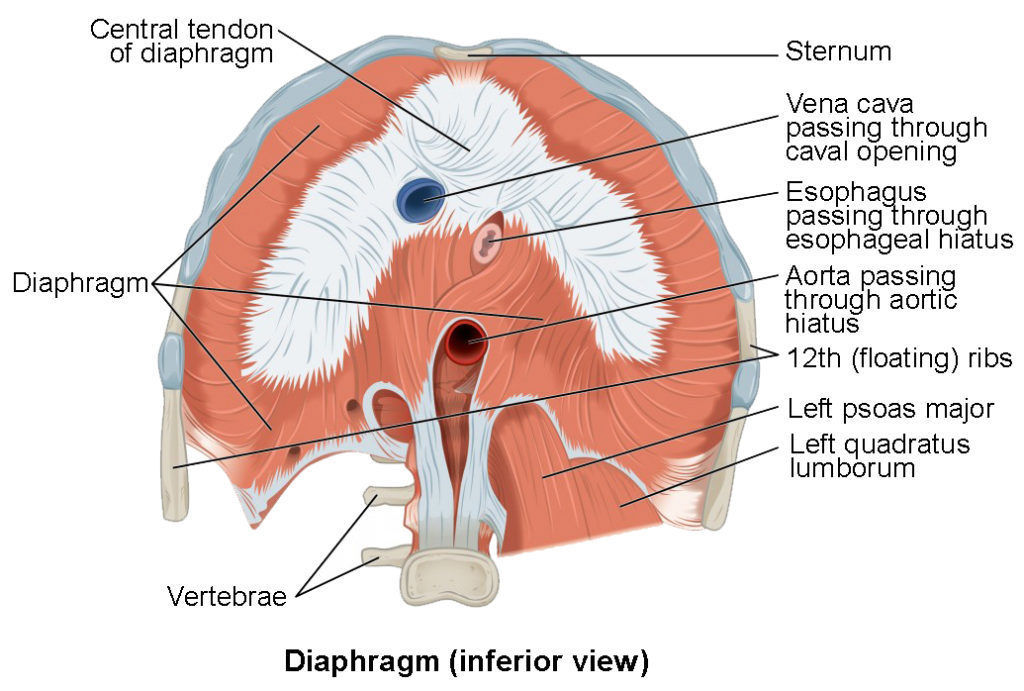
Results in raise in pressure above atmospheric - 3What are the 5 attachments of the Diaphragm?1. Lumbar vertebrae and accurate ligaments
- Right crus stretches down and attaches to L1, L2 & L3
- Left crus stretches down and attaches to L1 &L2
2. Coastal cartilages of ribs 7-10
3. Direct attachments of floating ribs 11 & 12
4. Xiphoid process of sternum
5. Central tendon of Diaphragm which is an aponeurosis (pearly white fibrous tissue)
- inferior to fibrous pericardium - 4What are the 3 major tubular structures passing through the diaphragm?1) Caval Hiatus/Opening
- Inferior Vena Cava (T8)
- Passes through the central tendon
2) Oesophagus Hiatus
- Oesophagus (T10)
- Oesophageal branches of left gastric artery/vein
3) Aortic hiatus
- Aorta (T12 - behind the diaphragm, sitting next to the vertebrae) - 5Which opening does the right phrenic nerve pass through in the oesophagus?Caval Hiatus with the inferior vena cava
- 6Which opening do the vagus nerves pass through in the oesophagus?Oesophagus Hiatus behind the root of the lung
- 7Which opening do the Thoracic duct and Azygous vein pass through in the oesophagus?Aortic hiatus
- 8What 2 things innervate the diaphragm?1. C3 4 5 keeps the diaphragm alive! Phrenic Nerve (somatic PNS)
2. Intercoastal Nerves - 9Motor neurons are located in theVentral root ganglion
- 10Sensory neurons are located in theDorsal root ganglion
- 11What are the primary muscles of respiration?Intercostal muscles
- 12What are the secondary muscles of respiration?1. Pectoralis Major
2. Pectoralis Minor
3. Sternocleidomastoid
4. Scalene muscles
5. Serratus Anterior
6. Subcostal muscles
7. Transversus thoracis
8. but MAINLY ABDOMINAL MUSCLES - 13What facilitates quiet expiration?Is a passive process facilitated by the elastic recoil of lungs
- 14Which 2 muscles are primarily involved in forced expiration?1. Internal intercostals
2. Abdominals - 15What is the function of the larynx?Produce sound
Breathe
Protect trachea from food aspiration
Opens during coughing/sneezing - 16Where is the pharynx? What does it do?In the throat right behind the nasal cavity, above the larynx and oesophagus
Plays a role in vocalisation - 17What are the three parts of the pharynx?1. Nasopharynx
2. Oropharynx
3. Laryngopharynx - 18What type of cartilage lines the trachea? What smooth muscle?Hyaline cartilage
The trachealis - 19What is the carina? Where is it located?A ring of cartilage between main division of bronchi (in line w sternal angle/T4)
Mucous membrane triggers cough reflex/prevents things from entering - 20Which bronchus is more vertical? What is a consequence of this?The right one (left is more angled because of the heart)
Foreign objects more likely to fall into right bronchus - 21What part of the lungs are the bronchopulmonary segments in? What is unique about them?In the tertiary branch of the bronchioles
Independent units with own artery/vein - 22The left lobe has how many lobes? Which fissure (s)?2 (smaller bc heart)
Oblique fissure - 23The right lobe has how many lobes? Which fissure (s)?3 (bigger bc no heart)
Oblique+horizontal fissure - 24What are the 3 surfaces and borders of the lungs?Surfaces: costal, diaphragmatic, mesdiastinal
Borders: anterior, inferior, posterior - 25What 6 things do the root of the lung contain?1. Bronchi
2. Pulmonary artery (superior)
3. Pulmonary vein (inferior)
4. Oesophagus
5. Aorta
6, Superior vena cava and inferior vena cava - 26What does the superior vena cava branch into?Right/left brachiocephalic veins
- 27What are the pleuras of the lung from inside to out?1. Visceral pleura (covers surface of lung)
2. Pleural cavity (fluid filled)
3. Parietal pleura (Membrane outside) - 28What are three functions of the pleura?1. reduce friction
2. reduce surface tension between layers
3. create negative pressure - 29The visceral pleura is innervated by1. Vagus nerve (pns)
2. sympathetic nerves - 30The parietal pleura is innervated by1. Intercostal nerves
2. Phrenic nerve - 31What are the two separate circulations to the lungs?1. Pulmonary (for reoxygenation)
2. Bronchial (for nutritive) - 32What does the phrenic nerve innervate?1. Diaphragm
2. Parietal pleura
3. Pericardium - 33What are the 4 subdivisions of the parietal pleura?1. Cervical (at apex)
2. Costal (at side)
3. Mediastinal (near heart)
4. Diaghpramatic (at bottom) - 34The posterior limit of the diaphragm is at? The anterior limit of the diaphragm is at? The inferior limit is at? The superior limit is at?1. T12
2. Costal margin
3. 4th intercostal for right
5th intercostal for left
xiphisternum for central tendon
Información
- Descripción
- BMS10 - Cardiovascular System Fichas sobre BMS12-1041 - Thorax 2 - Anatomy of respiration, creado por Evian Chai el 12/04/2020.
- Creado por
- Evian Chai
- Visitas
- 38
- Etiquetas
- Valoración