
Fichas
CS150
Fichas del conjunto (83)
- 1conception about bigger space before?more advisable to have bigger space before because that meant you can put more. but that concept was changed.
- 2What is parallel programming?small weak computers can be configured with processors/special software that would improve their performance; they are grped together as clusters/grid; massively parallel system
- 3types of multiprocessors?mainframe and server
- 4mainframe?perform concurrent simple tasks
- 5supercomputer?aimed to solve few computationally intensive tasks
- 6what make supercomp and mainframe similar?both have many processors. They can do what each other can do provided that they are given the same software. Their performance depends on the software installed to them.
- 7Changes in technologyPerformance- must double every 1.5 years
Cost- depreciation; people are smarter now in manufacturing; "learning curve"
Function- ie. phone that can be a camera, video recorder blabla - 8perception on size of a device- size as dictate of design not performance
- small/large device can be weak/powerful
- performance not based on size anymore - 9graphical representation of the relationship between learning and experiencelearning curve
- 10Moore's Lawperformance doubles every 1.5 years
- 11Why does Moore's Law's meaning never change?before, the number of transistors are parallel to the performance.
- 12What is a transistor?a microscopic switch with on/off states; allow/not allow electricity to pass through; more transistors mean more ability to answer
- 13What does a computer system do?it breaks down complex questions into simple ones that can be answered by yes/no (transistor's task) ; system is not smart, but fast because you have to explicitly state its course of decisions. Unlike for man, you can come into conclusion w/o explicitly saying the steps you took to arrive at such conclusion.
- 14Why does tech improve exponentially?because of other technology; the improvement of tech is brought about by an existing one; ex. iphone from ipod + phone; not really new in terms of products, but new in the sense of procedures
- 15transistor density? die size? disk?- how many transistors put together
- square that transforms itself into CPU
- optimal size that we can handle - 16task of computer architecture & factors to consider when recommending- be able to recommend computer/needs
- Application: saan gagamitin yung computer?
- History: what worked/didn't work in the company
- Prog Language- C, C#, Java ba?
Technology- web-based ba or.........
- budget!!!!
- maximize performance - 17yield?percentage of good products over total products; increase in yield means increase in LC which affects the cost
- 18formula for cost of die= wafer cost / (dies per wafer * die yield)
- 19IC cost formula(die cost + packaging cost + testing cost) / (final test yield)
- 20cost when finding out the good/bad die waferstesting cost
- 212000 die wafers, 50% die yield, 25% IC yield answer?= 2000 * 0.5 * 0.25
= 250 IC - 22die in the beginning..............has no circuit then the good ones are transformed into IC
- 23direct cost? gross margin? ave discount?- coming together of components; labor
- aka indirect cost; R&D, advertising cost
- profit; ito yung range na binabawasan ng retailers - 24time it takes to finish one tasklatency/execution time/response time
- 25how many tasks that can be performed at a given timethroughput/bandwidth; measured as rate
- 26execution time & performance??inversely proportional
- if lower exec time, better performance - 27Amdahl's Lawimproving 1 computer means improving the part/component that you use the most in order to feel the change
- 28Fraction enhanced and Speedup enhanced- how often is the component used? ; should be less than or equal to 1 (percentage)
- how much faster is the new improvement? ; greater than 1; if equal to 1, then there's no improvement at all - 29formula of amdahl's lawextime old / extime new = 1 / ((1-fe) + (fe/se))
- no unit; "___ times better than old performance" - 30CPU clock- have a particular cycle that dictates computer operations
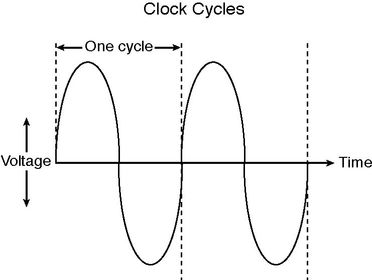
- comp operations are implemented in accordance with the rate of the cycle - 31What is a cycle?the interval between the start of the burst and the start of the next burst ; electricity is present during burst; measured by Hertz; 3 cycles = 3 Hertz
- 32CPU and floating numbers- floating number: ridiculous number of decimal pts
- CPU that can compute floating pt operations is more ideal/more precise
- such performance is significant when computing pixels for gaming - 33Locality of reference- CPU: the brain
- main memory or RAM: primary memory; what we upgrade is really the RAM
- secondary memory: large memory space that is relatively slow; hard drive; storage - 34interaction among CPU, RAM and HDAnalogy
- the secondary memory is like a cabinet with all files; RAM is the study table that contains address; CPU gets the data from memory then works on the RAM or respective address
- highest priority is given to the data you use now - 35temporal locality? spatial locality?- across time, there's data with high probability of referencing; for example, alam na ng waiter yung i-oorder mo kung yun yung lagi mong inoorder
- more on space; high probability of referencing of data that are juxtaposed with each other - 36- what is a benchmark? - types of benchmark?- benchmark is the act of running a computer program, a set of programs, or other operations, in order to assess the relative performance of an object, normally by running a number of standard tests and trials against it.
--- types---
- synthetic: fake program, can be cheated, artificially changing results to match with benchmarks
- Toy: literally toy; hindi gaanong ginagamit
- kernel: "isolated performance"; come from real program; real prog into pieces - 37Computer hardware - what are the parts of the computer?- processor: CU + datapath
- Memory: Main memory / secondary memory
- Input/Output - 38what is a control unit? what is a datapath?CPU- has control unit inside
control unit- issues signals to the rest of the CPU
- datapath is a collection of functional units, as arithmetic logic units or multipliers, that perform data processing operations, registers, and buses.
- all other parts won't function unless given a signal by the CU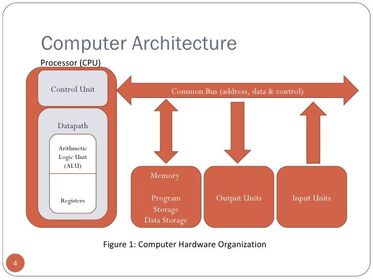
- 39Von Neumann Machine vs Harvard ArchiVN - applied the concept of alan turing; programs are executed sequentially; parameters can be changed; bottleneck
H.A.- made 4 pathways for data and instruction & their respective addresses; solved the bottleneck; can be accessed simultaneously
http://v-codes.blogspot.com/2010/09/difference-between-harward-and-von.html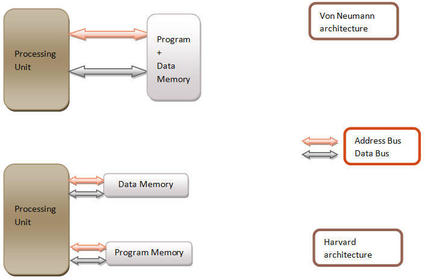
- 40What is the memory hierarchy- registry is the fastest
followed by cache, memory, secondary memory
- access time is the time it takes to locate the data and give data
- smaller size means better performance kasi mas konti yung space na hahanapan
- tapes are the slowest because it's sequential; longer process - 41- boss inside the CPU - fed with instructions - without its signals, other parts of CPU will not functionCONTROL UNIT
- 42parts of this have specific roles that are non-flexible; one primary example is register; general purpose- can hold general data and special purpose- limited to data specified to it (adobo analogy)DATAPATH
- 43higher vs lower programming languageHIGH LEVEL PL
- closer representation to the user; compiler tells RAM to make a space for 'x';various addresses contain x's; compiler binds value of x in the RAM's address
- garbage collection in higher level PL
- higher PL = more generic
- ease of implementation advantage
LOW LEVEL PL
- no garbage collection; explicitly states the need to have one
- closer to the machine; ex: C prog lang
- greater hardware detail = low level
- therefore, computer archi is more on low level
- control address of the hardware advantage
- more connected to hardware so you can specify the address - 44it performs the mapping - sets the representation - allows the operation to happeninstruction set architecture
- 45instruction cycleFetch instruction
Decode instruction
Operand Fetch
Execution
Store- store in the left operand - 46memory address register memory data register instruction register- contains the address to which the data is fetched from
- temporarily stores the data after it was fetched
- where the instructions permanently resides - 47signal issued by CU to fetch the instructionMEM read
- 48difference between risc and cisccomplex instruction set computers
- new processors are more powerful over older models to maintain compatibility
- use of microcode
- richer/more complex instruction sets simplify compiler design
- more powerful instruction means fewer instructions needed
- the more complex, the bigger the required control store is
Reduced ISC
- perform simpler ops and use simple addressing modes
- complex ops can be done by using several simpler ops
- 80/20 rule: if most used instructions was sped up, then the performance would be greater
- basic hardware ; easier to compile - 49set of machine level instructions for a particular type of computer or hardwareinstruction set
- 50the sequence of ops involved in processing an instructioninstruction cycle
- 51instruction cycle.....fetch instruction
decode instruction
operand fetch
execution
store - 52this happens when the memory informs the cpu that it has completed read/write request; memory sends mfc - memory function complete signal - situation in which memory & cpu are synchcpu-memory handshake
- 53types of control- hardwired
- microprogrammed - 54considerations to hardwired control- fast: everything done thru hardware
- permanent: difficult to modify
- difficult to implement in large instruction set - 55microprogrammed consideration- flexible because u can just modify the control store if needed
- slower and may require more hardware due to increasing number of instructions - 56considerations on microprogrammed- flexible because u can just modify the control store if needed
- slower and may require more hardware due to increasing number of instructions - 57areas of devt for cpu designsystem bus speed
internal and external clock freq
casing
cooling system
instruction set
wire material - 58what's the end result of these areas of devt in cpu design?enhance the speed of the cpu and system in general
- 59conduit for moving data between the processor and other sys componentssystem bus
main memory --> mar
MM --> mdr
MM --> control - 60speed of data processing inside the cpuinternal clock freq
- 61speed of data transfer to and from the cpu via the system busexternal clock freq
- 62faster? internal or external?internal!!!!!!!!!!!!!!!
external * multiplier = internal - 63how long will moore's law last?40 years!!!
- 64what's the purpose of micron tech? what is it in the first place?- 1 millionth of a meter
- objective is to have thinner wires
- allow cpu to operate at lower voltage
- generating less heat and operating at higher speeds - 65material used for wirecopper
- from MHz to GHz real quick - 66what about this system on chip?- many components bundled in one chip
this results to replacing dozen or separate chips - 67impact of system on a chip- longer battery life
- less heat dissipation
- smaller devices - 68fc-lga- for casing of the IC
- lower voltage used and less heat dissipation
- the pins are found in the socket and not in the chip itself - 69going beyond the recommended clock frequency; done by - system bus freq - cpu freq multiplier - change bothoverclocking
- 70exceeds the normal speeds depending on processing reqsdynamic overclocking
- 71cooling sysmake sure that cpu won't overheat as it tends to get hotter as it gets faster
- 72multimedia processing- gpu
- cpu that can compute floating pts operations faster is more ideal
- kung mabilis yung pixel calculation, mas okay daw for gaming - 73how to handle multimedia- speed up cpu
- use high-end 3d graphics cards
- pipeline implementation, multithreading (multiple processes at the same time)
- multimedia specific instructions - 74single-cpu innovation- internal: how many bits can the cpu process simultaneously?
- external: how many bits can the cpu receive simultaneously for processing? - 75superscalarSuperscalar processor executes multiple independent instructions in parallel. • Common instructions (arithmetic, load/store etc) can be initiated simultaneously and executed independently
- 76current innovation todaymulticore
multithreading - 77intel cpu lineuppentium
celeron
atom
core i3 5 7
xeon
itanium - 78amd cpu lineupdesktop
- amd fx
- phenom
- athlon
- sempron
tablet
- a series
server
- opteron - 79combining several components in a single chipaccelerated processing unit
cpu
gpu
memory controller
video encoder/decoder - 80intel cpu innovation- hyperthreading
- multicore
- quickpath interconnect - 81amd cpu innovation advanced micro deviceshypertransport
multicore
direct connect archi - 82POWER7+ 8 cores 4.42 Ghz 4 threads per core 32 nm process introduced TrueNorth- prototype chip that mimics 1 million human neurons and 256 million synapsesibm
- 83SPARC M6 Processor -12 cores 8 threads per core 3.6 Ghz 48 MB L3 cache 28 nm processORACLE
Información
- Descripción
- Fichas sobre CS150, creado por alanischelsea el 24/05/2015.
- Creado por
- alanischelsea
- Visitas
- 49
- Etiquetas
- Valoración