
Fichas
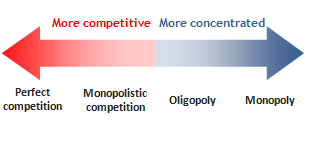
Concentrated Markets. Theory of Monopoly
Fichas del conjunto (45)
- 1—A monopoly is a market structure dominated by a single seller of a good
- 2Assumptions of a monopolyThe firm is the industry - the whole output of the industry is in the hands of a single firm
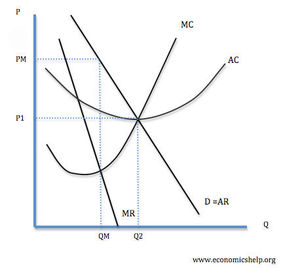
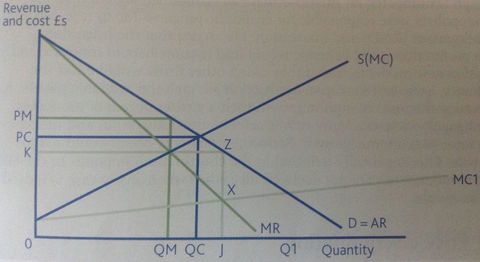
There are barriers to entry - no other firm is able to enter the industry - 3—The profit maximising output is where MR=MC so QM-PM. The monopolist is making SNP of P1-PM per unit. At this point the monopolist is not productively efficient because it is not producing at its lowest ATC. Firm may not be concerned about costs so it may be X-inneficient in terms of wasting resources it can save
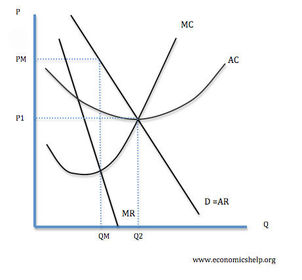
- 4X inefficientThe action of not reducing costs to their lowest level. It is the gap between the actual and lowest possible cost
- 5What barriers to entry can a monopolist use to keep competition away?Patent laws
Statutory monopolies
Economies of Scale
Unfair practices
High set up costs
Location - 6Patent lawsThe monopoly may have a grant of temporary monopoly rights over a product. For example, Dyson's vacuum cleaner.
- 7Statutory monopoliesWhere the government has nationalised an industry and it prohibits competition by law because they think the market is better off that way
For example, National Railway - 8LocationFirms may have control over essential raw materials. For example, local water companies or retailers buying most of the sites making it difficult for others to purchase suitable sites
- 9High set up costsIncumbent has created high fixed costs which will makes it difficult for new entrants coming into the market. For example, advertising on a massive scale.
- 10Why is the monopolist a price maker?Because it has total control over the market therefore they choose the level of output and price for the goods supplied depending on the firms objectives which may not always be to profit maximise. E.g. A natural monopoly
- 11How can monopolies develop?Horizontal Integration: Where two firms join at the same stage of production. E.g. Lloyds and TSB
Vertical Integration: where a firm gains power of the different stages of production. E.g. a car manufacturer that owns the component maker - 12What other objectives can a monopolist pursuit?Profit maximising output
Revenue maximising output
Marginal cost pricing
Average cost pricing
Pure economic theory suggests price should equal MC but this is difficult because MC can't be found easily - 13—Profit maximising output 0A where MR=MC
Monopolist's favoured position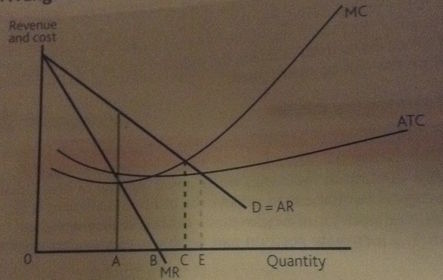
- 14—Revenue maximising, 0B where MR=0
This is the point where revenue is maximised
- 15—Marginal cost pricing, 0C where MC=AR. The point of allocative efficiency or welfare maximisation
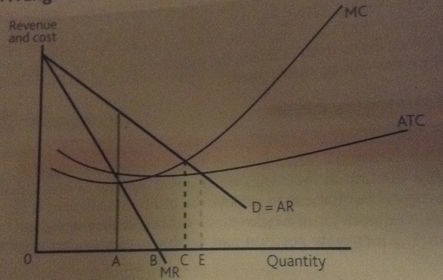
- 16—Average cost pricing, 0E where ATC=AR.
At this point the monopolist is making normal profits. This is the lowest price at which the firm will stay in the industry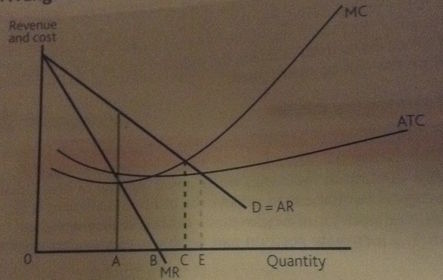
- 17Natural monopolies A firm that can gain continuous economies of scaleThis is a situation where competition would be inefficient as it would increase costs. For example, Railways or water provision because one firm can exploit economies of scale and use resources efficiently
- 18Characteristics of a Natural monopolyThey have extremely high capital costs to set up.
Duplication is unnecessary and wasteful.
MES does not occur until high levels of output as economies of scale doesn't diminish. - 19How can monopolies develop? (ORGANICALLY)The internal expansion of the firm: If the firm exploits economies of scale and therefore increases sales and market share to become a market leader. E.g. Google
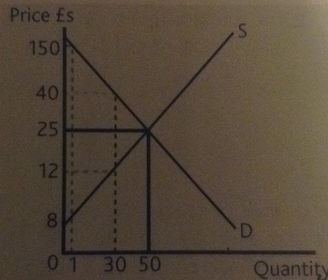
Being the first firm. E.g. Microsoft - 20—The equilibrium P is £25 and Q demanded is 50. If 1 was the first buyer in the axis they would have been prepared to pay £150 for the good when it only costs £8 to produce. The point where S crosses D is where both supplier and consumer benefit equally. "win-win"
- 21How can a monopoly reduce consumer surplus and increase producer surplus?Because monopolies are price makers they can choose the price and output at which they operate. Therefore, this may lead to some inefficients such as the reduction of consumer surplus if the firm is charging a higher price and restricting output to profit maximise.
- 22Why is a monopoly inefficient?At point PCQC both consumer and producer welfare are maximised. However, monopolies want to produce where MC=MR to profit maximise as producing beyond will mean that costs per unit will be greater than revenue. This results in a welfare loss of GKJ and is therefore inefficient because
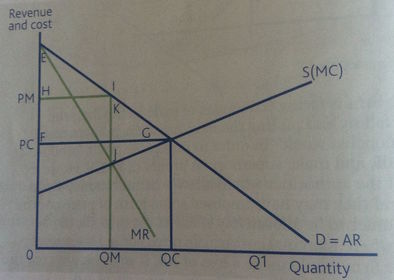
- 23Why is a monopoly efficient?They can be efficient if they use their profits to fund R&D. If the monopoly is able to achieve EoS then the MC moves downwards to MC1 and output therefore increases to 0J in excess of competitive output of 0QC at 0K price lower than 0PC. This could benefit the consumer more than a perfectly competitive situation
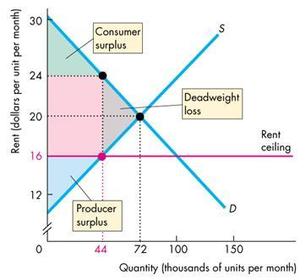
- 24Dead weight lossReduction in consumer and producer surplus when output is restricted to less than optimum level
- 25Benefits of a monopolyDynamically Efficiency (High output - Low prices)
Statutory monopoly could choose to be allocative efficient
Helps compete internationally - 26Internationally competitive (Advantage of Monopoly)The firm may need to be a monopoly in the domestic market in order to be competitive overseas especially with increasing globalisation of industries. For example, British steel industry
- 27Natural Monopoly (Advantages of Monopoly)The industry is better off if there is only one firm because it enables that one firm to exploit economies of scale in that industry and therefore be able to deal with the high fixed costs they normally have to deal with. E.g. Water supplier
- 28Research and Development (Advantages of Monopoly)Firms may choose to be dynamically efficient and reinvest their SNP in R&D to release new products that will benefit consumers with lower prices and greater output.
- 29Drawbacks of a monopolyReduction in consumer surplus
Less choice, Higher prices
Allocative and productive inefficient
X-Inefficiency - 30Reduction in consumer surplus (Disadvantages of monopoly)Higher prices leads to lower consumer surplus as they choose to operate where MC=MR therefore the consumer has to pay a higher price than what the firm could charge at that level of demand
- 31Less choice of goods and lower quality (Disadvantages of monopoly)Consumers will have less choice over the goods they buy because there is only one firm they can buy from. This could also mean lower quality goods because if the firm has power over the industry they aren't likely to have an incentive to innovate.
- 32X Inefficient (Disadvantages of Monopoly)Firm doesn't have the incentive to cut costs because its making SNP so it is not using its resources efficiently resulting in a higher ATC curve than what it would be if it reduced wastage
- 33Price discriminationWhere an identical good/service is sold to different customers at different prices for reasons not associated with costs
- 34What conditions are necessary for price discrimination?The seller can control whatever is offered and there are no other firms present that can sell at a lower price
The resale can be prevented
There would be different elasticity of demand - 35What are the methods of price discrimination?Geographical
Time
Age of customer - 36Geographical (Methods of discrimination)Where goods are sold at different prices in different countries. E.g. car companies sell cars more expensive in the UK than mainland Europe
Third price discrimination - 37Time (Methods of discrimination)This is where consumers are charged different prices at different times of purchase. E.g. train companies charge more in the early mornings or peak times
Second degree discrimination - 38Age of customer (Method of price discrimination)Consumers are charge differently depending their age. For example, Adults, pensioners and children are charged different prices for a train ticket.
Second degree discrimination - 39Dynamic price discriminationThis is where consumers are discriminated against for not buying from that firm. E.g. the benefits a consumer gets from their customer loyalty in their supermarket like £5 off their next purchase
- 40First degree price discriminationThis is where the firm can charge a separate price to each individual customer
"Perfect discrimination"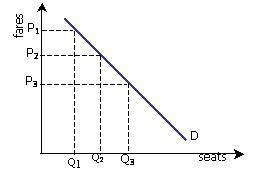
- 41Second degree price discriminationThis is where the firm charges different prices to different groups. For example, someone buying a large amount of the good paying less than someone buying one unit
- 42Third degree price discriminationWhen the discriminating firm can charge different prices in each country.

- 43What are the consequences from price discriminating? Advantages for the price discriminatorIncreased profitability and higher level of revenue that the best single price
Output will be larger than under single price monopoly because can sell more without lowering the price - 44What are the consequences from price discriminating? Effect on consumerLoss of welfare, consumers surplus disappears under first degree discrimination.
Inequitable, some consumers have to pay more than others but could help individuals in low incomes. E.g. Senior citizen pricing.
Long run benefits if profits are reinvested - 45Why is the MR curve steeper than the AR curve?Because MR decreases at a faster rate than AR. Due to the price lowering involved as output increases there is a faster decrease in MR than AR
Información
- Descripción
- Concentrated Markets
- Creado por
- Alvaro Ferreira6626 · jun 2015
- Actualizado
- 12 nov 2016
- Visitas
- 58
- Etiquetas
- Valoración