
Fichas
Contestable Markets
Fichas del conjunto (17)
- 1Contestable market IncumbentsThis is where there is free entry and exit of other firms
The existing firms in the industry - 2The theory of contestable marketsThis theory argues that the number of firms is not the most important factor and what really matters is the absence of barriers to entry and the level of sunk costs
- 3What are the assumptions of a contestable market?Contestable markets are assumed to have free entry to new firms and free exit for both incumbents and new entrants. Firms and new entrants have access to the same technology and cost curves. New firms are not prohibited from entry by incumbents.
- 4Sunk CostsAny form of entry is costly and these are sunk costs of entry. Free exit assumes there are no sunk costs when it leaves the industry. However this depends on whether the costs can be recovered. E.g. buying a factory for a specific good production may be a sunk cost because of the little resale value
- 5Hit and Run entryWhere new firms enter the industry, cream off some of the SNP of the incumbents and then exit. For example, the bus industry could have been seen as a contestable market because new routes could be open and by reducing fares to take some of the incumbents SNP
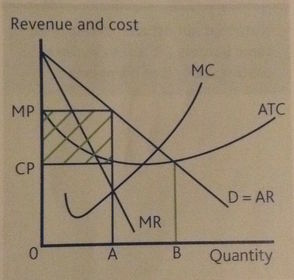
- 6—If the industry becomes contestable then the incumbent will lower its price to CP and increase output to 0B and strive to be productive efficient to keep new entrants away. Given ease of entry and exit, monopolies and oligopolies will act as if under perfect competition
- 7Assumptions of contestable markets?No one firm has a significant share of the marketplace
There is perfect knowledge in the market
Homogeneous or heterogeneous goods
Firms are short run profit maximisers
Firms compete so collusion does not occur - 8Contestable market theory Effective?As long as there is threat of competition consumers will be protected from abuses of monopoly/oligopoly power.
Potential entry can be achieved if its easily accomplished or incumbents take potential entry into account when making price and output decisions - 9Benefits of contestable marketsPrices are low because firms will operate at AC=AR to keep new entrants away.
Short run profits for new entrants (Hit and Run)
There is no government intervention
Focuses on the contestability rather than the number - 10Drawbacks of contestable market theoryLimited application, sunk costs may be extremely high and make it hard for firms to pull out. Takeovers and mergers may reduce LRAC and create unachievable economies of scale for new entrants
- 11Drawbacks of contestable market theory?Level of technical knowledge needed by the firm may be high and not freely available
Incumbents protect themselves with patents and don't make their R&D results widely available. E.g. Pharmaceutical firms - 12Drawbacks of contestable market theory?Theory ignores the possible aggressive actions of incumbents who alert potential entrants they will resist new entrants by limit pricing. Game theory can be used to analyse the effect on a contestable market E.g. Profit vs Loss (Enter or not) (Monopoly pricing or competitive pricing)
- 13How can markets be made more contestable?Removal of barriers to entry - Not renewing patents
Privatisation
Deregulation - 14What affects the contestability of markets?Recession
De-regulation of markets
Competition policy
EU single market
Technological change - 15Reality of contestable markets?There are many industries in which it will be difficult/impossible to recover sunk costs. E.g. spending on advertising is unrecoverable if the firm leaves.
Firms will be at a disadvantage in the short term using the same technology - 16Can barriers to entry be removed? Innocent entry barriersIndustry may have innocent entry barriers where they have not been created by the incumbent. This could automatically keep competition away but if there are a few innocent barriers then it can either accept competition and earn normal profits or create strategic barriers to entry to earn SNP
- 17Strategic entry barriersBarriers created by incumbents to stop other firms from entering the market. E.g. Product differentiation, predatory pricing or branding.
Bus industry has experienced takeovers to make the market less contestable
Información
- Descripción
- Contestable Markets
- Creado por
- Alvaro Ferreira6626 · jun 2015
- Actualizado
- 29 sep 2016
- Visitas
- 257
- Etiquetas
- Valoración