
Fichas
C5 - Chemicals of nature
Fichas del conjunto (37)
- 1What is the oceans and rivers sphere called?The hydrosphere.
- 2What is the earth sphere called?The lithosphere.
- 3What is the air sphere?The atmosphere.
- 4All molecules have a tendency to stick together, so why do O2 molecules not combine?The attractive force is too weak, and so they don't stick because they're moving too fast for the force to keep them.
- 5What is a covalent bond?A strong bond that holds atoms together in molecules.
- 6In what atoms do covalent bonds occur?Non-metallic.
- 7Describe the covalent bond.Positive nuclei repel each other but are held together by their attraction for the negative electrons they share.
- 8What is electrostatic attraction?Covalent bonding, basically.
- 9What are the four special properties of water?Liquid at room temp despite smaller mass than O2, ice expands and so is less dense than water, good solvent for salts.
- 10Why does the structure of the atoms in a water molecule cause its properties?They're at an angle and the electrons aren't evenly shared in the covalent bond. Oxygen has more than its fair share and so is slightly positive on the H side and slightly negative on the O.
- 11What is happening when a precipitate forms?The opposite of dissolving - the two salts meet and combine into an insoluble salt.
- 12What is an iconic equation?An equation that only includes the ions that are being focussed on.
- 13What test is used to identify metal ions in a precipitate?Sodium hydroxide is added.
- 14How do they found out what a non-metal precipitate is?They add dilute nitric acid then silver nitrate solution, and then observe the colour change. Or if the precipitate is white they test again with barium chloride.
- 15What are the two most common elements in the lithosphere?Non-metals oxygen and silicon.
- 16What is an ionic compound?A combination of positive metals and negative non-metals.
- 17What is ionic bonding?Very strong ionic forces that hold the ions together in an ionic compound.
- 18What is the structure of solid ionic compounds?A giant ionic lattice.
- 19Why do ionic compounds only conduct electricity when molten or dissolved in water?When solid the ions aren't free to move, but when 'liquid' they can separate and carry charge.
- 20What are the five properties that are the same for graphite and diamond?They're solid carbon, they have a giant covalent structure, high melting point, high boiling point, insoluble in water.
- 21What three properties of diamond are different from those of graphite?Diamond is strong and hard, it doesn't conduct electricity and it doesn't work as a lubricant.
- 22Describe the structure of diamond.Carbon atoms are evenly spaced and joined to their four neighbours in three dimensions - a pyramid shape that goes on and on.
- 23Describe the structure of graphite.Carbon atoms are joined to their three nearest neighbours in flat hexagon sheets, with each atom having one 'spare' electron that just about holds the sheets together.
- 24What are ores?Rocks that contain useful minerals.
- 25What are the four questions asked by a scientist when a company is considering digging up a new ore site?How can the ore be reduced? Is there a good supply of ore? What are the energy costs? What is the environmental impact?
- 26How is impure zinc (ZnS) refined into pure zinc (Zn)?It's oxidised by heating to make ZnO then the reducing agent carbon is used to make Zn and CO2.
- 27How is the relative formula mass of a compound calculated?The relative atomic masses are found in the period table and added together.
- 28You have Fe2O3 - Fe is 56 and O is 16. Calculate the relative formula mass.(56 x 2) + (16 x 3) = 160
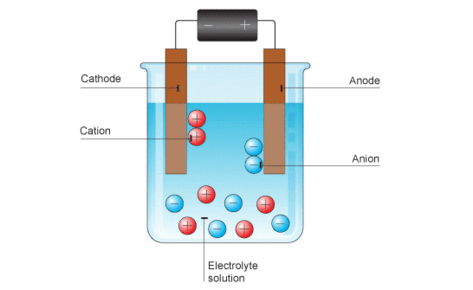
- 29When does electrolysis often take place?When the metal holds on to oxygen too strongly for carbon to work as a reducing agent.
- 30What is electrolysis?The splitting up of a chemical into its elements by passing an electric current through it.
- 31Draw (or mentally picture) an unlabelled diagram of electrolysis.
- 32How does electrolysis work?The mixed elements separate and are attracted to the negative and positive electrodes.
- 33What happens to the ions during electrolysis and why?They turn back to atoms because at the electrode they gain or lose electrons.
- 34What is the bonding between metals called?Metallic bonding.
- 35What are the four properties of metallic bonding?Strong but flexible, conducts electricity, has a high melting point.
- 36Describe the structure of a metallic bond.The atoms lose electrons easily and become positive, whilst the sea of negative electrons holds it all together. The electrons are free, so can drift.
- 37What are the two negative and two positive factors to consider in mining?The risks to the environment and the miners, vs the advantages of more materials and jobs.
Información
- Descripción
- Cambridge IGCSE Chemistry Fichas sobre C5 - Chemicals of nature, creado por franimal el 14/11/2013.
- Creado por
- franimal
- Visitas
- 70
- Etiquetas
- Valoración