
Fichas
Structure, Function, and Types of the Processor - OCR Computer Science A Level
Fichas del conjunto (25)
- 1What is the Purpose of the Control Unit?> Overall control of the CPU
- Activates and communicates with all parts of the CPU (as well as other components of the computer)
> Mainly executes program instructions via the F.D.E. cycle
> Controls the flow of data inside and outside the CPU
- Responsible for read and write requests to memory - 2What is the Purpose of the Program Counter?> Holds the memory address of the next instruction to be fetched from RAM
- Either incremented or changed via the CIR (if the code branches, in which case the previous value is added to a stack)
> Works closely with the MAR
- At the start of every cycle, the address in the PC is copied to the MAR - 3What is the Purpose of the Memory Address Register?> Holds the address of the memory location from which data is to be read / written
> Sends the address to memory down the Address Bus - 4What is the Purpose of the Memory Data Register?> Holds the actual data received from RAM (or was written to RAM)
> This data is sent from RAM down the Data Bus - 5What is the Purpose of the Current Instruction Register?> Holds the instruction currently being executed
> Contains the opcode and operand(s) of the current instruction
- Opcode - the operation to be done to the data
- Operand - the data affected by the operation - 6What is the Purpose of the Arithmetic Logic Unit?> Performs arithmetic and logical operations of data
- Includes addition, subtraction, multiplication, division, as well as bitwise shifts and logical operations (e.g., AND, OR, NOT etc.) - 7What is the Purpose of the Accumulator?> Temporary register that stores the immediate results of calculations from the ALU
- 8What is the Purpose of the Address Bus?> Carries memory addresses from the MAR that identify where the data is being read from and written to
- 9What is the Purpose of the Data Bus?> Carries the binary data that makes up information (data and instructions) being transmitted to the MDR
- 10What is the Purpose of the Control Bus?> Carries command and control signals to and from every other component of the CPU, to ensure that everything stays synchronised
- 11Generally, what is a Bus?> A vehicle that is always dirty
or
> A group of parallel wires that connect CPU components in order to pass signals between them - 12What is a Bus Request and a Bus Grant?> Request - indicates a device is requesting the use of the Data Bus
> Grant - indicates the CPU has granted access to the Data Bus - 13What is Clock Speed and How does it affect CPU Performance?> The number of cycles that a single processor core can carry out per second (measured in Hertz, Hz)
> A faster clock speed means that more instructions are fetched, decoded, and executed in a second - 14What is the Cache and How does it affect CPU Performance?> Temporary storage that is extremely fast for the CPU - slower than registers but much faster than requests to / from RAM
- It does not require instructions to be fetched via slow buses
> Stores frequently used data - the CPU checks the cache first, then the RAM
> Too much cache can be detrimental, as there's more data to search through every time data is required
> L1 - on the CPU chip, smallest and fastest, most expensive (also known as primary or internal cache)
> L2 - on the motherboard or CPU, larger but slower
> L3 - on the motherboard, larger again, but slowest - 15What are Cores and How do they affect CPU Performance?> Each core can process data independently from the rest, allowing for simultaneous processing
> It allows for parallel processing and multitasking
> Software must be designed to use multiple cores, otherwise there is no performance benefit - 16What is a GPU and How does it affect Performance?> Graphics processing unit
> Contains specialised circuits for handling graphics and image processing
> Relieves the processing load on the CPU, freeing it to do other things
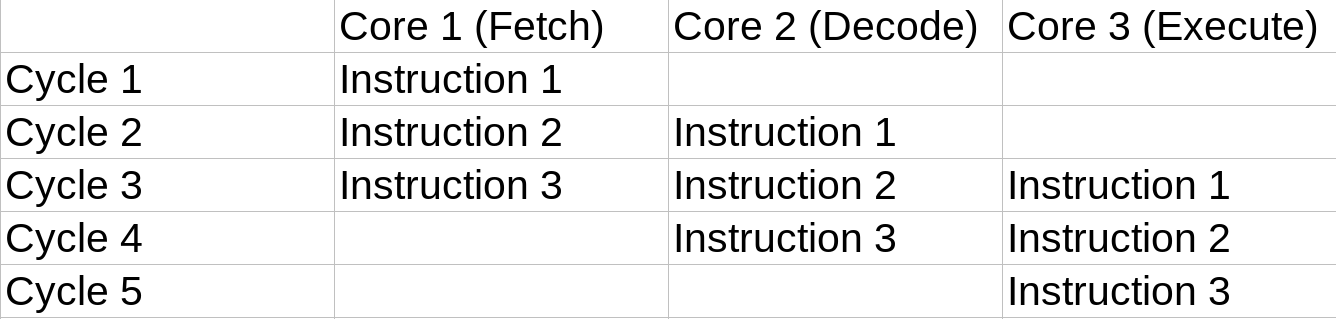
> Using high-end cards can vastly speed up software that renders graphics, i.e., 3D Design software (CAD) and games - 17What is Pipelining and How does it affect CPU Performance?> Each core performs one part of the fetch, decode, execute cycle for each instruction, which speeds up performance as it doesn't have to switch operations
> Branching can cause issues with pipelining since it may end up processing an instruction that will be skipped after an if statement - 18What is Word Size and How does it affect Performance?> Number of bits a CPU can process in one cycle (i.e., 8-bit, 16-bit, 32-bit, 64-bit)
> Modern systems have 64-bit architectures, although sometimes have backwards-compatibility - 19What are the Two Types of Parallel Processing and their Differences?> SIMD - Single Instruction, Multiple Data
> Same program can be executed on different data sets at the same time
> One Control Unit handles multiple ALUs
> MIMD - Multiple Instruction, Multiple Data
> Different programs can be executed on different processors at the same time
> Multiple Control Units each handle their own ALUs - 20What is Distributed Computing?> Alternative to Parallel Processing
> Uses the Internet to process a large problem
> Each node takes on a small part of the problem
> Each node has their own memory, unlike Parallel Processing, where it is shared - 21What is the Von Neumann Architecture?> Single shared memory and shared bus for data and instructions
> Bus transfers either data or instructions
> Bottleneck as the instruction cannot be completed until both data and instructions have been fetched and decoded - 22What is the Harvard Architecture?> Two separate memory and data buses for data and instructions
> Each memory has a dedicated bus which allows it to fetch data and instructions simultaneously
> Expensive and complex to implement - 23What is the Contemporary Architecture?> Uses aspects of both Von Neumann and Harvard
> Von Neumann architecture is used for the main memory - contains a bottleneck
> Harvard is used for the cache - data and instructions are fetched independently - no bottleneck - 24What is CISC Architecture?> Complex Instruction Set Computing
> Aims to complete the task in as few lines of assembly as possible
> Processor hardware and circuitry has to be more complicated
> Complex instructions that resembles high-level language
> Compiler has to do little work to translate the high-level language to assembly
> Instructions may take more than one cycle - no pipelining
> Used in PCs - x86 processors - 25What is RISC Architecture?> Uses simple instructions that are executed within a single clock cycle
> Instructions separated into smaller commands
> More lines of code required - compiler has to do more conversion work & more RAM is required to store instructions
> Processing takes up less energy; each instruction can be completed in a single clock cycle, and pipelining can be applied
> Requires fewer transistors and less complex hardware, leaving more room for general purpose registers, cache, and therefore lower energy requirements
> Used in smartphones, tablets, and embedded system via ARM processors
Información
- Descripción
- A level (Structure, Function, and Types of the Processor) Computer Science Fichas sobre Structure, Function, and Types of the Processor - OCR Computer Science A Level, creado por Malachy Moran-Tun el 04/04/2022.
- Creado por
- Malachy Moran-Tun
- Visitas
- 29
- Valoración