
Fichas
OB: SU4
Fichas del conjunto (18)
- 1Groups & Types of GroupsTwo or more interacting and interdependent individuals who collaborate to achieve specific goals.
Formal group: A group defined by an organisation’s structure
Informal group: A group that is neither formally structured nor organisationally determined that members voluntarily join because they derive personal benefits,
share a common interest or pursue similar goals - 2Reasons Why People Join GroupPeople join groups for a variety of reasons that are generally related to their drive to satisfy social, power, achievement and other personal needs.
1. Similarity: around those who share the same values or characteristics
2. Distinctiveness: show that they are different
3. Status: identify & associate themselves with high-status groups
4. Uncertainty reduction: want to better understand who they are and their role in the world - 3Tuckman’s 5 Stage Group Development Model1. Forming: uncertainty about the group’s purpose, structure, and leadership. Members try to determine what types of behaviour are acceptable.
2. Storming: Characterised by intra-group conflict. Members accept the existence of the group, but there is resistance to constraints on individuality.
3. Norming: Characterised by close relationships and cohesiveness. The group structure solidifies and the group has a common set of expectations for what defines correct member behaviour.
4. Performing: The group structure at this point is fully functional and accepted. Group is focused on performing the task at hand.
5. Adjourning: For temporary groups, the group prepares for its disbandment, wrapping up activities. - 4Group PropertiesCharacteristics of a group influence the behaviours and performance of its members.
1. Roles
2. Norms
3. Size
4. Diversity
5. Status
6. Cohesiveness - 5Group Decision-MakingReaching a decision through a collective process involving some, most
or all group members. - 6Why Group decision-making better than individual decision-making?1. Decision accuracy
2. Decision quality
3. Decisions requiring creativity
But not:
Decision speed - 7Group decision-making: Strengths & WeaknessesStrengths:
1. more inputs
2. better decisions
Weaknesses:
1. more time-consuming
2. responsibility is ambiguous
3. internal conflicts
4. groupthink & groupshift - 8GroupthinkPhenomenon where pressure for conformity prevents the group from critically appraising alternative views.
- 9Reasons for Groupthink1. high degree of group cohesiveness
2. Enjoying positive image
3. Members keen to protect group
positive image
4. Dominated by 1 member or clique - 10How to minimise groupthink?1. leaders to play an impartial role
2. Appointing a devil’s advocate role
3. Active discussion of diverse alternatives (Brainstorming) - 11GroupshiftPhenomenon where initial individual group members’ positions move towards a more extreme position.
- 12Reasons for Groupshift1. Risk-takers tend to be more admired
2. Conservatives want to show they are willing to take risk
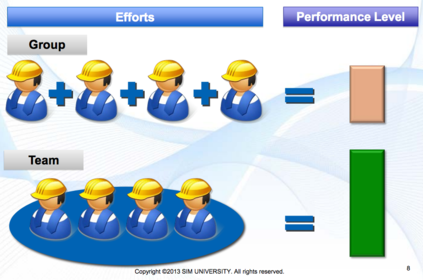
3. Group seems to diffuse individual accountability and responsibility - 13Groups vs Teams
- 14Work GroupInteracts primarily to share
information and make decisions to
help each group member perform
within his/her area of responsibility - 15Work TeamGenerates positive synergy through
coordinated effort and bring about better
performance than the sum of its members’
inputs - 16Types of Teams1. Problem-solving team
2. Self-managed team
3. Cross-functional teams
4. Virtual teams
5. Multiteam System - 17Factors that influence the effectiveness of teams1. Contextual Factors
2. Team Composition
3. Team Processes
4. Work Design - 18Turning Individuals Into Team Players1. Select
2. Train
3. Reward Policies