
Fichas
Geography GCSE Urbanisation
Fichas del conjunto (104)
- 1What is urbanisation?An increase in proportion of people living in towns and cities compared to urban areas
- 2Where and when did urbanisation begin?In Europe in the 1800s the Industrial Revelution began.
- 3What caused the Industrial Revolution?The Agricultural Revolution meant that less people were needed on farms. Factories were set up in the cities so people moved to find work
- 4What is the rate of urbanisation in MEDCs?SLOW. It means that the government could plan and provide for the needs of people.
- 5What is the rate of urbanisation in LEDCs?FAST. This means that the government can't provide for the needs of the population.
- 6What is a million city?A city with a population of over 1 million
- 7What is a Mega city?Cities which have a population of over 10 million
- 8What is rural to urban migration?The movement of people from countryside areas of towns and cities.
- 9What is a push factor?Negative factors that make people want to leave an area.
- 10What is a pull factor?Positive factors that attract people to an area.
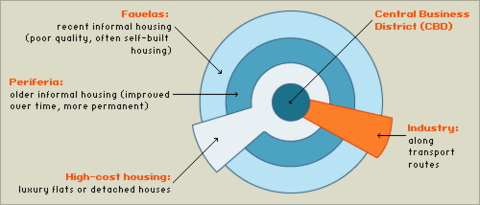
- 11—This is an LEDC city model.
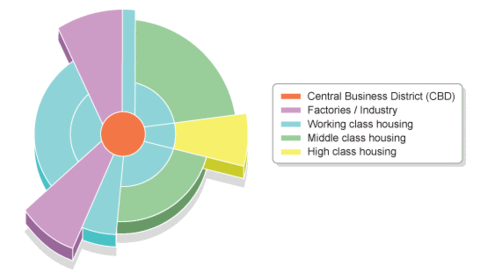
- 12—This is an MEDC city model
- 13What is a favela?A favela is a deprived area on the outskirts of a town consisting of large numbers of shanty dwellings.
- 14Name 3 environmental conditions in a favelaThere are landslides when there's heavy rain, destroying houses.
Houses are built with whatever materials that can be found.
There's no electricity.
Rubbish left on the roads.
Pollution. - 15Name 5 social conditions in the favelasAmenities eg water are really bad
There is strong community spirit
Lot's of crime-dangerous to be out at night
Some people have TVs
Drug lords rule favelas
Loads of shops
No sewers. When it rains sewage runs down the hills
Disease - 16State for economic conditions in favelas.Few jobse-some people work in factories but there is not many opportunities
People work in the informal sector eg: shoe shining
Some people work in the city as cleaners - 17What is a self-help housing scheme? (eg Rocinha)Residents help make improvements to their homes.
- 18What are the advantages of a self-help housing scheme?There is a strong community spirit as people help one another out.
Creates and area of medium-quality housing
Better sanitation
Improves QoL
Local authority doesn't have to pay - 19What are the disadvantages to self-help housing schemesPeople only upgrade houses when they know they won't be evicted.
Only small impact on favela. - 20What are local authority schemes to aid favelas? eg The Favela Bairro ProjectCity authorities set aside $300,000 million to improve favela living conditions.
- 21What are the environmental improvements produced in the local authority schemes to aid favelas?The favelas may have electricity eg for street lamps
There are water pipes
Collect rubbish weekly - 22What are the economic improvements created by local authority schemes for favelas?Residents can legally own their homes
Teach the people in the favelas skills so they can find jobs
People build single storey homes with the materials from the council - 23What are the social improvements created by local authority schemes in favelas?Day care centres and after school schemes to care for children while parents work
Adult education
Services to help those with addictions
Involves the community
Neighborhood associations formed
Health and living standards improved - 24What are the disadvantages to local authority schemes?People have to pay taxes due to msterial and land being provided-may not be able to afford
Not all favelas can be helped
Improvements restricted by steep hillsides - 25What is building a new town for the rich? (eg Barra de Tijuca)Wealthier people in Rio have started to move to a new town 20km away. It is connected to Rio by a motorway that cuts through the hills and is elevated over the sea
- 26What are the advantages of building a new town?It is quieter
Better QoL: leisure activities, beach, shopping malls, restaurants and high rise apartments.
Little to no congestion
Creates jobs for those in shanty towns
Less crime - 27What are the disadvantages of building a new town?Building a new town moves problems somewhere else:
The poor move with the rich to keep their jobs as maids etc. They can't afford homes so build new shanty towns. - 28What is the clearance of slums?Local authorities tell residents to move. Their homes are then bulldozed.
- 29What are the advantages of slum clearance?The government get their land back
No problem of disease and crime in area
Use shanty residents for labor to teach skills - 30What are the disadvantages of slum clearance?People could rebel and cause more problems
Homeless people
People move their slum to somewhere else - 31What is a site and service scheme? (eg Dandora scheme Nairobi Kenya)An area of land is divided into individual plots. People pay rent for a site and borrow money to buy building material to build/improve plot.
The rent is used to provide basic services eg electricity - 32What are the advantages of site and service schemes?Improves QoL
Easier to control for local authorities
Houses look better
Encourages people to work
Less crime-safer community
Can provide other basic services to family - 33What are the disadvantages to Site and Service schemes?Plots are small
Unemployed people can't afford rent-can't use plots
Can get into debt if borrow money
Spiral of decline
slum built somewhere else - 34What is encouraging migrants to return to the rural area?The government focus on improving employment opportunities in rural areas to get people to move back
- 35What are the advantages of encouraging migrants to return to rural areas?There's more space in the shanty towns as less people are moving
People can become self-sufficient
Less push factors
People in rural areas have more resources - 36What are the disadvantages of encouraging migrants to return to rural areas?The migrants can move back and original problem starts again
Rural areas could become more cramped
Could be competition for (best) land
May still be unemployment issues - 37What are the problems of rapid urbanisation in poorer parts of the world?Rapid urbanisation causes environmental problems:
eg air pollution
water pollution
waste disposal problems
e-waste - 38What are the causes of water pollution?Untreated industrial waste
Untreated oil from airports
Untreated sewage
Dumping other waste into rivers which is toxic
Dumping human waste
Washing out used oil drums - 39What are the knock on effects of water pollution?In the MITHI RIVER:
1.Solid waste clogs drains
2.Plants grow on the waste and increases flood risk
...
roads and railways flooded
some areas have no electricity
people die of disease
406 people died in recent floods in MITHI RIVER and it cost $100 million dollars to repair damage - 40How can water pollution be solved or managed?River channel dredged to make it hold more water
River widened
Obstacles in river removed
Banks smoothed to allow water to flow
Discharged factory waste checked
Public toilets built
Improving water supply
Education projects - 41What are the causes of air pollution?Exhaust gases from vehicles
Smoke from burning rubbish
More electricity --> more burning fossil fuels --> greenhouse gases - 42What are the knock-on effects of air pollution?Illnesses due to breathing problems
Adds to global warming - 43How can air pollution be managed/solved? (Mumbai)Metro systems in cities to reduce congestion
Diesel banned for taxi drivers, who now used compressed natural gases
Main roads upgraded to make smoother road surfaces and less congestion
In MEXICO CITY only odd number plates can drive on one day and even number plates the other - 44What are the causes of waster pollution?In shanty towns domestic waste is often not collected because of narrow streets
Toxic waste
E-waste (electronic waste) is dumped in LEDCs
Incinerators burn waste
Landfills
MEDCs leaving toxic wadte in LEDCs
Waste is a resource to the poor so they need an incentive to remove it - 45What are the knock-on effects of waste pollution?Greenhouse gases
LEDCs can't dispose of e-waste which is toxic-causes illness
Toxic gases produced - 46How can waste pollution be managed?Recycling plant
Toxic waste sent to USA to be disposed of safely
high tech companies dispose of own e-waste
MEDCs take responsibility for own waste
CHINA: household waste disposal units, waste used as fertiliser in rural areas - 47State 4 push factorsLimited resources eg food&water
Natural problems eg habitat loss
Badly paid jobs in bad conditions
Bad QoL
Poor housing, health, education and water
no education no job, no job no money
Poor transport: harder to move about, harder to sell products, can't earn money, can't feed family - 48State 4 pull factorsGood education means good jobs
Good healthcare
Good QoL
Better jobs&better working conditions. More money
Clean water
machinery to reduce manual labor
Better housing - 49What is another reason for rapid growth besides rural-urban migration?Natural increase: people who migrate are younger and are starting up families
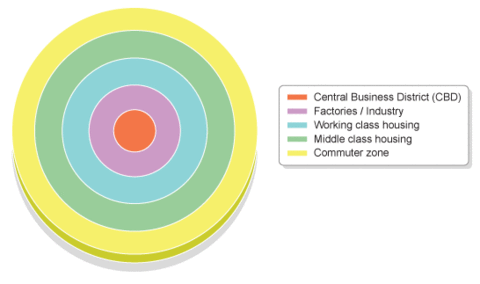
- 50What does the Burgess city model show of a town's morphology (internal structure)?
- 51Where is the CBD (Central Business District) located in both MEDC and LEDC cities?Normally in the center of town usually around a historic core. eg: Abbey ruins in Reading
- 52State one exception to where the CBD (Central Business District) is locatedBy the sea the CBD would be on the coast to improve tourism
- 53Is the CBD (Central Business district) accessibleYes, with main roads, railway stations and bus stations often leading to it.
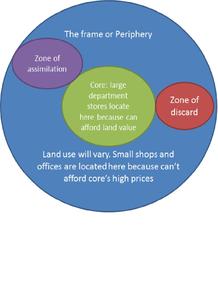
- 54What can you find within the CBD (Central Business District)It's the main shopping area
There are main shopping streets and linking shopping streets - 55Why does the CBD (Central Business District) have the highest land value per square meter?Because shops want to locate in areas with the easiest access and the highest footfall.
Shops compete for spots in a small area. The land goes to the highest bidder (bid rent value) - 56Why are lot's of businesses in the CBD (Central Business District)?There is easy access for the work force and business clients can easily find their way to the offices.
- 57What is the PLVP (Peak land value point)?The best locations with the highest footfall have the highest bid price so only the best shops can afford it.
Eg: Point on Broad Street at entrance to Oracle - 58What kind of shops are high order shops and why? Where are they located?Department stores: sell comparison goods that we buy infrequently. Need to be able to attract lots of people. They have a large sphere of influence
Found in CBD in PLVP - 59Where would you normally find independent stores?On connecting streets where land values are lower because of lower footfall
- 60What can you find on connecting streets?smaller low order shops selling low order convenience goods like food. Don't need a high footfall.
- 61What are middle order shops?They are in between low order and high order: buy things from them more frequently than high order.
eg: clothes stores, CD stores etc - 62Why does the CBD (central business district) have the tallest buildings?Land value is high so shops&businesses can't afford a large footprint so build upwards to gain space without having to buy more land
- 63Why is it that shops on the high street tend to occupy the ground floor?Because of easier access for people so higher footfall.
- 64Where are houses and businesses built on the high street?Above the shops because rent vale is lower because of low footfall
- 65Why don't people tend to live in the CBD?Because of the high land values so housing is too expensive.
Noise and air pollution (congestion) - 66What is a city model?A simplified representation of a town or city. It is used to represent a pattern of land use
- 67Why is the Hoyte city model a better model than the Burgess city model?Burgess model was only built around Chicago
Transport routes are important for morphology (factories radiate from CBD following a main road) - 68How are the MEDC and LEDC city models similar?CBD in the core of the city
Factories and industry radiate out from center
Land has highest value in center
Based on ring system - 69How are MEDC and LEDC city models different?Poorest housing in LEDC city is on the outskirts in favela.
In MEDC suburbs contain high quality housing - 70What can stop a city from expanding?Motorways
River
Sea
Hills - 71Where is the inner city located?Next to the CBD
- 72Why is the inner city the original zone of industry?Factories were set up along canals and railway lines for easy access
- 73Why does the inner city contain high density houses?The factory workers lived close by in high density terraced houses
- 74Why is the inner city a zone of transition?The old industry has closed and some sites remain derelict, eg around obsolete docks, canals and railway sidings
Some old factories redevelloped eg Huntley&Palmers--> apartments and Prudential offices - 75Why is the inner city an area of high-rise flats?Many old terraced houses became slums and needed redeveloping.
In 1960s large blocks of high-rise flats were built in their place
eg London - 76Why is the inner city an area of smart new developments?On old derelict land many cities built into smart new developments eg London Docklands
- 77How can you find the inner city on a mapLook for:
Straight rows of small houses
Streets close together with little open space
Large industrial buildings, often near railways and canals - 78Where are the suburbs located?Next to the inner city
- 79What are 1930 suburb houses like?Semi-detached and detached houses with front and back gardens
Garages
Inside bathrooms
Spacious
Eg Earley - 80What are 1960 suburb houses like?Private estates eg: Silverdale road, Earley
Some built by the council - 81What are 1980 suburb houses like?Modern large detached houses built on edge of towns with gardens and garages.
- 82What do 1930 and 1960 suburbs look like on maps?Houses have gardens
Roads are cul-de-sacs
School and parks nearby - 83What do 1980 suburbs look like on maps?Built closer together than 1930/1960 suburbs
- 84Why are the suburbs and area of modern factories (high-tech industry) and business parks?Easy access-built on the edge of towns near motorway junctions
or
Built along main roads on the outskirts - 85Why are the out of town shops in the suburbs?Modern shops and retail parks built on edge of town:
less congestion
Easier access
Cheaper to buy land - 86What is beyond the suburbs?Rural-urban fringe
- 87What are the social problems within the CBD (Central Business District)?Crime (shoplifting)
Vandalism
Very high rents - 88What are the economic problems within the CBD (Central Business District)?Expensive to maintain services (health, education)
- 89What re the environmental problems within the CBD (Central Business District)?Litter
Problems of waste collection
Graffiti
Congestion (air pollution) - 90What are the socail problems with the inner city industrial zone?Few amenities
Health problems - 91What are the economic problems within the inner-city industrial zone?Lower-paid jobs
industries run down - 92What are the environmental problems within the inner-city industrial zone?Derelict buildings
Noise and air pollution from traffic - 93What are the social problems within the inner-city housing?Racial tension
Large families
High density and poor quality housing - 94What are the economic problems within inner-city housing?Unemployment
Mainly semi-skilled/unskilled jobs - 95What are the environmental problems within inner-city housing?Noise and air pollution from traffic on main roads
- 96What are the social problems within the suburbs?Crime (burglary)
Increasing house prices - 97What are the economic problems within the suburbs?Time-distance cost of commuting to work
Public transport infrequent - 98What are the environmental problems within the suburbs?Traffic congestion
Litter - 99What are the social problems within the rural-urban fringe?Crime (burglary)
Very expensive housing - 100What are the economic problems within the rural-urban fringe?Time-distance cost of commuting to work
Public transport - 101What are the environmental problems within the rural-urban fringe?Loss of greenfield sites due to urban sprawl
- 102Why do CBDs (Central Business Districts) need revitalizing?Increasingly congested
Difficult to park
Unsafe place to go-especially at night
Empty at night so leisure facilities close
Out of town shopping centers more attractive-easier to park. Often contain leisure as well
CBD expensive for hsops so many close
CBDs can be run down when shops close and are vandalized
Less attractive to shop in - 103Explain the structure of the CBD
- 104Why did Reading build the Oracle?To improve the CBD: out of town facilities meant less people were coming to the CBD
Información
- Descripción
- Fichas sobre Geography GCSE Urbanisation, creado por p.northre el 01/02/2014.
- Creado por
- p.northre
- Visitas
- 269
- Valoración