
Fichas
Lecture Exam 2: Chapter 15: Cardiovascular System
Fichas del conjunto (43)
- 1What are the three largest veins in the body?Superior Vena Cava, Inferior Vena Cava, and Coronary Sinus
- 2What is anastomoses?Anastomoses is an alternative route from point A to point B in an artery incase the original pathway is obstructed.
- 3What is angiogenesis?Angiogenesis is the formation of new blood vessels. It is mainly controlled by Vasular Endothelial Growth Factor (VEGF), and highly regulated.
- 4Which is thicker, arteries or veins, and why? Describe how their formation affects the blood vessels' function.Arteries are thicker than veins because they transport blood at a higher pressure. Veins, being thinner than arteries, can blow out at high pressures sustained for long periods of time (varicosities).
- 5What are the three layers, or tunics, of arteries?1. Tunica interna (intima): Innermost layer
2. Tunica media: Smooth muscle and elastic tissue
3. Tunica externa (adventitia): Outer layer, connective tissue - 6What is the purpose of coronary bypass surgery?Coronary bypass surgery is the process of adding man-made anastomoses. When there is a clot, surgeons can create an alternative route.
- 7Why are veins typically larger than arteries, even though arteries are thicker?Arteries are thicker than veins because they sustain a higher blood pressure. Veins have to hold the same amount of blood as arteries, and thus must be larger than arteries because their thin walls cannot sustain such high blood pressure.
- 8Compare and contrast the general characteristics of arterioles and arteries.Arterioles have thinner walls than arteries, but they have the same three layer or tunics, although the walls of the tunica media and tunica externa become thinner as the arterioles become smaller. Both arteries and arterioles can undergo vasomotion.
- 9What is vasomotion?Vasomotion is movement of blood vessels, more specifically vasoconstriction and vasodilation.
- 10What is a metarteriole?A metarteriole is a branch off of an arteriole that feeds capillary beds (which supply, on average, 80 to 100 capillaries).
- 11Describe general characteristics of capillaries.Capillaries are the samllest blood vessels, and connect the smallest arterioles and smallest venules. Their walls are semi-permeable. Blood flow is regulated by precapillary sphincters.
- 12What is a sphincter? How does this affect blood flow in the form of precapillary sphinters?A sphincter is a muscle that can open and close much like a door (Remember, other sphincters are the orbicularis oris and anus). The precapillary sphincters can open and close to control blood flow. It cannot stop blood flow altogether, but it can stop it to an absolute drip if necessary.
- 13The blood flow in the capillaries/the amount of blood necessary for the tissue depends on what?The blood flow in the capillaries/the amount of blood necessary for the tissue depends on the action of the tissue. Remember, skeletal muscles during a race require must more blood than skeletal muscles while you're watching Netflix.
- 14Explain why capillaries have openings, or pores, and why that is imperative to their function.Capillaries have openings, or pores, depending on the necessary permeability. For example, there are large openings for the erythrocytes that come from red bone marrow into the cardiovascular system. Pores can be small, medium, or large.
- 15What increases the presence of capillary networks?More metabolic needs = More blood = More capillary networks.
Think of a runner and a couch potato. Who has a greater capillary network? Better put, who needs more blood flow to their tissues? The runner does, but the couch potato can easily increase his/her capillary networks if he/she decides to become a runner too...it's that easy! - 16Briefly explain the three methods of capillary exchange.Diffusion: This is the most important method! It deals with O2 and CO2.
Filtration: Hydrostatis pressure pushes molecules through membranes.
Osmosis: Osmotic pressure draws water into capillaries. This opposes filtration. - 17What are venules?Venules are just tiny veins. They have thinner walls and less smooth muscle than arterioles. They transport blood from capillaries to veins.
- 18What are the three layers of veins?The three layers of veins are the same as arteries. They are the tunica interna, tunica media, and tunica externa. The tunica media is less developed.
- 19Veins are known as the "blood reservoir." How much blood do they actually store?While resting, veins can store up to 2/3 of the body's blood, especially while sleeping at night.
- 20What occurs when veins "blow out?"A blow out is a varicosity, such as varicose veins. This occurs when there is too high of blood pressure in the veins for too long.
- 21What causes increased pressure in veins?Blood accumulation. This can occur due to pregnancy, excessive weight gain, and standing all day, especially in a single spot (like a factory worker or a hairdresser).
- 22What can be used to prevent varicosities, especially in the lower extremities?A compression hose or stocking can help prevent varicosities. They are tight fabric that increases the pressure on the muscles, further encouraging blood flow.
- 23What causes hemmorhoids?Hemmorhoids are caused by a varicosity of within or around the anus. This can be caused by sitting down for prolonged periods of time or increase pressure, such as that of a vaginal birth.
- 24What can cause varicosities in the esophagus?Varicosities in the esophagus can occur with excess vomiting, especially in the case of those who are bulimic or extreme alcoholics. These individuals can rupture the veins in their throat, as well as exposing the broken veins to stomach acid. This can cause someone to internally bleed. In the case of an alcoholic, one may be so intoxicated that he/she may not realize they are vomiting blood. In severe cases like such, an individual can die of internal bleeding.
- 25What is atherosclerosis?Atherosclerosis occurs when excess cholesterol lines lines the walls of arteries. This can cause tissue death.
- 26What is an aneurysm?An aneurysm occurs when pressure creates a bubble in a weak part of an artery. Aneurysms do not typically cause any problems, but the rupturing -- depending on its location -- can cause immediate death.
- 27What is phlebitis?Phlebitis is the inflammation of a vein. This is becoming more and more common.
- 28What are varicose veins?Varicose veins are abnormal and irregular dilations in superficial veins. These are most common in the legs.
- 29What does the term "blood pressure" refer to?Blood pressure refers to the pressure in systemic arteries.
- 30What is the function of our blood pressure?Blood pressure circulates our blood and, with it, moves nutrients and other substances.
- 31How is blood pressure represented?Blood pressure is represented as systolic (SP)/diastolic (DP) in mm Hg.
- 32What is normal blood pressure?Normal blood pressure is LESS THAN 120/80 mm Hg. Pharmaceutical companies have since changed this from "more or less than 120/80" to "less than." They are pushing to have that value lowered once again.
- 33What is systolic pressure?Systolic pressure is the maximum pressure reached during ventricular constriction.
- 34What is diastolic pressure?Diastolic pressure is the minimum pressure remaining before the next ventricular constriction.
- 35What is pulse pressure?Pulse pressure is the systolic pressure minus the diastolic pressure. On average, this value should be approximately 40.
- 36What is the mean arterial pressure?The mean arterial pressure is the average pressure in the arterial system. This represents the average force driving blood to the tissues (DP + 1/3 PP).
- 37High blood pressure is known as _______.Hypertension
- 38Arterial blood in the pulmonary circuit is _________ oxygenated than the venous blood in the pulmonary circuit.Arterial blood in the pulmonary circuit is less oxygenated than the venous blood in the pulmonary circuit. Remember that arterial blood is oxygen-poor and on its way to the lungs.
- 39Coronary artery disease is caused by what three primary risk factors?Coronary artery disease is caused by stress, obesity, and smoking.
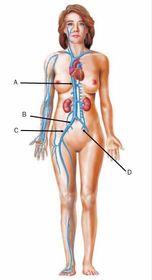
- 40Match the arrow with the vein.A: Inferior vena cava
B: Common iliac
C: External iliac
D: Internal iliac - 41What are three functions of the endothelium lining blood vessels?1. Provides a smooth surface for blood flow
2. Prevents inappropriate blood clotting
3. Secretes substances that stimulate vasomotion - 42Which changes would you expect to see as the cardiovascular system ages?Decrease in elastin production, deposition of calcium in blood vessels, and thickening of the tunica interna
- 43—
Información
- Descripción
- Ivy Tech Community College, Anatomy and Physiology 102 (APHY102), Lab and Lecture Exam 2, Chapter 15, The Cardiovascular System
- Creado por
- Kyla S
- Visitas
- 322
- Etiquetas
- Valoración