
Fichas
C7 revision
Fichas del conjunto (123)
- 1What is crude oil made up of ?It is a mixture of compounds called hydrocarbons
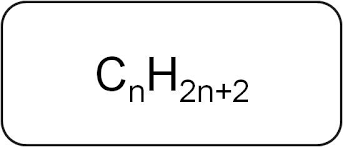
- 2What is the general formula for alkanes ?
- 3Describe the structure of an alkaneIt is a hydrocarbon that only contains single bonds between the carbon atoms, so they are known as saturated compounds. The carbons and hydrogens are bonded together with a covalent bond
- 4What are the first 5 alkanes, and what are their chemical formula?1. Methane C H4
2. Ethane C2 H6
3.Propane C3 H8
4.Butane C4 H10
5.Pentane C5 H12 - 5What happens to the properties of alkanes as they increase in chain length?They flow less (become more viscous)
They become less flammable
They become less volatile (doesn't evaporate as easily)
Their boiling point increases - 6What is the word equation for a combustion reaction with an alkane ?Alkane + Oxygen -> Carbon dioxide + Water
- 7What is the balanced symbol equation when methane reacts with oxygen in a combustion reaction ?CH4 (g) + 2O2 (g) ----> 2H2O (l) + CO2 (g)
- 8Why does the boiling point of an alkane increase as the molecules get longer?The intermolecular forces in the alkane becomes stronger as chain length increases, so more energy is required break these bonds
- 9Why are alkanes very unreactive?The C-C and C-H bonds are difficult to break
They don't react with any aqueous reagents (substances dissolved in water) - 10Describe the structure of alkenesThey are hydrocarbons with a double covalent bond between two carbon atoms, so are known as unsaturated (the carbon atoms are bonded to fewer hydrogen atoms than they could be).
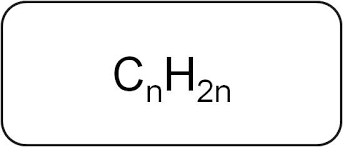
- 11What is the general formula for alkenes?
- 12What is the structure formula of ethene, propene and butene?
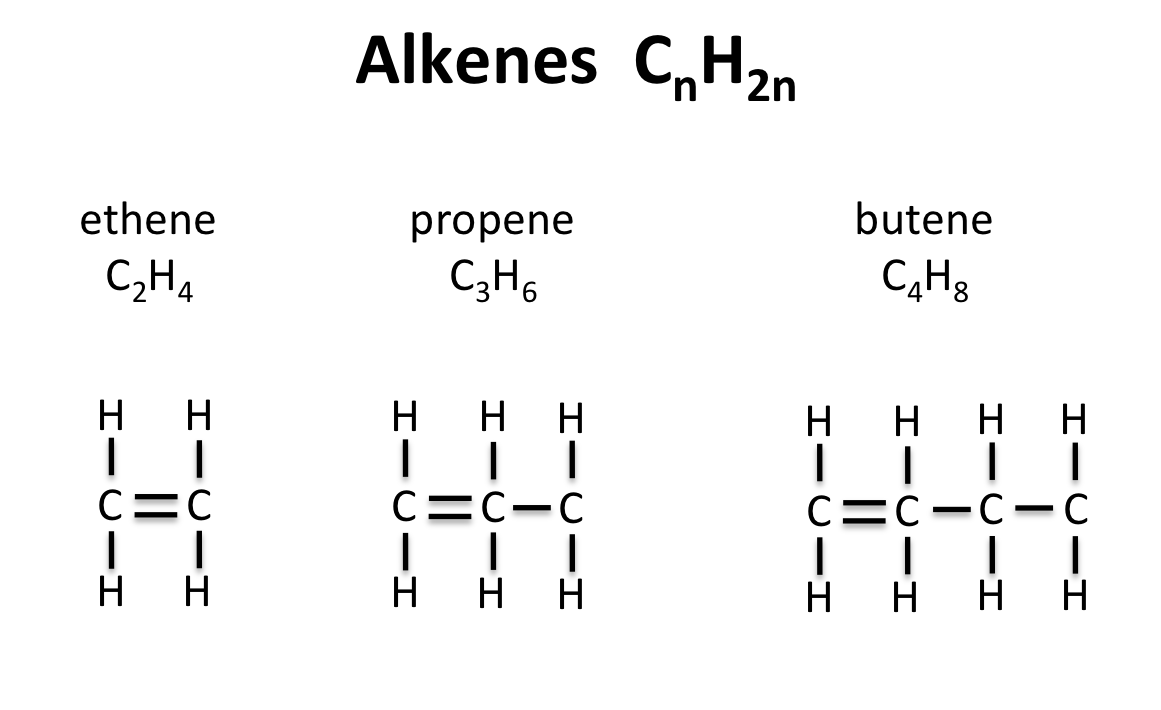
- 13What is the rule for the alkenes name, and what are the first 4 alkenes called ?Rule: ends in -ene
1. Ethene C2 H4
2. Propene C3 H6
3. Butene C4 H8
4. Pentene C5 H10 - 14Do alkenes combust (react with oxygen) ?Yes, and produce water and oxygen
Alkene + Oxygen -> Carbon dioxide +Water - 15What can the incomplete combustion of a hydrocarbon produce?Carbon and carbon monoxide ( a poisonous gas)
- 16What colour does a flame turn if carbon is present?Yellow
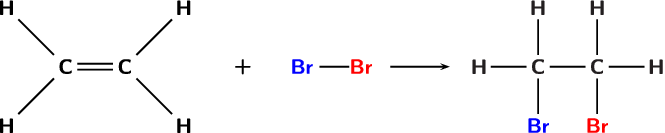
- 17How can we test for an alkene, and what is the structural formula when this reaction occurs with ethene?We can test for alkenes using bromine water, because the double bonds react with the bromine- the red/ orange bromine water goes colourless. This is called an addition reaction.
- 18What is a functional group?They are the groups of atoms in a molecule responsible for that molecules reactivity
e.g. for alcohols it is -OH - 19What is a homologous series?Different molecules with the same functional group- a series of compounds with the same general formula
- 20What is an organic compound?One which contains carbon
- 21What is the functional group, and general formula for alcohols?Functional group: -OH
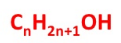
- 22What are the first 4 alcohols and their symbol equations ?1. Methanol C H3 OH
2. Ethanol C2 H5 OH
3. Propanol C3 H7 OH
4. Butanol C4 H9 OH - 23Draw the structual formula of methanol and ethanol
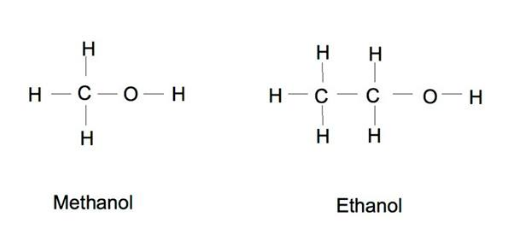
- 24What are the main properties of alcohols?1. They are liquids at room temperature:
The -OH group increases the size of the intermolecular forces between the
molecules, so the boiling point is higher
2. They mix with water: The -OH group helps it dissolve in H-O-H
3. Flammable: The hydrocarbon part C-H can burn, and is flammable
4. Reacts with sodium: The -OH group means that they react in a similar manner as water with sodium - 25Are alcohols and alkanes soluble and volatile?Ethanol is soluble in water
Alkanes are insoluble in water
Ethanol, methane and ethane are all volatile - 26Name one similarity between water and alcohols other than their reactivityThey are both good solvents
Alcohols can dissolve lots of compounds e.g. hydrocarbons and oils, which water can't, so they are very useful in industry - 27What is the difference between the reactions of sodium with ethanol, and sodium with water?Sodium + Ethanol ---> Sodium ethoxide + Hydrogen
The reaction isn't as strong
Sodium + Water ---> Sodium hydroxide + Hydrogen
The sodium fizzes. and reacts very violently (sometimes the Na melts due to the heat)
Water and ethanol both react, because they contain the -OH group - 28Name some uses of alcohols in manufacturingMethanol is used as a starting point for manufacturing other organic chemicals
Ethanol is used in perfumes and aftershave lotions as it can mix with oils ( smell) and water (bulk)
Methylated spirits is ethanol with other chemicals added to it (e.g. methanol), and is used to clean paint brushes and as fuel etc.
Pure ethanol and other alcohols is sometimes mixed with petrol, and is used as fuel for cars - 29How can alcohols e.g. ethanol be produced?In an addition reaction:
Ethene + Steam ----> Ethanol
During fermentation:
Glucose -----> Ethanol + Carbon dioxide - 30How can ethanol be produced through fermentation?Fermentation uses yeast to convert sugar into ethanol and carbon dioxide
The yeast cells contain zymase, which is an enzyme that acts as a catalyst in fermentation
This enzyme works fastest at 30 degrees C, and at a pH of 4 - 31Why is it important to prevent oxygen getting in the fermentation process?Oxygen converts the ethanol to ethanoic acid, which reduces the pH; this can stop the enzyme from working, as it denatures
- 32Why does the fermentation process stop when the concentration of ethanol reaches 10 to 20% ?The ethanol kills off the yeast cells (it is toxic to them), so they can't produce any more products
- 33How can ethanol sollution be concentrated?With distillation
- 34What are the main stages of distillation to produce concentrated ethanol?1) The ethanol solution is put in a flask below a fractionating column
2) The solution is heated, so the ethanol boils, and the ethanol vapour travels up the column, cooling as it gets higher
3) The temperature is chosen so that anything that has a higher boiling point (water) cools to a liquid and flows back down the column
4) Only the pure ethanol vapour reaches the top of the column, and this flows through a condenser, where it is cooled to a liquid - 35What information may you need to find out to see whether a process in sustainable?Will the raw materials run out?
How good is the atom economy?
What will you do with the waste products?
What are the energy costs?
Will it damage the environment?
What are the health and safety risks?
What are the benefits and risks to society?
Is it profitable? - 36How can ethanol be made from waste biomass?Waste biomass is the parts of a plant that would normally be thrown away e.g. corn stalks, rice husks and wood pulp
This can't be fermented in the normal way, because it contains a lot of cellulose, which can't be converted by yeast into ethanol
E. coli bacteria can be genetically modified, so they can convert the cellulose into ethanol - 37Main the two main stages that convert ethane into ethanolEthane is found in crude oil and natural gas, and it is cracked to form ethene and hydrogen gas
Ethene then reacts with steam to make ethanol; conditions needed: 300 degrees C, 70 atmospheres and phosphoric acid as a catalyst
ethane ----> ethene + hydrogen
ethene + steam ----> ethanol - 38Why is ethane used to make ethanol on an industrial scale?This method allows high quality ethanol to be produced continuously and quickly
Fermentation is too slow to make ethanol on a large scale - 39What is the functional group of carboxylic acids?-COOH
- 40What is the general formula for carboxylic acids?
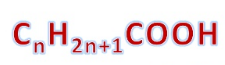
- 41What are the first 3 carboxylic acids and their structural formula ?Methanoic acid
Ethanoic acid
Propanoic acid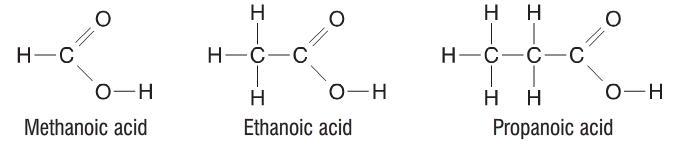
- 42How are carboxylic acids usually formed?By the oxidation of alcohols
ethanol + oxygen ---> ethanoic acid + water - 43What kind of acids are carboxylic acids?They are weak acids, so are less reactive than strong acids e.g. sulfuric acid- they have a lower pH
- 44Why are carboxylic acids weak?When dissolved in water, the H+ ions make it acidic, but only very few of these ions are formed, so it is weak
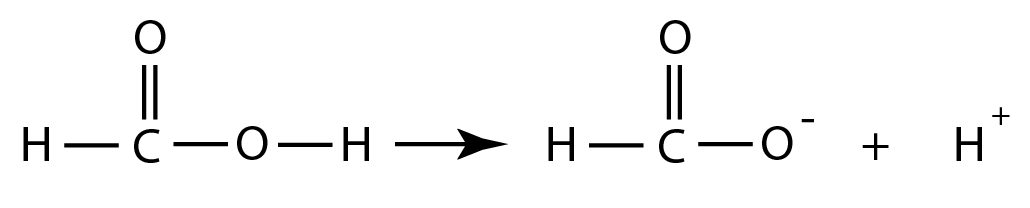
- 45How do carboxylic acids react?Just like other acids
They react with alkalis, carbonates and reactive metals - 46What is the name of a salt, which is formed in a reaction that involves carboxylic acids ?It ends in -anoate
e.g. ethanoic acid forms an ethanoate - 47What is the word and symbol equation when a metal reacts with a carboxylic acid ?carboxylic acid + metal ----> salt + hydrogen
e.g.
ethanoic acid +magnesium ----> magnesium ethanoate + hydrogen
2CH3COOH + Mg ---> Mg(CH3CO2)2 + H2 - 48What is the word and symbol equation when a metal carbonate reacts with a carboxylic acid ?carboxylic acid + metal ----> salt + water + carbon dioxide
e.g.
ethanoic acid + magnesium carbonate
---> magnesium ethanoate + water + carbon dioxide
2CH3COOH +MgCO3 ---> Mg(CH3CO2)2 + H2O + CO2 - 49What is the word and symbol equation when an alkali reacts with a carboxylic acid?carboxylic acid + alkali ----> salt + water
e.g.
ethanoic acid + magnesium hydroxide ---> magnesium thanoate + water
2CH3COOH +Mg(OH)2 ---> Mg(CH3CO2)2 + 2H2O - 50What are the main properties of carboxylic acids ?Pungent/ unpleasant smell
pH of around 4- red in universal indicator
They react like any other acid - 51What is the bond holding together sodium ethanoate?An ionic bond
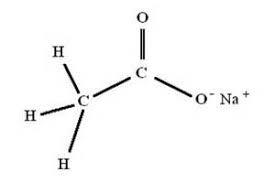
- 52How is an ester formed?An alcohol and a carboxylic acid can react together to form an ester- in an esterification reaction:
(This reaction requires warming and a strong acid as a catalyst e.g. sulphuric acid)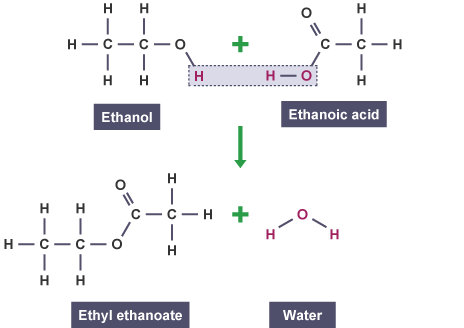
- 53How is an ester named?1st part: from the alcohol
e.g. ethyl, propyl, butyl
2nd part: from the carboxylic acid
e.g. ethanoate, propanoate, butanoate - 54What is the functional group of esters?-COO-
- 55What are the main properties of esters?They are volatile, so the molecules easily evaporate
They have pleasant smells- often sweet
They can act as solvents - 56What are esters used for?Flavourings
Perfumes
Solvents for paints, ink, glue etc.
As plastercisers- make plastics more flexible - 57What is hydrolysis?When an ester reacts with water and forms an acid and an alcohol
- 58How can a soap be formed?When a strong alkali e.g. calcium hydroxide is used as a catalyst during the hydrolysis of an ester
- 59What are fatty acids? What is glycerol? What is formed when they react together?Fatty acids are carboxylic acids with long carbon chains
Glycerol is an alcohol
When they react together fats and oils are made - 60What are the two main types of fatty acids?Saturated (only C-C bonds)
and
Unsaturated (some C=C bonds) - 61How is fat useful for organisms?They have a lot of energy packed into them, so they are good at storing energy
When an organism has excess energy, some of it is stored as fat- this can then be used later on when it is needed - 62What are the two main properties of animal fats?e.g. butter
They are solids at room temperature
They are mainly saturated hydrocarbon chains - 63What are the two main properties of vegetable oils?e.g. sunflower oil
They are liquids at room temperature- molecules aren't straight, so it is more difficult for them to pack together
They are mainly unsaturated hydrocarbon chains - 64What are soaps?The sodium or potassium salts of fatty acids
- 65What is the structure of glycerol?
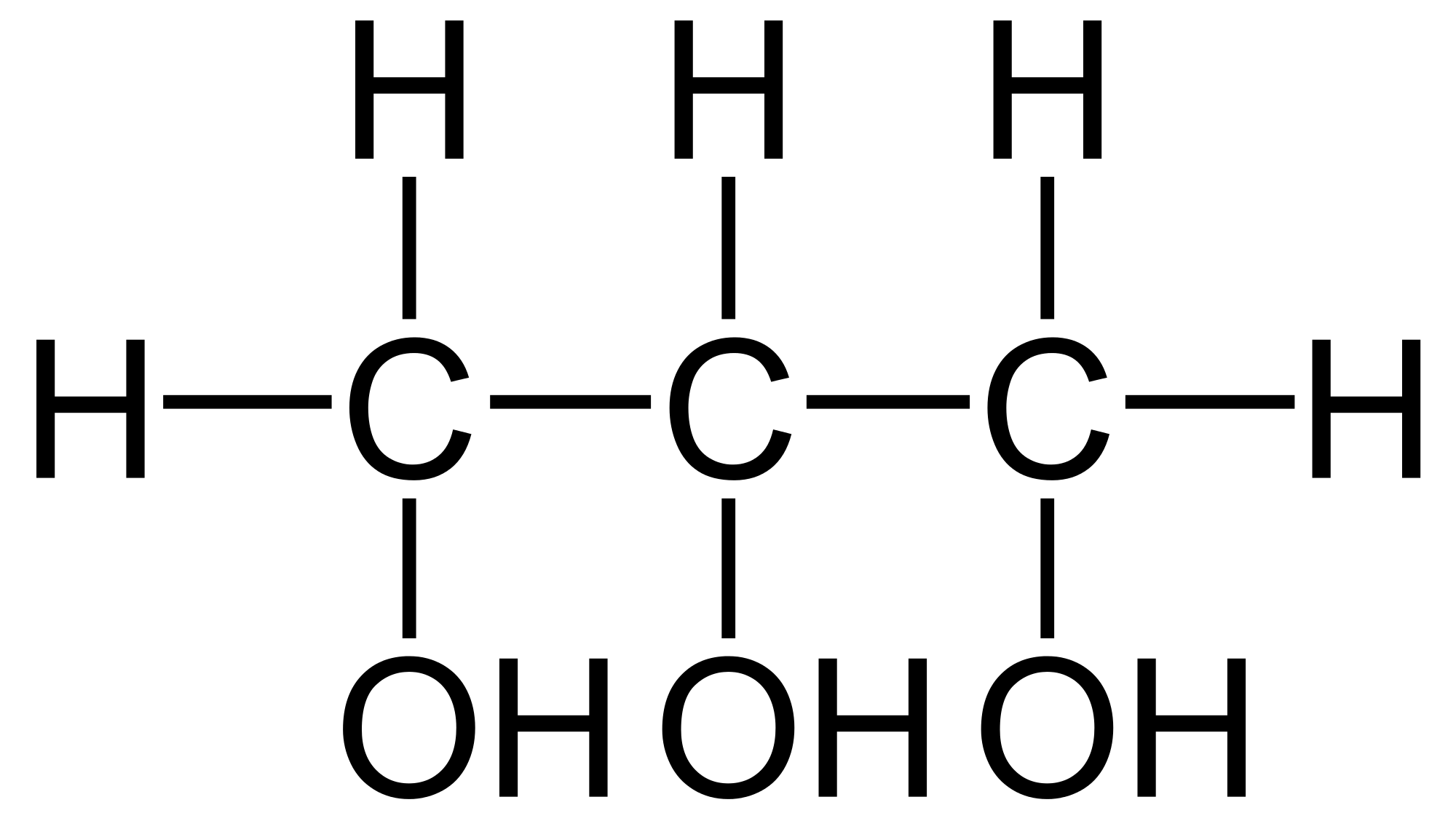
- 66What are the 4 main stages of making an ester?Refluxing
Distillation
Purification
Drying - 67What is refluxing?The mixture of the alcohol and carboxylic acid is gently heated in a flask which also contains a strong acid e.g. sulfuric acid as a catalyst
The flask is fitted with a condenser, which catches the vapour (evaporated reactants), and then allows them to condense. This means that they drop back down into the flask without being lost, so all the reactants can react to form an ester. - 68Why is distillation important when making an ester?This separates the ester from the other chemicals still in the flask
The mixture is heated below a fractionating column, and as the solution starts to boil, the vapour goes up this column. The temperature at the top of the column is the boiling point of the ester, so this liquid flows out of the condenser and is collected- an impure ester - 69Why is purification important when making an ester?It purifies the ester
The mixture is poured into a tap funnel, and mixed with sodium carbonate solution to remove any acidic impurities
It is then mixed with calcium chloride (once all the water has been removed through tapping) to remove any ethanol - 70Why is drying important when making an ester?Any remaining water can be removed by shaking it with lumps of anhydrous calcium chloride, which absorbs the water
The pure ester can be seperated from the solid CaCl2 by filtration - 71What is the atom economy?A measure of the efficiency with which a reaction uses its reactant atoms
- 72How can the atom economy be calculated?mass of atoms in the desired product
-------------------------------------------------------
mass of the atoms in the reactant
x 100 - 73What are bulk chemicals?Chemicals that are made in very large quantities
e.g. fertilizers, sulfuric acid, ammonia and sodium hydroxide - 74What are fine chemicals?Chemicals that are made in small quantities with high purities
e.g. medicines, perfumes and food additives - 75What can be done to a process to make it more 'Green' ?Waste prevention
High atom economy
Less hazardous chemical synthesis
Designing safer chemicals
Catalysis
Pollution prevention
Use of safer solvents and auxiliaries
Use of renewable feedstocks
Design for energy efficiency
Design for degredation
Reducing derivatives
Safer chemistry for accident prevention - 76How can percentage yield be calculated?Actual yield
------------------------
Theoretical yield
x100% - 77Name some exothermic reactionsneutralisation reaction
water turning into ice
combustion reaction - 78Name some endothermic reactionsthermal decomposition
water turning into steam- evaporation requires energy to occur - 79Why do boiling points differ between substances?Some bonds are stronger than others, so will require varying amounts of energy to break them
- 80What kind of reactions are making and breaking bonds?Making bonds releases energy- exothermic
Breaking bonds requires energy- endothermic
MEXOBENDO - 81What is the equation to find the enthalpy change/ energy change of a reaction?Bonds in reactants - Bonds in products
If the answer is negative the reaction is exothermic
If the answer is positive the reaction is endothermic - 82What does a catalyst do?It lowers the activation energy required to start the reaction by giving an alternative route. This speeds up the rate of reaction
- 83What is a reversible reaction?The symbol ⇌ is used to show that the reaction can occur in both direction, as the products can react together back into the reactants
- 84What is dynamic equilibrium?When the rate of the forwards reaction is equal to the rate of the backwards reaction
The number/ concentration of reactants and products present should always stay the same, but the reaction is still occuring - 85What are Le Chatelier's principles?It states that whatever change we make to the conditions of a reaction at equilibrium, the reaction acts to reverse this change
- 86What conditions can we change in a reaction?Concentration
Temperature
Pressure - 87If A + B ⇌ C (exothermic) What is the backwards reaction?Endothermic due to the conservation of energy
- 88A + B ⇌ C What will the reaction do if the concentration of A is increased?The reaction will want to reduce the concentration of A, by favouring the other side of the reaction
It will try to produce more of C, so increases the concentration of substances of the products too - 89A + B ⇌ C (exothermic) What will the reaction do if the temperature increases?The reaction will want to reduce the temperature, by favouring the endothermic reaction
It will try to produce more A and B, as this is the endothermic reaction, so takes in some of the heat - 90A + B ⇌ C What will the reaction do if the pressure increases?The reaction will want to reduce the pressure by favouring the reaction that produces less molecules of gas
It will try to produce more C, as in the forward reaction only one molecule is produced, whereas the backwards reaction produces two molecules - 91What is the word and symbol equation for the Haber process?Nitrogen + Hydrogen ---> Ammonia

- 92What are the feedstocks for the Haber process?nitrogen and hydrogen
- 93Ideally what conditions would their be to increase the amount of ammonia produced?Decrease the temperature
Increase the pressure
Increase the concentration of nitrogen and hydrogen - 94What are the conditions used for the Haber process when done industrially?Temperature : 450 °C
Pressure: 200 atmospheres
Catalyst: Iron - 95Why is 450°C used industrially for the Haber process even though this favours the endothermic reaction, which produces N2 and H2 ?If the temperature is any lower, the rate of reaction would be so slow that it wouldn't be profitable- the catalyst is also added to increase the rate of reaction
The temperature is put in the middle, as making it hotter would further increase the rate of reaction, but this may result in a lower yield of ammonia - 96Why is a pressure of 200 atmospheres used in the Haber process?A higher pressure may be dangerous and too costly, but it is still very high, so a lot of ammonia should be produced
- 97What happens to the hydrogen and nitrogen molecules that don't react in the reaction vessel?It doesn't stay in the reaction vessel for long, but it is recycled and passes through the vessel again. This means that none is wasted and more ammonia will be formed
- 98What is the main use of the Haber process?It produces ammonia, which is used in fertilisers
Nitric acid and ammonia react together to form ammonium nitrate- a commonly used fertiliser - 99Why are fertilisers important?They play a vital part in world food production, as they increase crop yields, so help to feed more people
- 100What are the other uses of ammonia?It is important in industry where it is used to manufacture plastics, explosives and pharmaceuticals
- 101What are some negatives of the Haber process?Fertilisers can cause eutrophication and water pollution
- 102Where do the nitrogen and hydrogen that are neede in the Haber process come from?The nitrogen comes from the air (78%)
The hydrogen comes from the cracking of chemicals in natural gas - 103What is nitrogen fixation?The process of turning N2 from the air into useful nitrogen compounds e.g. ammonia
- 104How can nitrogen fixing bacteria 'fix' nitrogen at room temperature and pressure?Using enzymes- biological catalysts
- 105What is needed before new chemical products are made?Lots of research and development
- 106To make a new production process run efficiently a new catalyst might have to be found- what are the main steps of this?1) Testing potential catalysts using a process of trial and error
2)Making computer models of the reaction
to try and work out which substance might work as a catalyst
3) Designing or refining the manufacture of the catalyst - make sure the product can be mass produced safely, efficiently and cost effectively
4) Investigating the catalyst's risks to the environment, and how these can be reduced
5) Monitoring the quality of the product to make sure it isn't affected by the catalyst - 107What do government regulations do?They protect workers, the general public and the environment
- 108What kind of government regulations exist for chemical processes?1) Using chemicals- sulfuric acid is sprayed on potato fields to make harvesting easier; government regulations restrict how much acid can be used, and signs have to be put out to warn the public
2)Storage- dangerous chemicals have to be stored in locked storerooms, and poisonous chemicals must be stored in either sealed containers or well- ventilated store cupboards
3) Transport- lorries transporting chemicals must display hazard symbols and identification numbers to help emergency services deal safely with any accidents or spills - 109What are the 5 main stages involved in producing a chemical?1. Raw materials are converted into feedstock
2. Synthesis
3. The products are separated
4. The purity of the product is monitored
5. By- products and waste are dealt with - 110What is the difference between raw materials and feedstock ?Raw materials are the naturally occurring substances which are needed
e.g. crude oil and natural gas
Feedstocks are the actual reactants needed for the process
e.g. hydrogen and ethanol
The raw material usually have to be purified or changed in some way to make the feedstock - 111What is chemical synthesis?The feedstock (reactants) are converted into new chemicals (products)
The conditions are carefully monitored and controlled to make sure the reaction occurs at a reasonable rate - 112Why do the products have to be seperated?Chemical reactions usually provide the required substance and other chemicals known as by- products. There may also be some left over reactants, so everything is separated, so it can be dealt with in different ways
- 113Why is the purity of the product monitored?Even after all the chemicals have been separated, they may still not be perfectly pure
The purity has to be monitored to make sure it is between certain levels and safe to use- medicines have to be very pure - 114How are by- products and waste dealt with?Where possible by- products are sold or used in another reaction
If the reaction is exothermic, it will release heat- this excess heat can be used to produce steam or hot water for other reactions, saving energy and money
There are legal requirements about carefully disposing of waste products, so it doesn't harm people or the environment - 115What is qualitative and quantitative analysis ?Qualitative analysis tells you which substances are present in a sample
Quantitative analysis tells you how much of a substance is present in the sample - 116Why is chemical analysis carried out on samples?It might be difficult and expensive to test all of the material, and it means that the rest can be used for its actual purpose
If something goes wrong with the analysis, another sample can be used
The sample has to represent all the chemical, so a mean can be calculated - 117How is a solution made?By dissolving the sample in a solvent
- 118What are the two main types of solution?Aqueous solutions: the solvent is water- they're shown by the state symbol (aq)
Non- aqueous solutions: the solvent is anything other than water e.g. ethanol - 119What are standard procedures?They are agreed methods of working that are safe, effective and accurate
They can be agreed within a company, nationally or internationally
They are there for the collection, storage and analysis of a sample, so results should always be very similar - 120What is chromatography used for?To identify and separate chemicals in a mixture
To check the purity of a sample
To purify small samples of a chemical - 121What are the two phases used in chromatography?The mobile phase: The solvent or gas that moves up/ along the stationary phase- the molecules can move
The stationary phase: The material that doesn't move, and it is always a solid or really thick liquid - 122How can the Rf value be calculated?Distance traveled by the sample
---------------------------------------------------
Distance traveled by the solvent - 123Why do different chemicals seperate out and end at different points?How quickly a chemical moves depends on how it distributes itself between the two phases
Información
- Descripción
- GCSE Chemistry Fichas sobre C7 revision, creado por Anna Kanz el 19/06/2017.
- Creado por
- Anna Kanz
- Visitas
- 37
- Valoración