
Fichas
Fossil Evidence For Evolution

Fichas del conjunto (22)
- 1FossilA fossil is the preserved remains of a once living organism.
→ Examples of fossils
• Footprints
• Burrows
• Faeces
• Bones Shells and Teeth. - 2Fossil Evidence• Fossil evidence shows that species today did not exist in the past.
• This suggests these species today and millions of years ago arrived at different times.
• Also Fossils showing a slow gradual difference in characteristics suggests there has been a modification of existing structures (primates being quadrupedal and humans now being bipedal) - 3Fossil Formation• Fossils/parts of an organism may become fossilised when buried by:
→ Drifting sand
→ Mud deposited by rivers
→ Volcanic ash
→ If buried rapidly, conditions may not be “suitable” for the activity of decay and decomposition may be slowed or prevented. - 4Good conditions vs Bad conditions for fossil formation Soil Preservation→ Good conditions
• Soil that contains no oxygen
→ this slows the rate of decomposition.
→ Example includes peat, which is partly decayed vegetation.
• Soils rich in alkali.
→ They produce the best fossils (minerals in bones and teeth are not dissolved)
Bad conditions
• Wet acidic soils
→ Minerals in bones will be dissolved and no fossilisation will occur. - 5Good conditions vs Bad conditions for fossil formation EnvironmentGood conditions
• High salt and low oxygen environments.
→ Examples include salt lakes, river systems, and volcanic ash
• Lack of soil movement.
• Cold conditions
→ Stops bacterial decay.
Bad conditions
• Remains being left on land
→ Remains are more like to be destroyed by scavengers or erosion
• Remains being left in a high energy environment
→ Your remains are more likely to be destroyed by mechanical processes. - 6Exposing fossils→ Erosion
• By wind or water
→ Major earth movement
• Can shift and destroy fossils (earthquakes)
→ Human movement
• Mining, construction and site development. - 7How is a fossil formed ?1. Sediment
• An animal is buried by sediment such as volcanic ash or silt, shorty after dies.
2. Layers
• More sedimental layers accumulate above the animals remains.
3. Movement
• Movement of tectonic plates that make up the earths surface lifts up the sediments and pushes the fossil closer to the surface.
4. Erosion
• Erosion from rain, rivers, and winds wears away he remaining rock layers. Eventually, erosion or human movements ill expose the persevered remains. - 8Exposing fossils at a excavation dig1. Scientists investigate the area and mark out sections to be exposed.
2. They use small hand tools to remove soil gently so they don’t destroy any material.
3. Soil that is removed is then sieved so any small or large fragments are caught and looked at.
4. Anything found will be labelled and catalogue.
5. Photographs are taken and recorded as evidence. - 9Artefacts• Artefacts are objects that have been deliberately made by humans.
→ Examples
• Stone tools
• Beads
• Carvings,
• Charcoal from cooking fires
• Cave paintings. - 10Absolute Dating• Absolute dating is the process of placing an actual age of a fossil in years.
• This is done by a range of specialised scientific techniques including:
→ Potassium-argon dating
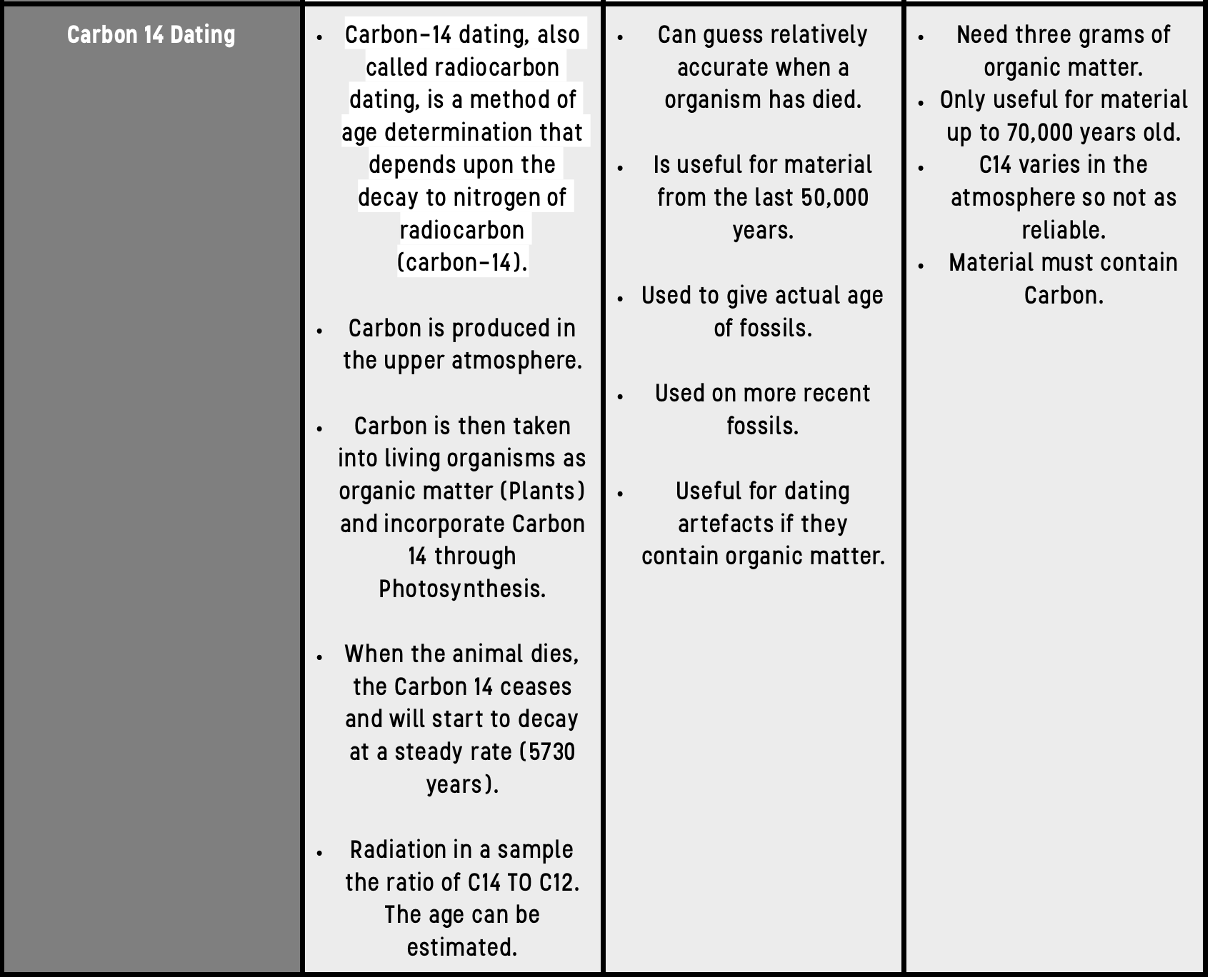
→ Carbon 14 dating
→ AMS
→ Dendrochronology - 11Methods of Absolute Dating Potassium-argon dating
- 12Methods of Absolute Dating Carbon 14 Dating
- 13Methods of Absolute Dating AMS (Accelerator mass Spectrometry)

- 14Methods of Absolute Dating Dendrochronology

- 15Relative Dating• Relative dating is the process of establishing an approximate age based on comparing it to other known fossils.
• Scientists will determine whether if the artefact or fossil is older or younger than another sample.
• Examples of this type of dating are:
→ Stratigraphy (Two methods)
→Index fossils
→ Fluorine dating. - 16Method of Relative Dating Fluorine Dating• Bones buried in the same environment absorb fluorine ions at the same rate.
• When a bone is left in soil, fluoride ions, which are present in the water in the soil, replace some of the ions in the bone itself.
• If bones found at the same location contain the same concentration of fluorine, it can be assumed that they are of the same age.
• All the fossil bones in a particular deposit should contain the same amount of fluoride, so that fossils that have been displaced can be detected.
• The older the fossil the more fluoride it contains, so that the relative ages can be established.
• It is not possible to decide absolute ages using this method since the concentration of fluoride in ground water varies from place to place and from time to time. - 17Method of Relative Dating Index Fossils• Certain types of fossils and preserved remains can also assist in relative dating.
• These are known as index fossils
Index fossils are of distinctive appearance, have a short time span and have a broad geographical distribution.
• If rocks in different locations contain the same index fossils, it is likely that both areas are of the same age.
• Often human fossils have been found in deposits along with these 'index fossils' so it was assumed that the humans also lived during that time period. - 18Method of Relative Dating Stratigraphy• Stratigraphy is the study of layers which can consist of soil, rock, fossils and artefacts.
• There are two methods in which stratigraphy can be useful in dating fossil. - 19Methods of Stratigraphy Principle Of Superposition• The principle of superposition states that rock layers at the bottom of a sequence are older than the ones on top.
• The problem with this principle is that many rock layers don't remain in the order they were originally laid down.
• Over millions of years, the earth's surface has experienced geological movements and erosion from wind and water.
• These factors can alter surface rocks as well as the layers beneath. Also, humans and animals can disturb surface rocks, disturbing the original layering.
• The deeper the strata (layers) the fossil at the bottom was deposited first. Which means it is older. - 20Methods of Stratigraphy Correlation of rock strata• Correlation of rock strata involves matching layers of rock from different parts of the world.
• Matching strata can be done by examining the rock itself and by studying the fossils it contains.
• It can be assumed that both objects are of the same age.
• Certain fossils are of great value in this correlation work because they are widely distributed and were present on the earth only for a limited period of time, making the relative dating of strata more precise.
• An Example includes Index fossils (Trilobite) - 21Fossil Record• The fossil record shows all of the fossil evidence which has been found in the Earth’s strata,
• It provides physical evidence about which organisms lived on Earth in the past.
• And provides examples of intermediate organisms between species which may not exist today.
• It Allows scientists to create evolutionary links between species
• Helps to establish recent common ancestry
• Used to determine diet and teeth from vegetation-fossil pollen
• Fossil record indicates increase in complexity and diversity
• Fossil record has complete sequences - 22Problems with the fossil recordFossils may be:
1. Not recognised/ only fragments found.
2. Buried too deep to find
3. Rock may be too hard to penetrate so they cant find any older fossils.
4. Located in places impossible to get to.
5. Difficult to date due to limitations in dating methods.
6. Exposed and weathered before the discovery/ destroyed by human activity.
7. Scientists can disagree on the interpretation of fossils.
Información
- Descripción
- Year 12 (Chapter 16 • Fossil Evidence For Evolution • ) ATAR Human Biology Fichas sobre Fossil Evidence For Evolution , creado por Lewis Johnson el 02/07/2017.
- Creado por
- Lewis Johnson
- Visitas
- 40
- Valoración
Más sobre Evidence for Evolution