
Diagrama de flujo
Chapter 24-2: Antitrust
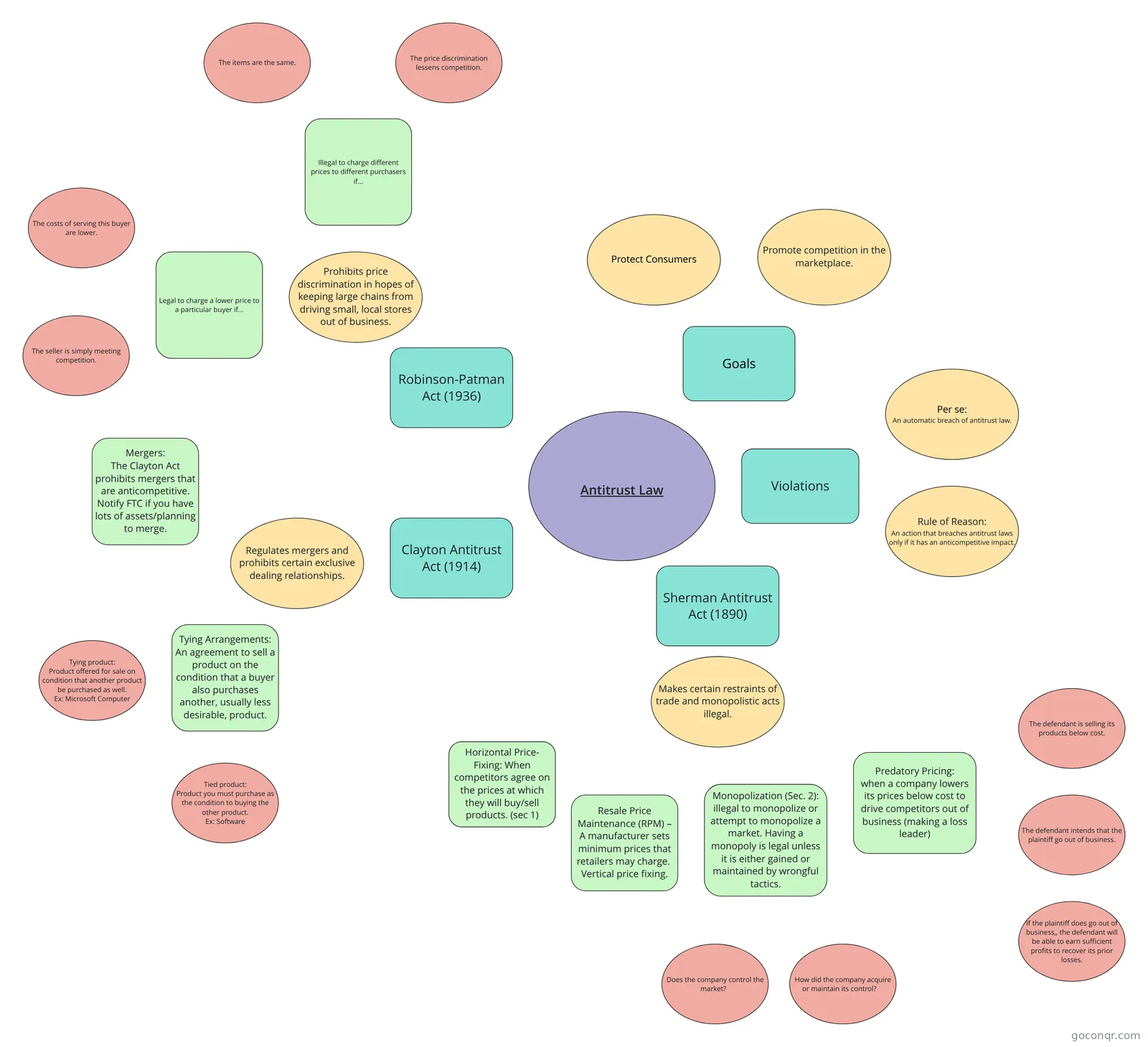
Flowchart: antitrust law
Contenido del diagrama
Antitrust Law
Goals
Protect Consumers
Promote competition in the marketplace.
Violations
Rule of Reason:
An action that breaches antitrust laws only if it has an anticompetitive impact.
Per se:
An automatic breach of antitrust law.
Sherman Antitrust Act (1890)
Makes certain restraints of trade
and monopolistic acts illegal.
Monopolization (Sec. 2): illegal to monopolize or attempt to
monopolize a market. Having a monopoly
is legal unless it is either gained
or maintained
by wrongful tactics.
Resale
Price Maintenance (RPM) – A manufacturer sets minimum prices that
retailers may charge. Vertical price fixing.
Horizontal Price-Fixing: When competitors agree on the prices at which they will buy/sell products. (sec 1)
Predatory Pricing:
when a company lowers its prices below
cost to drive competitors out of business (making a loss leader)
Does
the company control the market?
How
did the company acquire or maintain its control?
The defendant is selling its products below cost.
The defendant intends that the plaintiff go out of business.
If the plaintiff does go out of business,, the defendant will be able to earn sufficient profits to recover its prior losses.
Clayton Antitrust Act (1914)
Regulates mergers and prohibits
certain exclusive dealing relationships.
Mergers:
The Clayton Act prohibits mergers that are anticompetitive.
Notify FTC if you have lots of assets/planning to merge.
Tying Arrangements:
An agreement to sell a product on the condition that a buyer also purchases another, usually less desirable, product.
Tied product:
Product you must purchase as the condition to buying the other product.
Ex: Software
Tying product:
Product offered for sale on condition that another product be purchased as well.
Ex: Microsoft Computer
Robinson-Patman Act (1936)
Prohibits price discrimination in hopes of keeping large chains from driving small, local stores out of business.
Illegal to charge different prices to different purchasers if...
Legal to charge a lower price to a particular buyer if...
The costs of serving this buyer are lower.
The seller is simply meeting competition.
The price discrimination lessens competition.
The items are the same.