
Mapa mental
Cranial Nerves
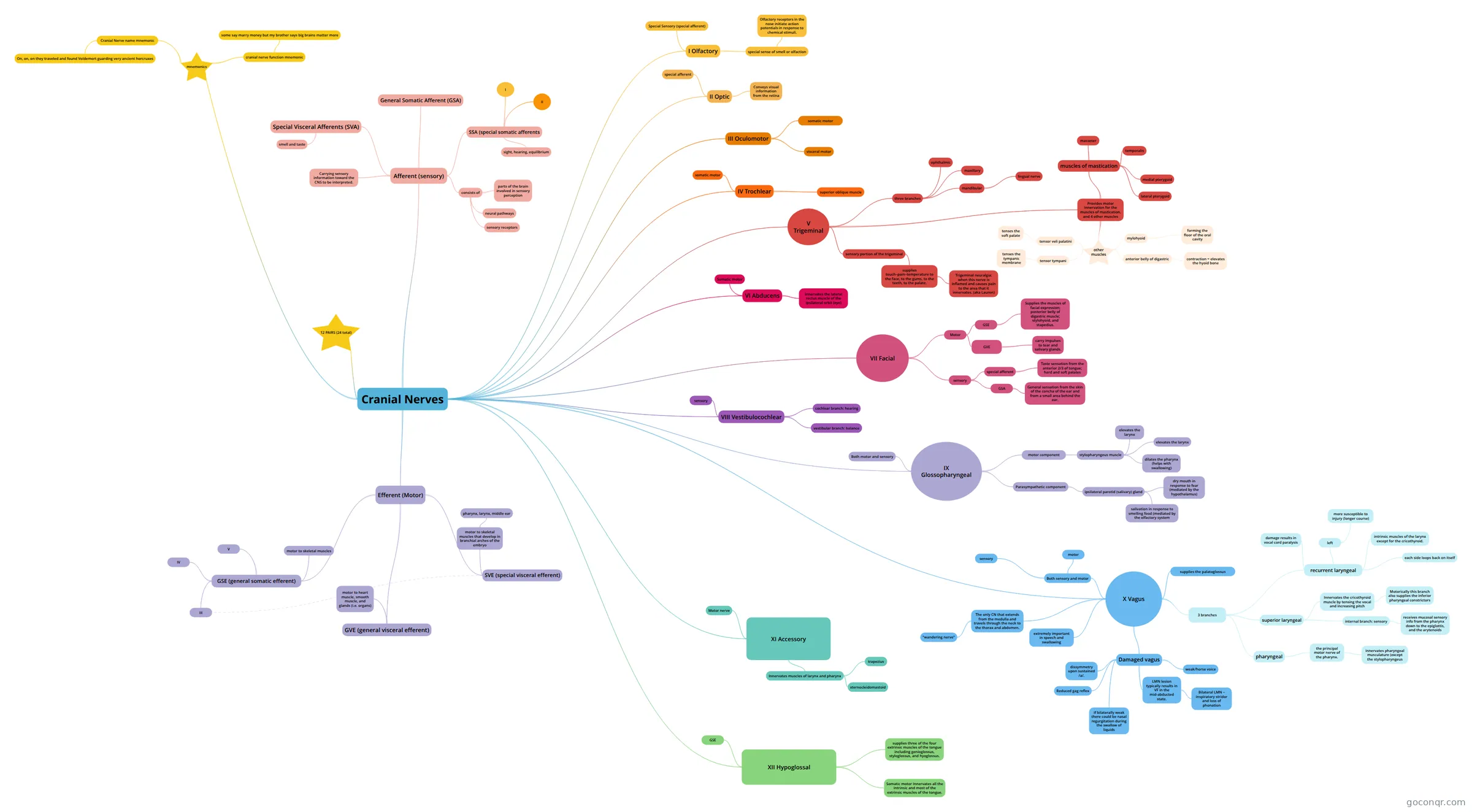
Mind map: Cranial nerves
Contenido del mapa
Cranial Nerves
I Olfactory
- Special Sensory (special afferent)
- special sense of smell or olfaction
- Olfactory receptors in the nose initiate action potentials in response to chemical stimuli.
II Optic
- special afferent
- Conveys visual information from the retina
III Oculomotor
- somatic motor
- The somatic motor component of CN III plays a major role in controlling the muscles responsible for the precise movement of the eyes for visual tracking or fixation on an object.
- visceral motor
- The visceral motor component is involved in the pupillary light and accommodation reflexes.
- somatic motor
IV Trochlear
- somatic motor
- superior oblique muscle
V Trigeminal
- three branches
- ophthalmic
- maxillary
- mandibular
- lingual nerve
- supplies sensory innervation to the anterior 2/3 tongue, but not taste
- lingual nerve
- Provides motor innervation for the muscles of mastication, and 4 other muscles
- muscles of mastication
- masseter
- temporalis
- medial pterygoid
- lateral pterygoid
- other muscles
- tensor veli palatini
- tenses the soft palate
- mylohyoid
- forming the floor of the oral cavity
- •Hyolaryngial elevation •When you swallow, this helps drag up the back of the tongue
- forming the floor of the oral cavity
- anterior belly of digastric
- contraction = elevates the hyoid bone
- If you can’t elevate your tongue, you can’t elevate your hyoid and the larynx won’t lift up, and food and drink will be able to enter your respiratory system and cause pneumonia (special type – look it up)
- contraction = elevates the hyoid bone
- tensor tympani
- tenses the tympanic membrane
- tensor veli palatini
- muscles of mastication
- sensory portion of the trigeminal
- supplies touch–pain–temperature to the face, to the gums, to the teeth, to the palate.
- Trigeminal neuralgia: when this nerve is inflamed and causes pain to the area that it innervates. (aka Lauren)
- supplies touch–pain–temperature to the face, to the gums, to the teeth, to the palate.
- three branches
VI Abducens
- Somatic motor
- innervates the lateral rectus muscle of the ipsilateral orbit (eye)
VII Facial
- Motor
- GSE
- Supplies the muscles of facial expression; posterior belly of digastric muscle; stylohyoid, and stapedius.
- GVE
- carry impulses to tear and salivary glands.
- GSE
- sensory
- special afferent
- Taste sensation from the anterior 2/3 of tongue; hard and soft palates
- GSA
- General sensation from the skin of the concha of the ear and from a small area behind the ear.
- special afferent
- Motor
VIII Vestibulocochlear
- sensory
- cochlear branch: hearing
- vestibular branch: balance
IX Glossopharyngeal
- •Carries visceral sensory information from the carotid sinus (of the carotid artery) and body. •Provides general sensory information from the skin of the external ear, internal surface of the tympanic membrane, upper pharynx, and the posterior one-third of the tongue. •Provides taste sensation from the posterior one-third of the tongue
- Both motor and sensory
- motor component
- stylopharyngeus muscle
- elevates the larynx
- elevates the larynx
- dilates the pharynx (helps with swallowing)
- stylopharyngeus muscle
- Parasympathetic component
- ipsilateral parotid (salivary) gland
- dry mouth in response to fear (mediated by the hypothalamus)
- salivation in response to smelling food (mediated by the olfactory system
- ipsilateral parotid (salivary) gland
X Vagus
- extremely important in speech and swallowing
- Both sensory and motor
- motor
- –Supplies the voluntary muscles of the pharynx and most of the larynx, as well as one extrinsic muscle of the tongue (palatoglossus ). –the vagus forms part of the involuntary nervous system and commands unconscious body procedures, such as keeping the heart rate constant and controlling food digestion
- sensory
- –Provides visceral sensory information from the larynx, esophagus, trachea, and abdominal and thoracic viscera, as well as the stretch receptors of the aortic arch and chemoreceptors of the aortic bodies . –Provides general sensory information from the skin of the back of the ear and external auditory meatus, parts of the external surface of the tympanic membrane, and the pharynx. –Provides taste sensation from the epiglottic region
- motor
- The only CN that extends from the medulla and travels through the neck to the thorax and abdomen.
- "wandering nerve"
- 3 branches
- pharyngeal
- the principal motor nerve of the pharynx.
- innervates pharyngeal musculature (except the stylopharyngeus
- the principal motor nerve of the pharynx.
- recurrent laryngeal
- left
- more susceptible to injury (longer course)
- intrinsic muscles of the larynx except for the cricothyroid.
- each side loops back on itself
- damage results in vocal cord paralysis
- left
- superior laryngeal
- This branch of the vagus nerve divides into and internal and external branch. The external laryngeal nerve supplies the inferior pharyngeal consticotrs and the cricothyroid muscle (which controls pitch by lengthening the VCs). The internal laryngeal nerve is a sensory nerve that receives mucosal sensory information from the pharynx down to the epiglottis, the aryepiglottic folds and the arytenoids.
- Innervates the cricothyroid muscle by tensing the vocal and increasing pitch
- Motorically this branch also supplies the inferior pharyngeal constrictors
- internal branch: sensory
- receives mucosal sensory info from the pharynx down to the epiglottis, and the arytenoids
- pharyngeal
- Damaged vagus
- dissymmetry upon sustained /a/.
- Reduced gag reflex
- weak/horse voice
- LMN lesion typically results in VF in the mid-abducted state.
- Bilateral LMN – inspiratory stridor and loss of phonation
- If bilaterally weak there could be nasal regurgitation during the swallow of liquids
- supplies the palatoglossus
XI Accessory
- Motor nerve
- Innervates muscles of larynx and pharynx
- trapezius
- sternocleidomastoid
XII Hypoglossal
- GSE
- Somatic motor Innervates all the intrinsic and most of the extrinsic muscles of the tongue.
- supplies three of the four extrinsic muscles of the tongue including genioglossus, styloglossus, and hyoglossus.
mnemonics
- Cranial Nerve name mnemonic
- On, on, on they traveled and found Voldemort guarding very ancient horcruxes
- cranial nerve function mnemonic
- some say marry money but my brother says big brains matter more
- Cranial Nerve name mnemonic
12 PAIRS (24 total)
Afferent (sensory)
- Carrying sensory information toward the CNS to be interpreted.
- consists of
- sensory receptors
- neural pathways
- parts of the brain involved in sensory perception
- SSA (special somatic afferents
- sight, hearing, equilibrium
- I
- II
- Special Visceral Afferents (SVA)
- smell and taste
- General Somatic Afferent (GSA)
- fibers are related to receptors for pain temperature and mechanical receptors in the skin, muscles and joints.
Efferent (Motor)
- GSE (general somatic efferent)
- motor to skeletal muscles
- III
- IV
- V
- GVE (general visceral efferent)
- motor to heart muscle, smooth muscle, and glands (i.e. organs)
- SVE (special visceral efferent)
- motor to skeletal muscles that develop in branchial arches of the embryo
- pharynx, larynx, middle ear
- motor to skeletal muscles that develop in branchial arches of the embryo
- GSE (general somatic efferent)
Información
- Descripción
- (Exam 1) Neural Bases Mapa Mental sobre Cranial Nerves, creado por Stashia Casimir el 05/09/2017.
- Creado por
- Stashia Casimir
- Visitas
- 3
- Valoración