
Mapa mental
C2.1 Structure And Bonding
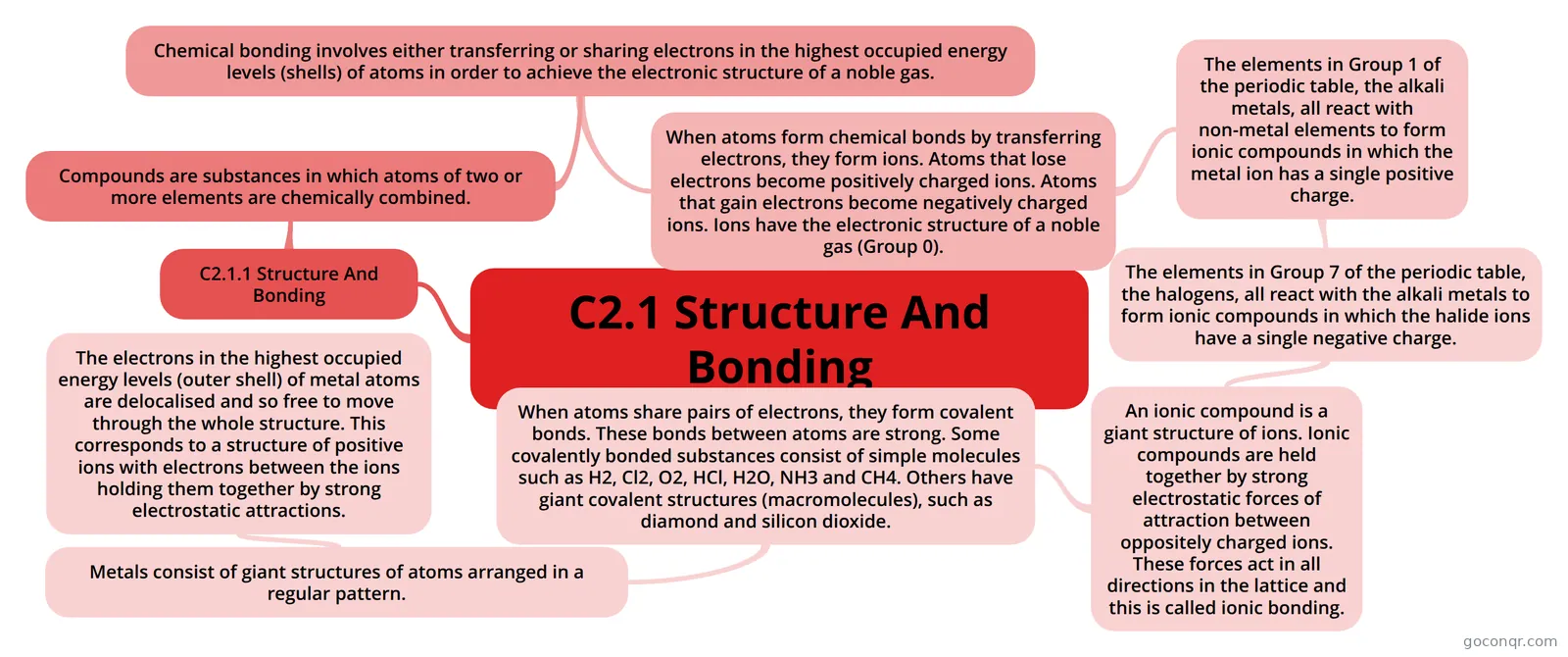
Mind map: C2.1 structure and bonding
Contenido del mapa
C2.1 Structure And Bonding
C2.1.1 Structure And Bonding
- Compounds are substances in which atoms of two or more elements are chemically combined.
- Chemical bonding involves either transferring or sharing electrons in the highest occupied energy levels (shells) of atoms in order to achieve the electronic structure of a noble gas.
- When atoms form chemical bonds by transferring electrons, they form ions. Atoms that lose electrons become positively charged ions. Atoms that gain electrons become negatively charged ions. Ions have the electronic structure of a noble gas (Group 0).
- The elements in Group 1 of the periodic table, the alkali metals, all react with non-metal elements to form ionic compounds in which the metal ion has a single positive charge.
- The elements in Group 7 of the periodic table, the halogens, all react with the alkali metals to form ionic compounds in which the halide ions have a single negative charge.
- An ionic compound is a giant structure of ions. Ionic compounds are held together by strong electrostatic forces of attraction between oppositely charged ions. These forces act in all directions in the lattice and this is called ionic bonding.
- When atoms share pairs of electrons, they form covalent bonds. These bonds between atoms are strong. Some covalently bonded substances consist of simple molecules such as H2, Cl2, O2, HCl, H2O, NH3 and CH4. Others have giant covalent structures (macromolecules), such as diamond and silicon dioxide.
- Metals consist of giant structures of atoms arranged in a regular pattern.
- The electrons in the highest occupied energy levels (outer shell) of metal atoms are delocalised and so free to move through the whole structure. This corresponds to a structure of positive ions with electrons between the ions holding them together by strong electrostatic attractions.
- Metals consist of giant structures of atoms arranged in a regular pattern.
- When atoms share pairs of electrons, they form covalent bonds. These bonds between atoms are strong. Some covalently bonded substances consist of simple molecules such as H2, Cl2, O2, HCl, H2O, NH3 and CH4. Others have giant covalent structures (macromolecules), such as diamond and silicon dioxide.
- An ionic compound is a giant structure of ions. Ionic compounds are held together by strong electrostatic forces of attraction between oppositely charged ions. These forces act in all directions in the lattice and this is called ionic bonding.
- The elements in Group 7 of the periodic table, the halogens, all react with the alkali metals to form ionic compounds in which the halide ions have a single negative charge.
- The elements in Group 1 of the periodic table, the alkali metals, all react with non-metal elements to form ionic compounds in which the metal ion has a single positive charge.
- When atoms form chemical bonds by transferring electrons, they form ions. Atoms that lose electrons become positively charged ions. Atoms that gain electrons become negatively charged ions. Ions have the electronic structure of a noble gas (Group 0).
- Chemical bonding involves either transferring or sharing electrons in the highest occupied energy levels (shells) of atoms in order to achieve the electronic structure of a noble gas.
- Compounds are substances in which atoms of two or more elements are chemically combined.
Información
- Descripción
- GCSE (C2) Chemistry Mapa Mental sobre C2.1 Structure And Bonding, creado por killthemoment el 25/07/2014.
- Creado por
- killthemoment
- Visitas
- 297
- Etiquetas
- Valoración