
Mapa mental
C2.3 Atomic Structure, Analysis And Quantitative Chemistry
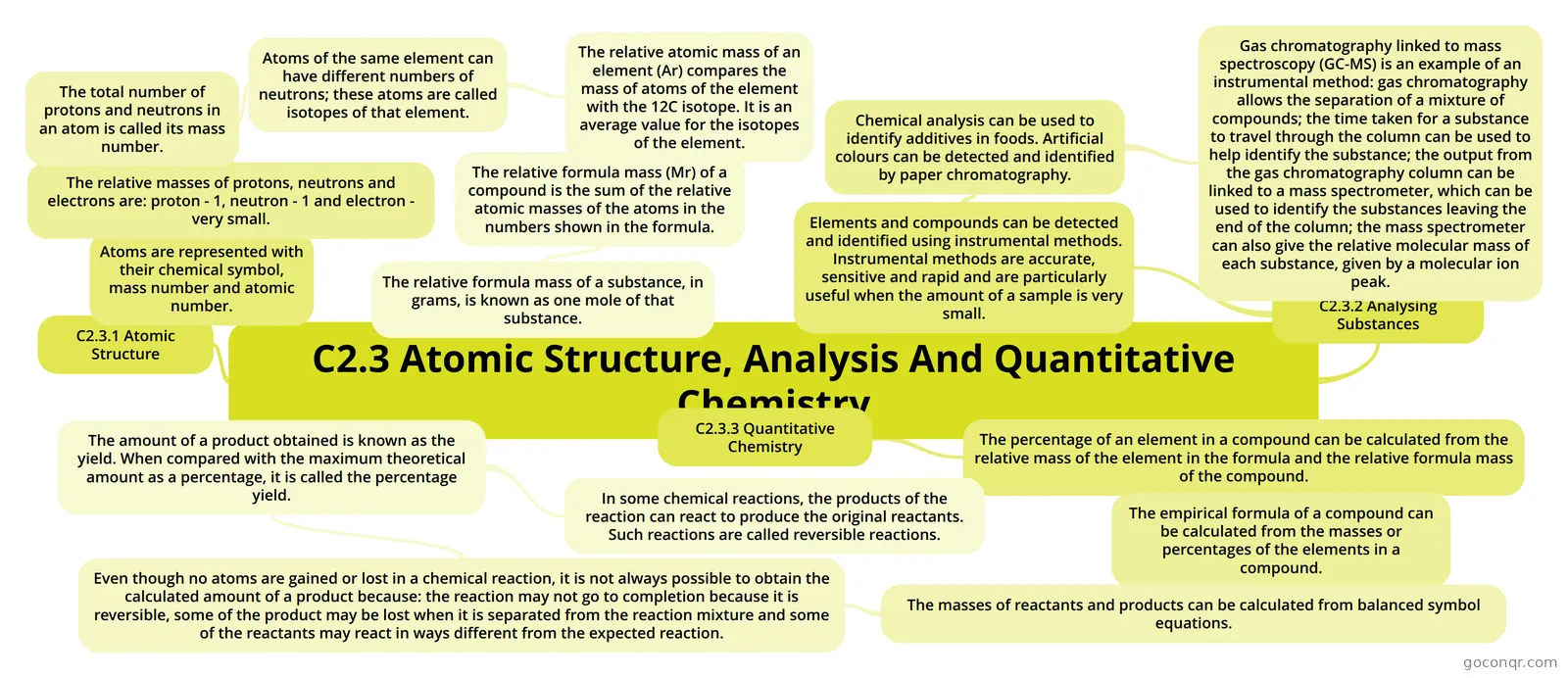
Mind map: atomic structure, analysis and quantitative chemistry
Contenido del mapa
C2.3 Atomic Structure, Analysis And Quantitative Chemistry
C2.3.1 Atomic Structure
- Atoms are represented with their chemical symbol, mass number and atomic number.
- The relative masses of protons, neutrons and electrons are: proton - 1, neutron - 1 and electron - very small.
- The total number of protons and neutrons in an atom is called its mass number.
- Atoms of the same element can have different numbers of neutrons; these atoms are called isotopes of that element.
- The relative atomic mass of an element (Ar) compares the mass of atoms of the element with the 12C isotope. It is an average value for the isotopes of the element.
- The relative formula mass (Mr) of a compound is the sum of the relative atomic masses of the atoms in the numbers shown in the formula.
- The relative formula mass of a substance, in grams, is known as one mole of that substance.
- The relative formula mass (Mr) of a compound is the sum of the relative atomic masses of the atoms in the numbers shown in the formula.
- The relative atomic mass of an element (Ar) compares the mass of atoms of the element with the 12C isotope. It is an average value for the isotopes of the element.
- Atoms of the same element can have different numbers of neutrons; these atoms are called isotopes of that element.
- The total number of protons and neutrons in an atom is called its mass number.
- The relative masses of protons, neutrons and electrons are: proton - 1, neutron - 1 and electron - very small.
- Atoms are represented with their chemical symbol, mass number and atomic number.
C2.3.2 Analysing Substances
- Elements and compounds can be detected and identified using instrumental methods. Instrumental methods are accurate, sensitive and rapid and are particularly useful when the amount of a sample is very small.
- Chemical analysis can be used to identify additives in foods. Artificial colours can be detected and identified by paper chromatography.
- Gas chromatography linked to mass spectroscopy (GC-MS) is an example of an instrumental method: gas chromatography allows the separation of a mixture of compounds; the time taken for a substance to travel through the column can be used to help identify the substance; the output from the gas chromatography column can be linked to a mass spectrometer, which can be used to identify the substances leaving the end of the column; the mass spectrometer can also give the relative molecular mass of each substance, given by a molecular ion peak.
- Chemical analysis can be used to identify additives in foods. Artificial colours can be detected and identified by paper chromatography.
- Elements and compounds can be detected and identified using instrumental methods. Instrumental methods are accurate, sensitive and rapid and are particularly useful when the amount of a sample is very small.
C2.3.3 Quantitative Chemistry
- The percentage of an element in a compound can be calculated from the relative mass of the element in the formula and the relative formula mass of the compound.
- The empirical formula of a compound can be calculated from the masses or percentages of the elements in a compound.
- The masses of reactants and products can be calculated from balanced symbol equations.
- Even though no atoms are gained or lost in a chemical reaction, it is not always possible to obtain the calculated amount of a product because: the reaction may not go to completion because it is reversible, some of the product may be lost when it is separated from the reaction mixture and some of the reactants may react in ways different from the expected reaction.
- The amount of a product obtained is known as the yield. When compared with the maximum theoretical amount as a percentage, it is called the percentage yield.
- In some chemical reactions, the products of the reaction can react to produce the original reactants. Such reactions are called reversible reactions.
- The amount of a product obtained is known as the yield. When compared with the maximum theoretical amount as a percentage, it is called the percentage yield.
- Even though no atoms are gained or lost in a chemical reaction, it is not always possible to obtain the calculated amount of a product because: the reaction may not go to completion because it is reversible, some of the product may be lost when it is separated from the reaction mixture and some of the reactants may react in ways different from the expected reaction.
- The masses of reactants and products can be calculated from balanced symbol equations.
- The empirical formula of a compound can be calculated from the masses or percentages of the elements in a compound.
- The percentage of an element in a compound can be calculated from the relative mass of the element in the formula and the relative formula mass of the compound.
Información
- Descripción
- GCSE (C2) Chemistry Mapa Mental sobre C2.3 Atomic Structure, Analysis And Quantitative Chemistry, creado por killthemoment el 25/07/2014.
- Creado por
- killthemoment
- Visitas
- 277
- Etiquetas
- Valoración