
Mapa mental
C4
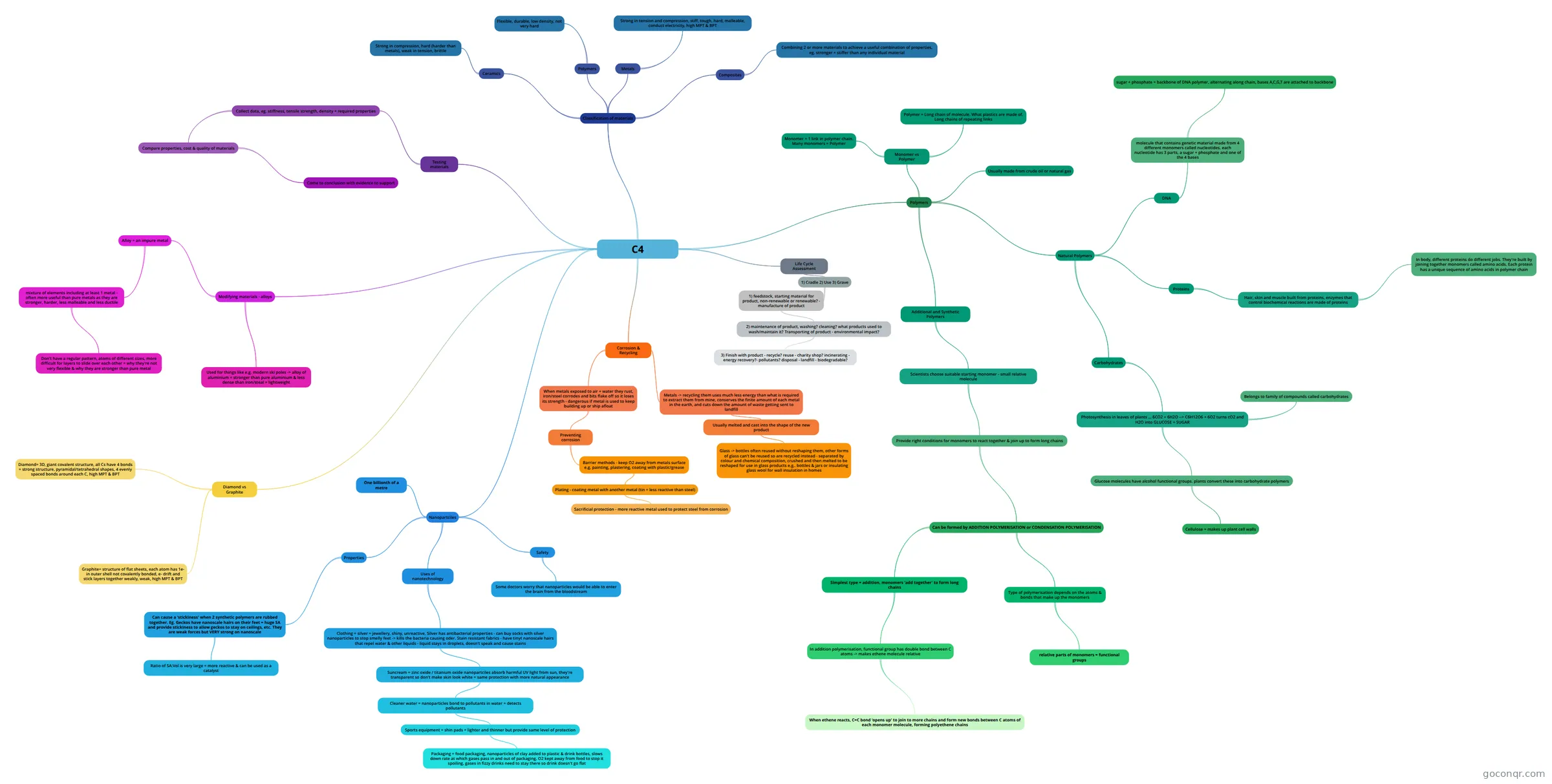
Mind map: C4 chemistry materials
Contenido del mapa
C4
Classification of materials
- Ceramics
- Strong in compression, hard (harder than metals), weak in tension, brittle
- Polymers
- Flexible, durable, low density, not very hard
- Metals
- Strong in tension and compression, stiff, tough, hard, malleable, conduct electricity, high MPT & BPT
- Composites
- Combining 2 or more materials to achieve a useful combination of properties, eg. stronger + stiffer than any individual material
- Ceramics
Polymers
- Monomer vs Polymer
- Monomer = 1 link in polymer chain. Many monomers = Polymer
- Polymer = Long chain of molecule. What plastics are made of. Long chains of repeating links
- Usually made from crude oil or natural gas
- Natural Polymers
- DNA
- molecule that contains genetic material made from 4 different monomers called nucleotides. each nucleotide has 3 parts, a sugar + phosphate and one of the 4 bases
- sugar + phosphate = backbone of DNA polymer, alternating along chain, bases A,C,G,T are attached to backbone
- molecule that contains genetic material made from 4 different monomers called nucleotides. each nucleotide has 3 parts, a sugar + phosphate and one of the 4 bases
- Proteins
- Hair, skin and muscle built from proteins, enzymes that control biochemical reactions are made of proteins
- In body, different proteins do different jobs. They're built by joining together monomers called amino acids. Each protein has a unique sequence of amino acids in polymer chain
- Hair, skin and muscle built from proteins, enzymes that control biochemical reactions are made of proteins
- Carbohydrates
- Photosynthesis in leaves of plants ... 6CO2 + 6H2O --> C6H12O6 + 6O2 turns cO2 and H2O into GLUCOSE = SUGAR
- Belongs to family of compounds called carbohydrates
- Glucose molecules have alcohol functional groups. plants convert these into carbohydrate polymers
- Cellulose = makes up plant cell walls
- Photosynthesis in leaves of plants ... 6CO2 + 6H2O --> C6H12O6 + 6O2 turns cO2 and H2O into GLUCOSE = SUGAR
- DNA
- Additional and Synthetic Polymers
- Scientists choose suitable starting monomer - small relative molecule
- Provide right conditions for monomers to react together & join up to form long chains
- Can be formed by ADDITION POLYMERISATION or CONDENSATION POLYMERISATION
- Type of polymerisation depends on the atoms & bonds that make up the monomers
- relative parts of monomers = functional groups
- Simplest type = addition, monomers 'add together' to form long chains
- In addition polymerisation, functional group has double bond between C atoms -> makes ethene molecule relative
- When ethene reacts, C=C bond 'opens up' to join to more chains and form new bonds between C atoms of each monomer molecule, forming polyethene chains
- In addition polymerisation, functional group has double bond between C atoms -> makes ethene molecule relative
- Type of polymerisation depends on the atoms & bonds that make up the monomers
- Can be formed by ADDITION POLYMERISATION or CONDENSATION POLYMERISATION
- Provide right conditions for monomers to react together & join up to form long chains
- Scientists choose suitable starting monomer - small relative molecule
- Monomer vs Polymer
Testing materials
- Collect data, eg. stiffness, tensile strength, density = required properties
- Compare properties, cost & quality of materials
- Come to conclusion with evidence to support
- Compare properties, cost & quality of materials
- Collect data, eg. stiffness, tensile strength, density = required properties
Modifying materials - alloys
- Alloy = an impure metal
- mixture of elements including at least 1 metal - often more useful than pure metals as they are stronger, harder, less malleable and less ductile
- Don't have a regular pattern, atoms of different sizes, more difficult for layers to slide over each other = why they're not very flexible & why they are stronger than pure metal
- mixture of elements including at least 1 metal - often more useful than pure metals as they are stronger, harder, less malleable and less ductile
- Used for things like e.g. modern ski poles -> alloy of aluminium = stronger than pure aluminium & less dense than iron/steal = lightweight
- Alloy = an impure metal
Diamond vs Graphite
- Diamond= 3D, giant covalent structure, all Cs have 4 bonds = strong structure, pyramidal/tetrahedral shapes, 4 evenly spaced bonds around each C, high MPT & BPT
- Graphite= structure of flat sheets, each atom has 1e- in outer shell not covalently bonded, e- drift and stick layers together weakly, weak, high MPT & BPT
Nanopartciles
- One billionth of a metre
- Properties
- Can cause a 'stickiness' when 2 synthetic polymers are rubbed together. Eg. Geckos have nanoscale hairs on their feet = huge SA and provide stickiness to allow geckos to stay on ceilings, etc. They are weak forces but VERY strong on nanoscale
- Ratio of SA:Vol is very large = more reactive & can be used as a catalyst
- Can cause a 'stickiness' when 2 synthetic polymers are rubbed together. Eg. Geckos have nanoscale hairs on their feet = huge SA and provide stickiness to allow geckos to stay on ceilings, etc. They are weak forces but VERY strong on nanoscale
- Uses of nanotechnology
- Clothing = silver = jewellery, shiny, unreactive, Silver has antibacterial properties - can buy socks with silver nanoparticles to stop smelly feet -> kills the bacteria causing oder. Stain resistant fabrics - have tinyt nanoscale hairs that repel water & other liquids - liquid stays in droplets, doesn't speak and cause stains
- Suncream = zinc oxide / titanium oxide nanopartciles absorb harmful UV light from sun, they're transparent so don't make skin look white = same protection with more natural appearance
- Cleaner water = nanoparticles bond to pollutants in water = detects pollutants
- Sports equipment = shin pads = lighter and thinner but provide same level of protection
- Packaging = food packaging, nanoparticles of clay added to plastic & drink bottles, slows down rate at which gases pass in and out of packaging. O2 kept away from food to stop it spoiling, gases in fizzy drinks need to stay there so drink doesn't go flat
- Sports equipment = shin pads = lighter and thinner but provide same level of protection
- Cleaner water = nanoparticles bond to pollutants in water = detects pollutants
- Suncream = zinc oxide / titanium oxide nanopartciles absorb harmful UV light from sun, they're transparent so don't make skin look white = same protection with more natural appearance
- Clothing = silver = jewellery, shiny, unreactive, Silver has antibacterial properties - can buy socks with silver nanoparticles to stop smelly feet -> kills the bacteria causing oder. Stain resistant fabrics - have tinyt nanoscale hairs that repel water & other liquids - liquid stays in droplets, doesn't speak and cause stains
- Safety
- Some doctors worry that nanoparticles would be able to enter the brain from the bloodstream
Life Cycle Assessment
- 1) Cradle 2) Use 3) Grave
- 1) feedstock, starting material for product, non-renewable or renewable? - manufacture of product
- 2) maintenance of product, washing? cleaning? what products used to wash/maintain it? Transporting of product - environmental impact?
- 3) Finish with product - recycle? reuse - charity shop? incinerating - energy recovery?- pollutants? disposal - landfill - biodegradable?
- 2) maintenance of product, washing? cleaning? what products used to wash/maintain it? Transporting of product - environmental impact?
- 1) feedstock, starting material for product, non-renewable or renewable? - manufacture of product
- 1) Cradle 2) Use 3) Grave
Corrosion & Recycling
- When metals exposed to air + water they rust, iron/steel corrodes and bits flake off so it loses its strength - dangerous if metal is used to keep building up or ship afloat
- Preventing corrosion
- Barrier methods - keep O2 away from metals surface e.g. painting, plastering, coating with plastic/grease
- Plating - coating metal with another metal (tin = less reactive than steel)
- Sacrificial protection - more reactive metal used to protect steel from corrosion
- Plating - coating metal with another metal (tin = less reactive than steel)
- Barrier methods - keep O2 away from metals surface e.g. painting, plastering, coating with plastic/grease
- Preventing corrosion
- Metals -> recycling them uses much less energy than what is required to extract them from mine, conserves the finite amount of each metal in the earth, and cuts down the amount of waste getting sent to landfill
- Usually melted and cast into the shape of the new product
- Glass -> bottles often reused without reshaping them, other forms of glass can't be reused so are recycled instead - separated by colour and chemical composition, crushed and then melted to be reshaped for use in glass products e.g.. bottles & jars or insulating glass wool for wall insulation in homes
- Usually melted and cast into the shape of the new product
- When metals exposed to air + water they rust, iron/steel corrodes and bits flake off so it loses its strength - dangerous if metal is used to keep building up or ship afloat