
Mapa mental
EU Institutions
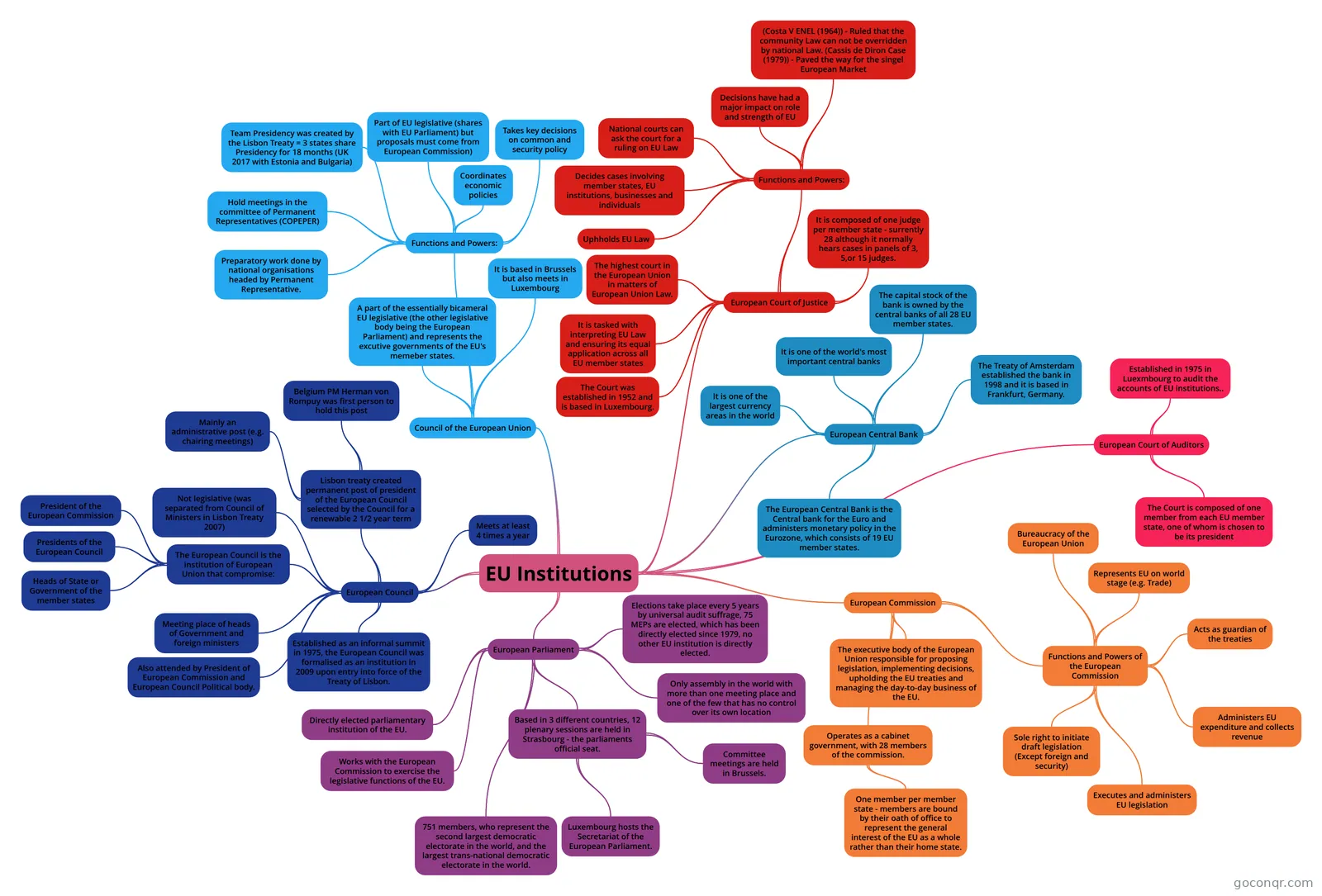
Mind map: EU institutions
Contenido del mapa
EU Institutions
European Parliament
- Directly elected parliamentary institution of the EU.
- Works with the European Commission to exercise the legislative functions of the EU.
- 751 members, who represent the second largest democratic electorate in the world, and the largest trans-national democratic electorate in the world.
- Based in 3 different countries, 12 plenary sessions are held in Strasbourg - the parliaments official seat.
- Committee meetings are held in Brussels.
- Luxembourg hosts the Secretariat of the European Parliament.
- Only assembly in the world with more than one meeting place and one of the few that has no control over its own location
- Elections take place every 5 years by universal audit suffrage, 75 MEPs are elected, which has been directly elected since 1979, no other EU institution is directly elected.
European Commission
- The executive body of the European Union responsible for proposing legislation, implementing decisions, upholding the EU treaties and managing the day-to-day business of the EU.
- Operates as a cabinet government, with 28 members of the commission.
- One member per member state - members are bound by their oath of office to represent the general interest of the EU as a whole rather than their home state.
- Functions and Powers of the European Commission
- Sole right to initiate draft legislation (Except foreign and security)
- Executes and administers EU legislation
- Administers EU expenditure and collects revenue
- Acts as guardian of the treaties
- Represents EU on world stage (e.g. Trade)
- Bureaucracy of the European Union
European Council
- The European Council is the institution of European Union that compromise:
- Heads of State or Government of the member states
- Presidents of the European Council
- President of the European Commission
- Meeting place of heads of Government and foreign ministers
- Established as an informal summit in 1975, the European Council was formalised as an institution in 2009 upon entry into force of the Treaty of Lisbon.
- Also attended by President of European Commission and European Council Political body.
- Not legislative (was separated from Council of Ministers in Lisbon Treaty 2007)
- Meets at least 4 times a year
- Lisbon treaty created permanent post of president of the European Council selected by the Council for a renewable 2 1/2 year term
- Belgium PM Herman von Rompuy was first person to hold this post
- Mainly an administrative post (e.g. chairing meetings)
- The European Council is the institution of European Union that compromise:
Council of the European Union
- A part of the essentially bicameral EU legislative (the other legislative body being the European Parliament) and represents the excutive governments of the EU's memeber states.
- It is based in Brussels but also meets in Luxembourg
- Functions and Powers:
- Preparatory work done by national organisations headed by Permanent Representative.
- Hold meetings in the committee of Permanent Representatives (COPEPER)
- Team Presidency was created by the Lisbon Treaty = 3 states share Presidency for 18 months (UK 2017 with Estonia and Bulgaria)
- Part of EU legislative (shares with EU Parliament) but proposals must come from European Commission)
- Coordinates economic policies
- Takes key decisions on common and security policy
European Court of Justice
- The highest court in the European Union in matters of European Union Law.
- It is tasked with interpreting EU Law and ensuring its equal application across all EU member states
- The Court was established in 1952 and is based in Luxembourg.
- It is composed of one judge per member state - surrently 28 although it normally hears cases in panels of 3, 5,or 15 judges.
- Functions and Powers:
- Uphholds EU Law
- Decides cases involving member states, EU institutions, businesses and individuals
- National courts can ask the court for a ruling on EU Law
- Decisions have had a major impact on role and strength of EU
- (Costa V ENEL (1964)) - Ruled that the community Law can not be overridden by national Law. (Cassis de Diron Case (1979)) - Paved the way for the singel European Market
European Central Bank
- The European Central Bank is the Central bank for the Euro and administers monetary policy in the Eurozone, which consists of 19 EU member states.
- It is one of the largest currency areas in the world
- It is one of the world's most important central banks
- The capital stock of the bank is owned by the central banks of all 28 EU member states.
- The Treaty of Amsterdam established the bank in 1998 and it is based in Frankfurt, Germany.
European Court of Auditors
- Established in 1975 in Luexmbourg to audit the accounts of EU institutions..
- The Court is composed of one member from each EU member state, one of whom is chosen to be its president