
Mapa mental
External Influences
Contenido del mapa
External Influences
The Market
- A competitive market usually means a market in which large numbers of producers actively compete with each other to satisy the wants and needs of a large number of consumers.
- Market Structures
- Competitive Market: A market structure in which there are a large number of firms producing a similar product, who are competing to meet the needs of a large number of consumers.
- These firms have to accept the price in market and have little power in the market, e.g. it is difficult for any one of them to raise the price because consumers will simply switch to another supplier. Therefore no single producer can dictate price.
- Monopoly: A market which is controlled by a single business (monopolist). They can control the market because it is the only supplier of the product and can therefore charge whatever price it likes (adopts a 'take it or leave it' approach to customers).
- Can be defined as a situation where a business has 25%+ share of the market.
- Monopolistic Competition: There is usually a non-price competition - products are branded and promoted by the business. Each firm has a monopoly over its brand name and uses it to promote minor differences between it and another brand. This non-price competition can be through the use of loyalty cards to gain and retain customers.
- Oligopoly: It exists where a market is dominated by a few large firms. It is suggested that oligopolists collude (secretly agree) to keep prices higher than they would be if the markey was behaviour. This is illegal as it is anti-competitive, but it is hard to prove. This may be done so that if one business raises its price and the others do not, it will lose revenue. If it cuts its price and the others follow, they will likely end up with the same market share.
- Competitive Market: A market structure in which there are a large number of firms producing a similar product, who are competing to meet the needs of a large number of consumers.
- Market Size and Growth
- Market size is the number of individuals in a certain market who are potential buyers and/or sellers of a product or service.
- Market growth refers to an increase in the demand for a business's product(s) over a period of time.
- Competition and Market Dominance
- Competition is beneficial because it forces business to be efficient in terms of keeping costs as low as possible to keep prices down for consumers. It also encourages innovation and emphasis on meeting customer needs. If the firms in a competitive market are small, they will not be able to gain economies of scale (reductions in unit costs) and therefore customers may be paying a higher price than they would if the firm was larger and able to gain these economies.
- Employees: competitive pressure to keep costs down may impact negatively on conditions of servece (E.g. wages, overtime payments, hours, holidays etc.) and conditions of work.
- Suppliers: May be offered a 'take it or leave it approach' to the conditions of supply and payement in a bid to keep costs down. They may be little loyalty to a supplier is a business is under a lot of competitive pressure.
- Shareholders: A small firm that is subject to intense competition will have little markey power and small or no degree of control over prices. This may mean dividends are relatively low, especially if it is not easy for the firm to cut costs,
- Market Dominance: A measure of the strength of a business and its product(s) relative to the competition. To calculate market dominance is to consider market share(the share of the market that the product or business controls in a particular area). Ways in which a business may increase its market share and dominance in the market could be done by:
- Being aware of customer needs - and meeting them.
- Selling more to existing customers.
- Finding out why 'old' customers no longer use your products.
- Having a clear marketing plan.
- Using a variety of marketing techniques - pricing, advertising and promotion
- Market dominance needs to be a precise deginition of what 'the market' actually is. The less dominant a business is, the weaker its market power over price will be. Factors to prevent this are known as barriers to entry:
- Large start-up costs - these will be capital costs (buildings and machinery). A firm simply may not be able to afford the necessary expense.
- Having to match the marketing budgets of those already in the market. Many customers are going to be loyal to existing firms - may take a vast marketing budget to get them to alter their behaviour.
- Legal restrictions such as a patent or government restrictions. Trying to copy another's success by making a similar product may lead to legal action if the product has a patent. Some markets have restrictions placed on them by the government, e.g. a business cannot just try to set up another national lottery.
- Competition is beneficial because it forces business to be efficient in terms of keeping costs as low as possible to keep prices down for consumers. It also encourages innovation and emphasis on meeting customer needs. If the firms in a competitive market are small, they will not be able to gain economies of scale (reductions in unit costs) and therefore customers may be paying a higher price than they would if the firm was larger and able to gain these economies.
Global Context
- The process of globalisation has come through the growth in transport, telecommunications and the internet. The process of globalisation is increasingly rapid as telecommunications improve.
- The International Monetary Fund (IMF) identified four factors that have contributed to globalisation in 2000:
- 1. Increase in trade and the number of transactions taking place.
- 2. Increase in movements of capital for investment.
- 3. Increase in the movements of people across international borders of work.
- 4. Increase in the availability of knowledge, particularly through the internet.
- The biggest companies in the world are now multinational corporations that operate on a global scale - may produce in many centres in different countries and are likely to sell well in most countries also.
- Companies that are keen to operate on a global scale must also have strategies to consider how to build competitive global advancements which are the best locations to trade and produce products.
- In developed countries, globalisation is often seen as a good thing because it allows firms to take advantage of economies of scale to reduce the process for the consumer. However, globalisation is not helping to reduce the gap between rich and poor countries - worsening the situation as a result of the low wages paid to vulnerable groups, in manufacturing businesses in the developing world.
- Several factors have contributed to speeding up the process of globalisation:
- Trade is now freer on a world level than it has ever been as trade barriers between countries are reduced.
- Telecommunications have improved in all areas, from the use of mobile phones to teleconferencing and the internet. In developing countries new mobile phone networks have opened up communications to all - no longer necessary to install expensive landline systems.
- There are huge economies of scale possible now in transport of freight by air and see.
- Multinationals are increasingly moving to developing countries to take advantage of factors such as lower wages, fewer legal constraints, government grants towards setting up and the opportunity to sell in a new market with less competition.
- Emerging Markets
- Refers to developing countries that are achieving rapid growth and industrialisation and are quickly achieving the status of developing markets. The main countries in this category are India and China.
- For the developed world the emerging economues represent both an opportunity and a threat.
- The opportunities arise from:
- New markets with higher disposable income.
- Opportunity to move production into these markets and take advantage of the new group of consumers.
- Investment opportunities in infradtructure and production.
- The threats arise from:
- Lower labour costs and the ability to produce more cheaply than in developed economies.
- Fewer exports from developed economies as the emerging economies become able to produce for themselves.
- Greater independence for emerging economies.
- The opportunities arise from:
- Advantages and Disadvantages
- + The incoming company brings investment, jobs and training.
- + News and ideas are spread quickly and easily around the world so that we know about the events such as natural disasters and environmental problems on a world scale.
- + LDCs need foreign currency to enable them to buy the imports they need to develop further. This money can also be used to improve the lives of inhabitants by providing clean water, medical services and education.
- - The benefits og globalisation are mostly felt by developed countries, their inhabitants and their businesses. Thses businesses may repatriate their profits so that there may be little benefit for the LDC.
- - The lack of clear and robust legal framework in LDCs can often result in poor working conditions, lack of concern for the environment and pay that is too low to sustain a reasonable living standard.#
- - The multinational coporation might impose its ideas, morals and ethics on local populations in LDCs.
- - There is always a fear in developed countries that jobs will be lost to LDCs. This has been the case with call centre workers when businesses such as M&S moved part of their work to India.
- Globalisation + the growth of multinational firms are now an inevitable part of live in developed and the developing world. However, it is not possible/advisable for all companies to go down this route - small businesses can meet the needs of local or national markets, alongside the world brands that we all recognise.
- Opportunities and Threats
- Not all businesses are affected by globalisation: newly industrialised countries are likely to concentrate their production in areas such as motor vehicles and textiles first.
- However, the rate of expansion in these countries is very rapid because they are able to take advantage of competition and will soon be felt by businesses in all areas of the developed world.
- In the past, it has been possible for businesses to use comparative advantage and make changes to concrete production in specialist areas or niche markets, so that they were not facing direct comeptition from lower-wage economies - increadingly difficult as the developing economies become more sophisticated.
- Globalisation brings with it all opportunities created by larger markets and lower production costs, but also brings threats of high interdepoendence of nations and unemployment in those areas - businesses that connot compete efficiently or economically.
Economic Factors
- Gross Domestic Products (GDP)
- The total output of all goods and services produced, usually in a year. Gross in this case means total and domestic measns within a particular country.
- Part of any rise in GDP will be due to a rise in prices. GDP is therefore adjusted by deducting the rate of inflation to give 'GDP' in real terms.
- Factors Affecting Economic Activity
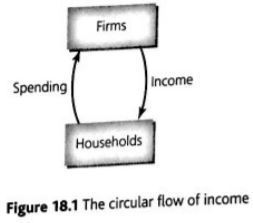
- In the households group, people go to work and earn income - a flow of income from businesses to households as payment for the work done. Most of this income will be spent and therefore there is a flow of income in the opposite direction from households to busineses - called consumption.
- The circular flow of income begins with the flow of income that households have earned being spent on goods and services - spending enables firms to acquire monry they need to finance the next round of production.
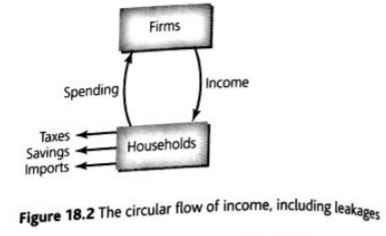
- There are three reasons why all the income earned by households in the UK will not directly go to the UK firms:
- Taxes: The government takes a proportion of income through taxes.
- Savings: Whatever remains after tax from an employee's wages is known as disposable income and people may decides to save some of this.
- Imports: Products that are made abroad and purchased by UK households are known as imports. When income is spent on products that are important, there is a flow of income to foreign, rather than UK, firms.
- These three reasons mean that there ate leakages from the circular flow of income, which is why UK businesses do not receive back all the income that they have paid out to their employees.
- There are a number of injections of income into the economy, which help to offset the leakages. These injections come from elsewhere (not the UK).
- Government spending: the government is a big spender in the UK on services such as schools, hospitals and defence.
- In summary: The circular flow of income is a continuous process. PEople are earning and being taxed, saving and spending all the time. Businesses are continuously enployed = paying peiple income. They are also exporting productsabroad, investing in capital equipment. The government issues in tax revenue and spends it.
- In the households group, people go to work and earn income - a flow of income from businesses to households as payment for the work done. Most of this income will be spent and therefore there is a flow of income in the opposite direction from households to busineses - called consumption.
- Direct Taxes
- Taken directly from either a person's income when they work, or from a company who makes a profit (coporation tax).
- Gross Domestic Products (GDP)
Legal Factors
- Types of Laws
- Civil L:aw: Concerned with the rules that govern the relations between businesses and/or people e.g. employment and consumer rights.
- Criminal Law: This law defines the actions that the state has decided are 'wrong', and the punishment that such actions will result from. In a criminal court, if a business/person is found guilty, the result can be a fine or imprisonment. The court has to be convinced 'beyond reasonable doubt' that the defendant is guilty.
- EU Law: Originates from the EU's Social Charter = a charter of rights for employees concerning areas such as working conditions, wages, workforce. UK businesses have to adhere to these laws just as if they had originated the UK parliament. There are two types:
- Types of Laws
Imágenes y archivos del mapa
Información
- Descripción
- AS level Business Studies Mapa Mental sobre External Influences, creado por Keana Campbell el 30/04/2018.
- Creado por
- Keana Campbell
- Visitas
- 1
- Valoración