
Mapa mental
System Software
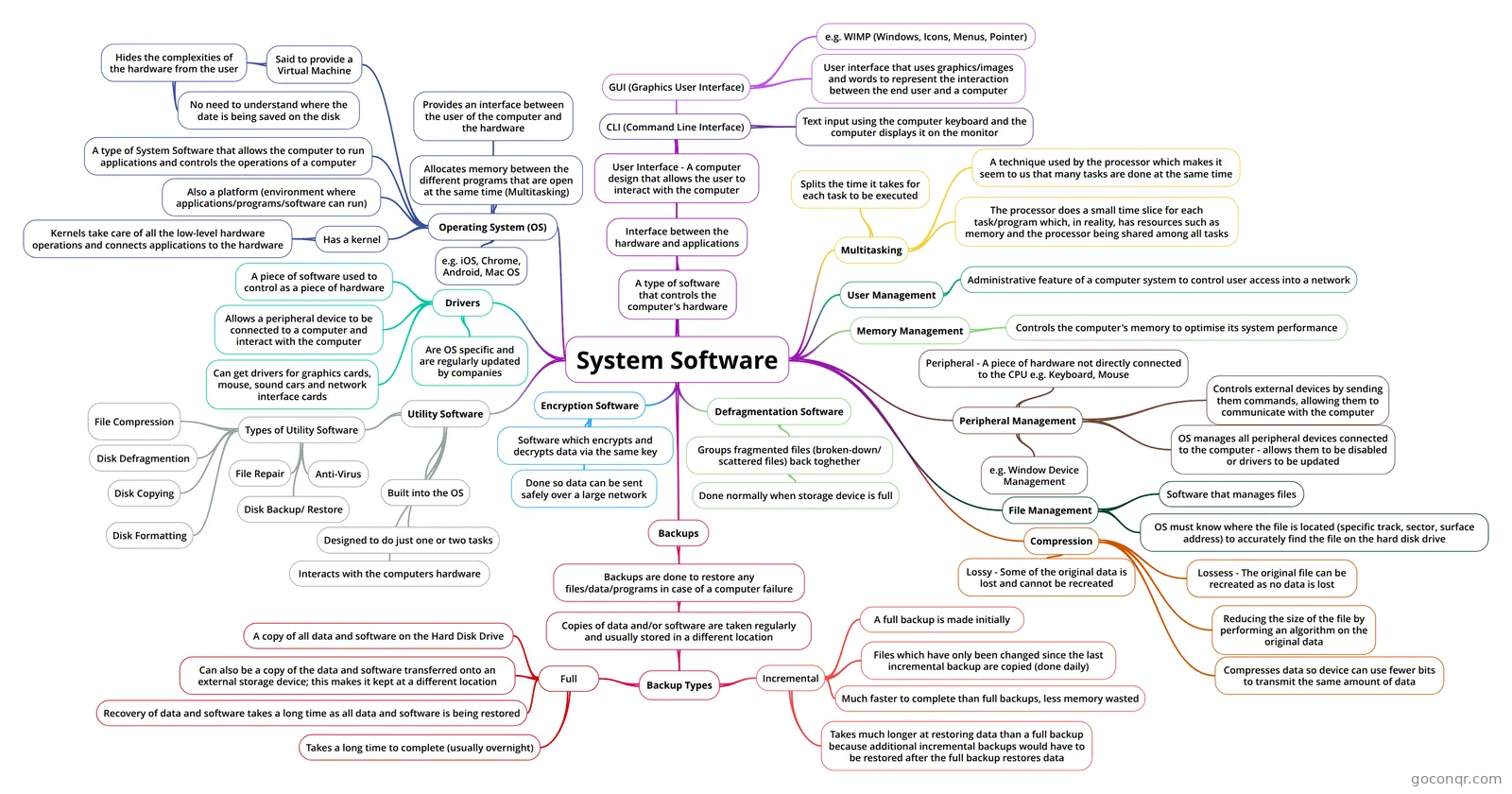
Mind map: system software
Contenido del mapa
System Software
A type of software that controls the computer's hardware
- Interface between the hardware and applications
Operating System (OS)
- A type of System Software that allows the computer to run applications and controls the operations of a computer
- Said to provide a Virtual Machine
- Hides the complexities of the hardware from the user
- No need to understand where the date is being saved on the disk
- Hides the complexities of the hardware from the user
- Allocates memory between the different programs that are open at the same time (Multitasking)
- Provides an interface between the user of the computer and the hardware
- Also a platform (environment where applications/programs/software can run)
- Has a kernel
- Kernels take care of all the low-level hardware operations and connects applications to the hardware
- e.g. iOS, Chrome, Android, Mac OS
Multitasking
- A technique used by the processor which makes it seem to us that many tasks are done at the same time
- The processor does a small time slice for each task/program which, in reality, has resources such as memory and the processor being shared among all tasks
- Splits the time it takes for each task to be executed
Drivers
- A piece of software used to control as a piece of hardware
- Allows a peripheral device to be connected to a computer and interact with the computer
- Can get drivers for graphics cards, mouse, sound cars and network interface cards
- Are OS specific and are regularly updated by companies
Peripheral Management
- Peripheral - A piece of hardware not directly connected to the CPU e.g. Keyboard, Mouse
- OS manages all peripheral devices connected to the computer - allows them to be disabled or drivers to be updated
- e.g. Window Device Management
- Controls external devices by sending them commands, allowing them to communicate with the computer
File Management
- Software that manages files
- OS must know where the file is located (specific track, sector, surface address) to accurately find the file on the hard disk drive
Utility Software
- Designed to do just one or two tasks
- Interacts with the computers hardware
- Built into the OS
- Types of Utility Software
- File Compression
- Disk Defragmention
- File Repair
- Disk Copying
- Disk Formatting
- Disk Backup/ Restore
- Anti-Virus
Compression
- Reducing the size of the file by performing an algorithm on the original data
- Lossess - The original file can be recreated as no data is lost
- Lossy - Some of the original data is lost and cannot be recreated
- Compresses data so device can use fewer bits to transmit the same amount of data
Defragmentation Software
- Groups fragmented files (broken-down/ scattered files) back toghether
- Done normally when storage device is full
- Groups fragmented files (broken-down/ scattered files) back toghether
Encryption Software
- Software which encrypts and decrypts data via the same key
- Done so data can be sent safely over a large network
Backups
- Backups are done to restore any files/data/programs in case of a computer failure
- Copies of data and/or software are taken regularly and usually stored in a different location
- Backup Types
- Full
- A copy of all data and software on the Hard Disk Drive
- Can also be a copy of the data and software transferred onto an external storage device; this makes it kept at a different location
- Takes a long time to complete (usually overnight)
- Recovery of data and software takes a long time as all data and software is being restored
- Incremental
- A full backup is made initially
- Files which have only been changed since the last incremental backup are copied (done daily)
- Much faster to complete than full backups, less memory wasted
- Takes much longer at restoring data than a full backup because additional incremental backups would have to be restored after the full backup restores data
- Full
- Backup Types
- Copies of data and/or software are taken regularly and usually stored in a different location
- Backups are done to restore any files/data/programs in case of a computer failure
User Interface - A computer design that allows the user to interact with the computer
- GUI (Graphics User Interface)
- User interface that uses graphics/images and words to represent the interaction between the end user and a computer
- e.g. WIMP (Windows, Icons, Menus, Pointer)
- CLI (Command Line Interface)
- Text input using the computer keyboard and the computer displays it on the monitor
- GUI (Graphics User Interface)
Memory Management
- Controls the computer's memory to optimise its system performance
User Management
- Administrative feature of a computer system to control user access into a network
Información
- Descripción
- GCSE (1.7 System Software) Computing Mapa Mental sobre System Software, creado por 2402 2003 el 14/05/2018.
- Creado por
- 2402 2003
- Visitas
- 37
- Valoración