
Mapa mental
Unit 4: Module 1 - Rings, Acids and Amines
Contenido del mapa
Unit 4: Module 1 - Rings, Acids and Amines
BENZENE: Structure
- Formula: C6H6
- Cyclic
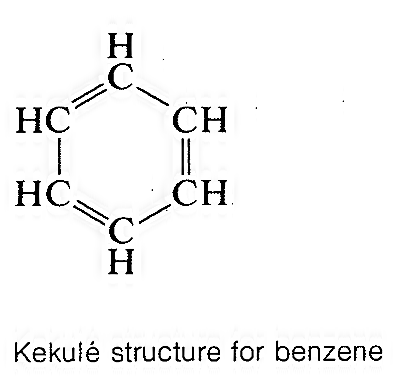
- Two ways of representing it...
- Kekule's
- If it was correct..
- 3 x length of C-C bonds (147pm)
- 3 x length of C=C bonds (135pm)
- HOWEVER
- X-ray diffraction have shown all the bond lengths have the same value (140pm)
- Hydrogenation Enthalpy Change of C=C bond is -120 Kj/mol
- so with 3 C=C bonds, enthalpy change should be -360 Kj/mol
- HOWEVER
- Experimental enthalpy change is -208 Kj/mol...... Far less exothermic than expected
- Indicates that Benzene is more stable than the Kekule structure would be. This is thought to be due to the delocalised electrons.
- Experimental enthalpy change is -208 Kj/mol...... Far less exothermic than expected
- HOWEVER
- so with 3 C=C bonds, enthalpy change should be -360 Kj/mol
- If it was correct..
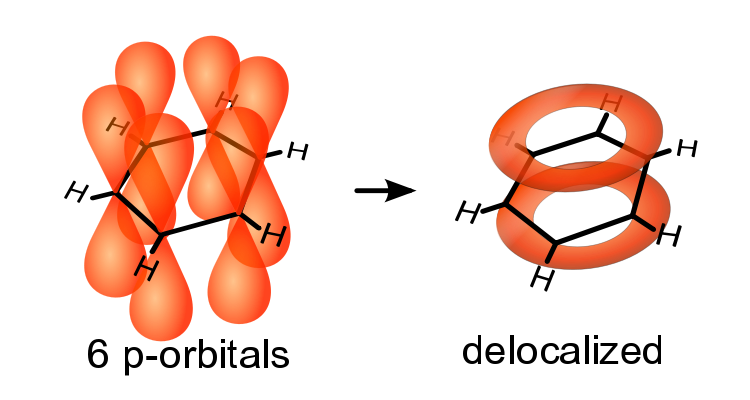
- Delocalised Model
- P-Orbitals of all 6 Carbon atoms overlap to create Pi Bonds
- 3 Electrons in the top ring, 3 in the bottom ring (due to the repulsion of negative charges)
- P-Orbitals of all 6 Carbon atoms overlap to create Pi Bonds
- Kekule's
- Two ways of representing it...
BENZENE: Aromatic Compounds
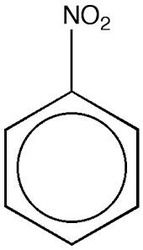
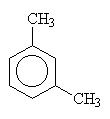
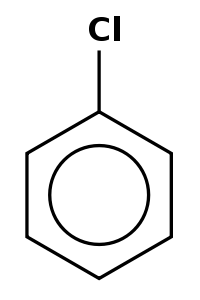
- Compounds containing a benzene ring are called arenes or 'aromatic compounds'
- Chlorobenzene
- Nitrobenzene
- 1,3-dimethylbenzene
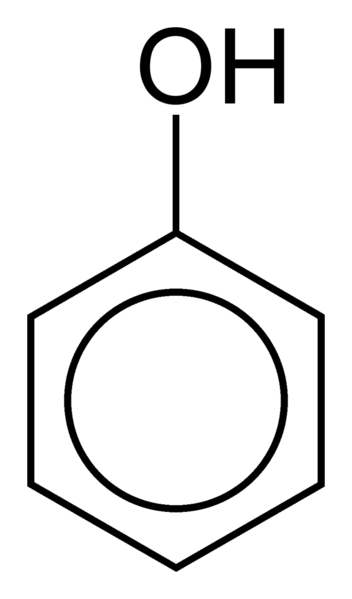
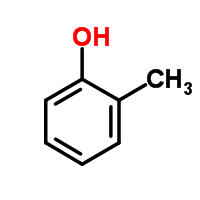
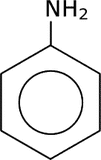
- Others are named as compounds with a phenyl group (C6H5) attached
- Phenol
- 2-methylphenol
- phenylamine
- Compounds containing a benzene ring are called arenes or 'aromatic compounds'
Reactions with Benzene
- Alkenes react easily with Bromine water (the famous experiment where Br water decolourises)
- If the Kekule model was correct, Benzene would be expected to react similarly (due to the C=C bonds)
- Because of the electron rings above and below the carbon atoms, it makes the benzene ring VERY staable, and spreads out the negative charge.
- This means Benzene is very unwilling to undergo addition reactions which would destroy the stable ring
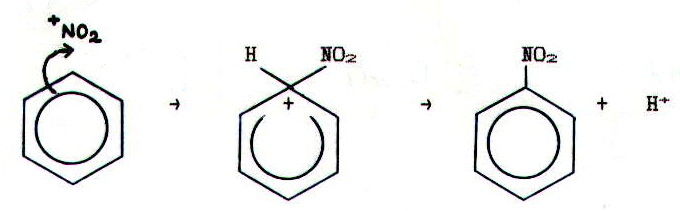
- Instead, benzene prefers to react by electrophilic substitution
- Electrophile: Positively charged ions or polar molecules that are attracted to ares of high electron density
- Arenes undergo Electrophilic Substitution with....
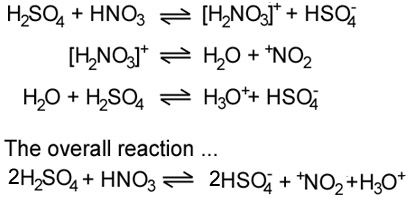
- With Nitric Acid and a Catalyst (this catalyst is Sulfuric acid)
- Sulfuric acid (how to make the NO2+)
- HALOGENS using a HALOGEN CARRIER
- PICTURE OF BROMINE OR CHLORINE REACTING WITH BENZENE IS TOO BLOODY HARD TO FIND - JUST LEARN IT
- With Nitric Acid and a Catalyst (this catalyst is Sulfuric acid)
- Instead, benzene prefers to react by electrophilic substitution
- This means Benzene is very unwilling to undergo addition reactions which would destroy the stable ring
- Because of the electron rings above and below the carbon atoms, it makes the benzene ring VERY staable, and spreads out the negative charge.
- If the Kekule model was correct, Benzene would be expected to react similarly (due to the C=C bonds)
- Alkenes react easily with Bromine water (the famous experiment where Br water decolourises)
Imágenes y archivos del mapa
Información
- Descripción
- (Unit 4) Chemistry Mapa Mental sobre Unit 4: Module 1 - Rings, Acids and Amines, creado por tommyshellerpaulson el 12/11/2014.
- Creado por
- tommyshellerpaulson
- Visitas
- 178
- Etiquetas
- Valoración