
Mapa mental
Evol Lecture 1: Intro to Evolution
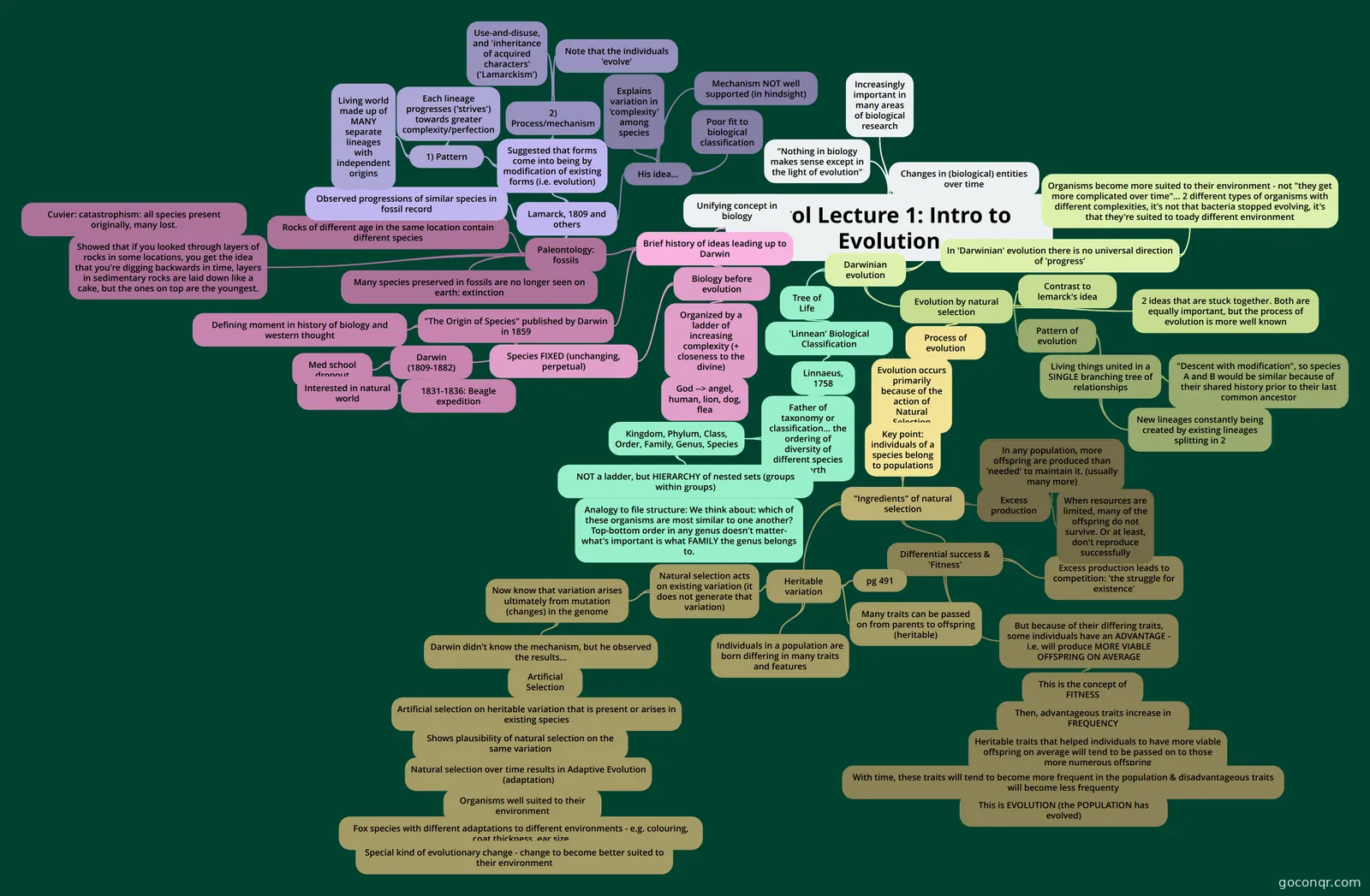
Mind map: Intro to evolution
Contenido del mapa
Evol Lecture 1: Intro to Evolution
Changes in (biological) entities over time
Unifying concept in biology
Increasingly important in many areas of biological research
"Nothing in biology makes sense except in the light of evolution"
Brief history of ideas leading up to Darwin
- "The Origin of Species" published by Darwin in 1859
- Defining moment in history of biology and western thought
- Darwin (1809-1882)
- Med school dropout
- Interested in natural world
- 1831-1836: Beagle expedition
- Biology before evolution
- Species FIXED (unchanging, perpetual)
- Organized by a ladder of increasing complexity (+ closeness to the divine)
- God --> angel, human, lion, dog, flea
- Paleontology: fossils
- Rocks of different age in the same location contain different species
- Many species preserved in fossils are no longer seen on earth: extinction
- Showed that if you looked through layers of rocks in some locations, you get the idea that you're digging backwards in time, layers in sedimentary rocks are laid down like a cake, but the ones on top are the youngest.
- Cuvier: catastrophism: all species present originally, many lost.
- Lamarck, 1809 and others
- Observed progressions of similar species in fossil record
- Suggested that forms come into being by modification of existing forms (i.e. evolution)
- 1) Pattern
- Living world made up of MANY separate lineages with independent origins
- Each lineage progresses ('strives') towards greater complexity/perfection
- 2) Process/mechanism
- Use-and-disuse, and 'inheritance of acquired characters' ('Lamarckism')
- Note that the individuals 'evolve'
- 1) Pattern
- His idea...
- Explains variation in 'complexity' among species
- Mechanism NOT well supported (in hindsight)
- Poor fit to biological classification
- "The Origin of Species" published by Darwin in 1859
Darwinian evolution
- Tree of Life
- 'Linnean' Biological Classification
- Linnaeus, 1758
- Father of taxonomy or classification... the ordering of diversity of different species on earth
- Kingdom, Phylum, Class, Order, Family, Genus, Species
- NOT a ladder, but HIERARCHY of nested sets (groups within groups)
- Analogy to file structure: We think about: which of these organisms are most similar to one another? Top-bottom order in any genus doesn't matter- what's important is what FAMILY the genus belongs to.
- NOT a ladder, but HIERARCHY of nested sets (groups within groups)
- Kingdom, Phylum, Class, Order, Family, Genus, Species
- Father of taxonomy or classification... the ordering of diversity of different species on earth
- Linnaeus, 1758
- 'Linnean' Biological Classification
- Evolution by natural selection
- Pattern of evolution
- Living things united in a SINGLE branching tree of relationships
- New lineages constantly being created by existing lineages splitting in 2
- "Descent with modification", so species A and B would be similar because of their shared history prior to their last common ancestor
- Living things united in a SINGLE branching tree of relationships
- Process of evolution
- Evolution occurs primarily because of the action of Natural Selection
- Key point: individuals of a species belong to populations
- "Ingredients" of natural selection
- Heritable variation
- pg 491
- Individuals in a population are born differing in many traits and features
- Many traits can be passed on from parents to offspring (heritable)
- Natural selection acts on existing variation (it does not generate that variation)
- Now know that variation arises ultimately from mutation (changes) in the genome
- Darwin didn't know the mechanism, but he observed the results...
- Artificial Selection
- Artificial selection on heritable variation that is present or arises in existing species
- Shows plausibility of natural selection on the same variation
- Natural selection over time results in Adaptive Evolution (adaptation)
- Organisms well suited to their environment
- Fox species with different adaptations to different environments - e.g. colouring, coat thickness, ear size
- Special kind of evolutionary change - change to become better suited to their environment
- Fox species with different adaptations to different environments - e.g. colouring, coat thickness, ear size
- Organisms well suited to their environment
- Natural selection over time results in Adaptive Evolution (adaptation)
- Shows plausibility of natural selection on the same variation
- Artificial selection on heritable variation that is present or arises in existing species
- Artificial Selection
- Darwin didn't know the mechanism, but he observed the results...
- Now know that variation arises ultimately from mutation (changes) in the genome
- Excess production
- In any population, more offspring are produced than 'needed' to maintain it. (usually many more)
- When resources are limited, many of the offspring do not survive. Or at least, don't reproduce successfully
- Differential success & 'Fitness'
- Excess production leads to competition: 'the struggle for existence'
- But because of their differing traits, some individuals have an ADVANTAGE - i.e. will produce MORE VIABLE OFFSPRING ON AVERAGE
- This is the concept of FITNESS
- Then, advantageous traits increase in FREQUENCY
- Heritable traits that helped individuals to have more viable offspring on average will tend to be passed on to those more numerous offspring
- With time, these traits will tend to become more frequent in the population & disadvantageous traits will become less frequenty
- This is EVOLUTION (the POPULATION has evolved)
- With time, these traits will tend to become more frequent in the population & disadvantageous traits will become less frequenty
- Heritable traits that helped individuals to have more viable offspring on average will tend to be passed on to those more numerous offspring
- Then, advantageous traits increase in FREQUENCY
- This is the concept of FITNESS
- Heritable variation
- "Ingredients" of natural selection
- Key point: individuals of a species belong to populations
- Evolution occurs primarily because of the action of Natural Selection
- Contrast to lemarck's idea
- 2 ideas that are stuck together. Both are equally important, but the process of evolution is more well known
- Pattern of evolution
- In 'Darwinian' evolution there is no universal direction of 'progress'
- Organisms become more suited to their environment - not "they get more complicated over time"... 2 different types of organisms with different complexities, it's not that bacteria stopped evolving, it's that they're suited to toady different environment
- Tree of Life
Información
- Descripción
- Mapa Mental sobre Evol Lecture 1: Intro to Evolution, creado por julia guk el 13/11/2014.
- Creado por
- julia guk
- Visitas
- 13
- Valoración