
Mapa mental
S1W8- Relationships 2
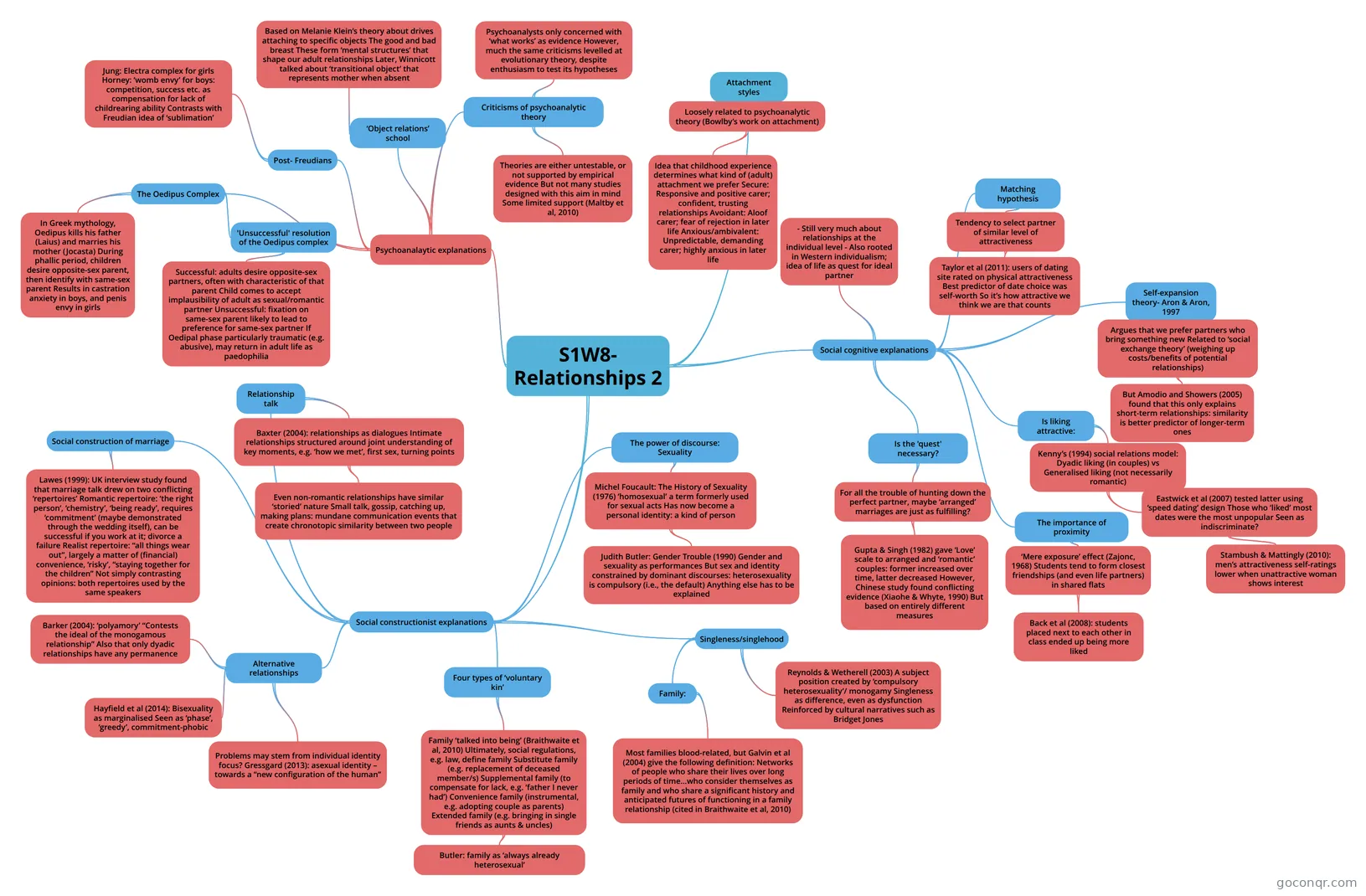
Mind map: relationships psychology
Contenido del mapa
S1W8- Relationships 2
Psychoanalaytic explanations
- The Oedipus Complex
- In Greek mythology, Oedipus kills his father (Laius) and marries his mother (Jocasta) During phallic period, children desire opposite-sex parent, then identify with same-sex parent Results in castration anxiety in boys, and penis envy in girls
- 'Unsuccessful' resolution of the Oedipus complex
- Successful: adults desire opposite-sex partners, often with characteristic of that parent Child comes to accept implausibility of adult as sexual/romantic partner Unsuccessful: fixation on same-sex parent likely to lead to preference for same-sex partner If Oedipal phase particularly traumatic (e.g. abusive), may return in adult life as paedophilia
- Post- Freudians
- Jung: Electra complex for girls Horney: ‘womb envy’ for boys: competition, success etc. as compensation for lack of childrearing ability Contrasts with Freudian idea of ‘sublimation’
- ‘Object relations’ school
- Based on Melanie Klein’s theory about drives attaching to specific objects The good and bad breast These form ‘mental structures’ that shape our adult relationships Later, Winnicott talked about ‘transitional object’ that represents mother when absent
- Criticisms of psychoanalytic theory
- Theories are either untestable, or not supported by empirical evidence But not many studies designed with this aim in mind Some limited support (Maltby et al, 2010)
- Psychoanalysts only concerned with ‘what works’ as evidence However, much the same criticisms levelled at evolutionary theory, despite enthusiasm to test its hypotheses
- The Oedipus Complex
Social cognitive explanations
- - Still very much about relationships at the individual level - Also rooted in Western individualism; idea of life as quest for ideal partner
- Matching hypothesis
- Tendency to select partner of similar level of attractiveness
- Taylor et al (2011): users of dating site rated on physical attractiveness Best predictor of date choice was self-worth So it’s how attractive we think we are that counts
- Tendency to select partner of similar level of attractiveness
- Self-expansion theory- Aron & Aron, 1997
- Argues that we prefer partners who bring something new Related to ‘social exchange theory’ (weighing up costs/benefits of potential relationships)
- But Amodio and Showers (2005) found that this only explains short-term relationships: similarity is better predictor of longer-term ones
- Argues that we prefer partners who bring something new Related to ‘social exchange theory’ (weighing up costs/benefits of potential relationships)
- Is liking attractive:
- Kenny’s (1994) social relations model: Dyadic liking (in couples) vs Generalised liking (not necessarily romantic)
- Eastwick et al (2007) tested latter using ‘speed dating’ design Those who ‘liked’ most dates were the most unpopular Seen as indiscriminate?
- Stambush & Mattingly (2010): men’s attractiveness self-ratings lower when unattractive woman shows interest
- Eastwick et al (2007) tested latter using ‘speed dating’ design Those who ‘liked’ most dates were the most unpopular Seen as indiscriminate?
- Kenny’s (1994) social relations model: Dyadic liking (in couples) vs Generalised liking (not necessarily romantic)
- The importance of proximity
- ‘Mere exposure’ effect (Zajonc, 1968) Students tend to form closest friendships (and even life partners) in shared flats
- Back et al (2008): students placed next to each other in class ended up being more liked
- ‘Mere exposure’ effect (Zajonc, 1968) Students tend to form closest friendships (and even life partners) in shared flats
- Is the 'quest' necessary?
- For all the trouble of hunting down the perfect partner, maybe ‘arranged’ marriages are just as fulfilling?
- Gupta & Singh (1982) gave ‘Love’ scale to arranged and ‘romantic’ couples: former increased over time, latter decreased However, Chinese study found conflicting evidence (Xiaohe & Whyte, 1990) But based on entirely different measures
- For all the trouble of hunting down the perfect partner, maybe ‘arranged’ marriages are just as fulfilling?
Social constructionist explanations
- Social construction of marriage
- Lawes (1999): UK interview study found that marriage talk drew on two conflicting ‘repertoires’ Romantic repertoire: ‘the right person’, ‘chemistry’, ‘being ready’, requires ‘commitment’ (maybe demonstrated through the wedding itself), can be successful if you work at it; divorce a failure Realist repertoire: “all things wear out”, largely a matter of (financial) convenience, ‘risky’, “staying together for the children” Not simply contrasting opinions: both repertoires used by the same speakers
- Relationship talk
- Baxter (2004): relationships as dialogues Intimate relationships structured around joint understanding of key moments, e.g. ‘how we met’, first sex, turning points
- Even non-romantic relationships have similar ‘storied’ nature Small talk, gossip, catching up, making plans: mundane communication events that create chronotopic similarity between two people
- Baxter (2004): relationships as dialogues Intimate relationships structured around joint understanding of key moments, e.g. ‘how we met’, first sex, turning points
- The power of discourse: Sexuality
- Michel Foucault: The History of Sexuality (1976) ‘homosexual’ a term formerly used for sexual acts Has now become a personal identity: a kind of person
- Judith Butler: Gender Trouble (1990) Gender and sexuality as performances But sex and identity constrained by dominant discourses: heterosexuality is compulsory (i.e., the default) Anything else has to be explained
- Michel Foucault: The History of Sexuality (1976) ‘homosexual’ a term formerly used for sexual acts Has now become a personal identity: a kind of person
- Singleness/singlehood
- Reynolds & Wetherell (2003) A subject position created by ‘compulsory heterosexuality’/ monogamy Singleness as difference, even as dysfunction Reinforced by cultural narratives such as Bridget Jones
- Family:
- Most families blood-related, but Galvin et al (2004) give the following definition: Networks of people who share their lives over long periods of time…who consider themselves as family and who share a significant history and anticipated futures of functioning in a family relationship (cited in Braithwaite et al, 2010)
- Four types of ‘voluntary kin’
- Family ‘talked into being’ (Braithwaite et al, 2010) Ultimately, social regulations, e.g. law, define family Substitute family (e.g. replacement of deceased member/s) Supplemental family (to compensate for lack, e.g. ‘father I never had’) Convenience family (instrumental, e.g. adopting couple as parents) Extended family (e.g. bringing in single friends as aunts & uncles)
- Butler: family as ‘always already heterosexual’
- Family ‘talked into being’ (Braithwaite et al, 2010) Ultimately, social regulations, e.g. law, define family Substitute family (e.g. replacement of deceased member/s) Supplemental family (to compensate for lack, e.g. ‘father I never had’) Convenience family (instrumental, e.g. adopting couple as parents) Extended family (e.g. bringing in single friends as aunts & uncles)
- Alternative relationships
- Barker (2004): ‘polyamory’ “Contests the ideal of the monogamous relationship” Also that only dyadic relationships have any permanence
- Hayfield et al (2014): Bisexuality as marginalised Seen as ‘phase’, ‘greedy’, commitment-phobic
- Problems may stem from individual identity focus? Gressgard (2013): asexual identity – towards a “new configuration of the human”
- Social construction of marriage
Attachment styles
- Loosely related to psychoanalytic theory (Bowlby’s work on attachment)
- Idea that childhood experience determines what kind of (adult) attachment we prefer Secure: Responsive and positive carer; confident, trusting relationships Avoidant: Aloof carer; fear of rejection in later life Anxious/ambivalent: Unpredictable, demanding carer; highly anxious in later life
- Loosely related to psychoanalytic theory (Bowlby’s work on attachment)
Información
- Descripción
- print Mapa Mental sobre S1W8- Relationships 2, creado por Spanner Price el 17/01/2019.
- Creado por
- Spanner Price
- Visitas
- 0
- Valoración